The umpire tensed for the pitch and tried to ignore the creeping storm clouds.
These American Legion baseball games were set to end at seven innings, but a tied score had pushed this game into one, then two extra innings — as an early-summer thunderstorm growled threats from the prairie horizon.
The umpire wasn’t sure if they’d get to finish the game.
Time for the pitch. The catcher set up on the outside corner, the ball came in close and tight; the catcher shifted toward it at the last moment.
Did the ball hit the batter’s pant leg or not? It was hard to see.
“Did that hit me?” the batter asked, unsure himself.
It did not, the umpire declared.
The last arbiter in a line of moving pieces, the umpire had tried to position himself well and keep reality in his gaze. And at the end of the pitch, he had to call it like he saw it, no matter whom it thrilled or devastated. No matter how the crowd howled.
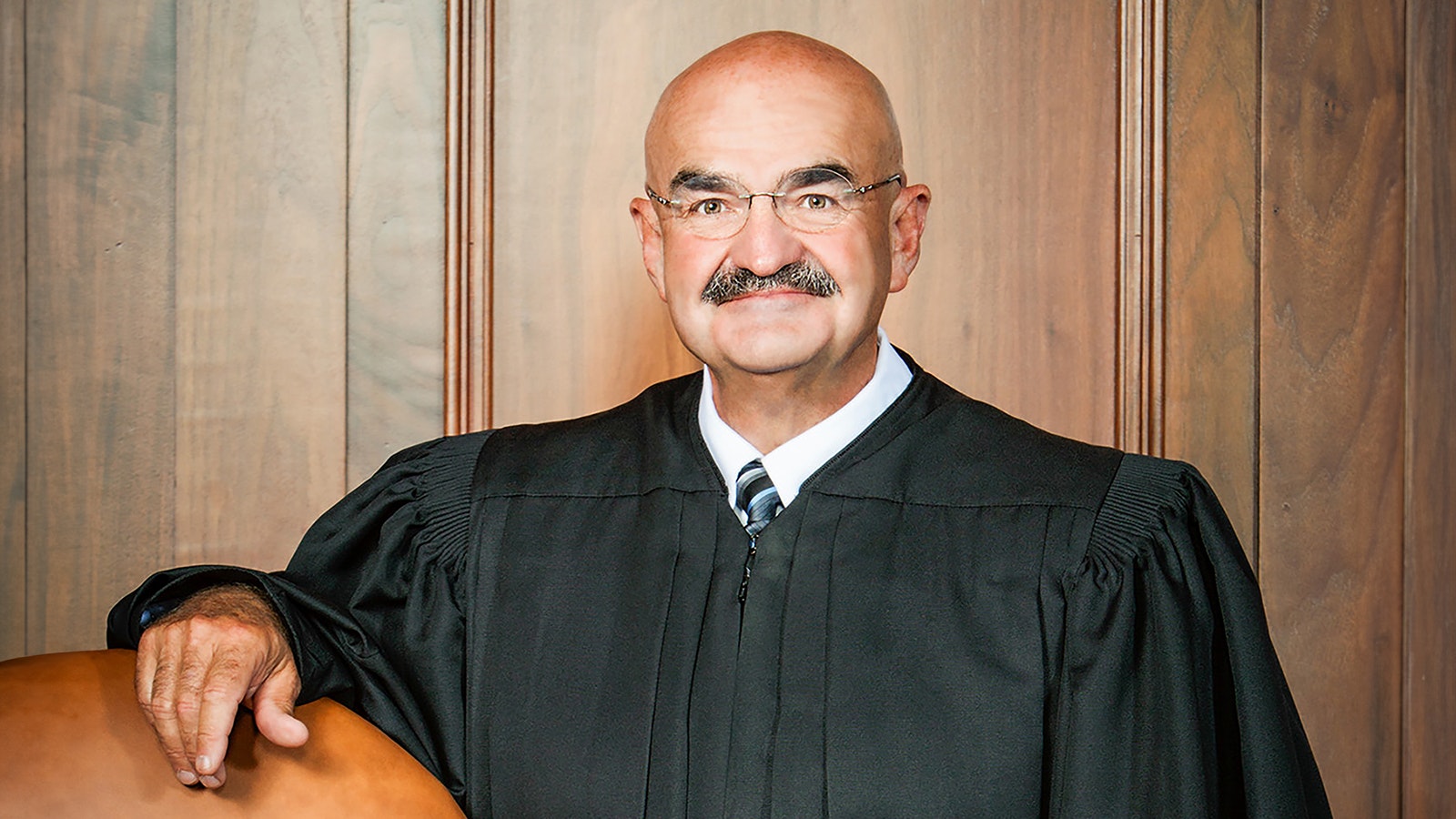
About 20 years after umpiring that game, Wyoming Supreme Court Justice Keith Kautz can’t remember who won or what the final score was.
But he does remember these details:
- Both pitchers were class acts.
- The storm didn’t end the game early.
- The rules governed the game, and that made it fun.
Kautz was a District Court Judge at the time for Wyoming’s Eighth Judicial District, based in his hometown of Torrington, Wyoming.
He is now preparing to retire from the bench altogether. March 26 will be his last day serving in the Wyoming Supreme Court, after a 46-year legal career that still delights him.
As District Court judge, Kautz oversaw felony-level criminal cases and civil lawsuits. He also snagged cases from other parts of the state when other judges recused themselves.
He sorted through crimes and quarreling every day.
But he resolved not to let that darken his view of the world or his connection to his community.
“You start getting that view of the world, that everyone is in those shoes,” Kautz told Cowboy State Daily this week. “It’s hard to keep balance as a trial court judge or even as a Supreme Court justice. You’ve got to stay involved in your community, and in life; you’ve got to be around all kinds of other people.”
So he umpired baseball games. He stayed involved with local school programs and activities. He served as an adjunct teacher. He raised his three children and now, stays involved with his six grandchildren.
Farm Boy First
Before he had any thought to practice law, Kautz was a farm boy.
In the summer between his sixth- and seventh-grade years, Kautz’s family had moved from a farm in the panhandle of Nebraska to another farm just six miles to the west, outside Torrington.
He figured he’d be a farmer all his life.
But in 1970, his junior year at Torrington High School, an attorney who would later become Laramie County District Court Judge, Joe Maier came to discuss the legal craft with students. Maier sat down with Kautz and quizzed the youth on his interests, his aptitudes.
“You know,” said Maier. “You’d make a great lawyer.”
It hadn’t occurred to Kautz before, but he acknowledged that he loved the stretch and challenge of logic. He doubled down on his mathematics study – a secret weapon for a man pursuing law, Kautz said – and he headed to the University of Wyoming, determined to graduate eventually from law school.
First, he got married, in 1975.
He graduated from law school three years later.
Being married in law school developed him as a man and a person, he now believes. His schedule locked into a pattern of study and building his relationship with his new wife, Karen. Cementing those priorities early on has served him well, he said.
They’ve been married 49 years.

Homesick
Kautz’s first job right out of law school was working under an attorney in Sheridan, Bob Kester.
“What a great first guy to work for,” Kautz said.
Kautz and his wife Karen rented a lovely house at the base of the Big Horn Mountains. It was picturesque.
But the rugged landscape and cool pastel mornings couldn’t hold Kautz: he missed home.
“That experience showed me that there’s a whole lot more to life than, in particular, where you live,” he said. “We were homesick for family.”
Back to Torrington’s windswept plains they went. Kautz walked into a law firm and asked for a job.
Mike Warren and George Sawyer hired him as a general-practice lawyer.
Through the 1980s, Kautz came to focus most on farm and ranch cases. Getting to know farmers and ranchers and help them work out deals or “get out of a pickle” was his favorite part of that gig.
And he didn’t mind when cases went to trial. In fact, he enjoyed the clash of the courtroom.
The Law Is Alive
Then-Gov. Mike Sullivan appointed Kautz to the District Court bench in 1993. His district was rural and included Torrington, Wheatland, Douglas and Lusk.
There he stayed for 22 years.
A judge’s days are somewhat scripted: Defendants must hear the same rights; proceedings must follow a set pattern.
But Kautz couldn’t let himself get numb, he said. The stakes were too high.
“Being the judge in places where I knew a lot of the people helped remind me that even if it seems routine to me, this is a big deal to them,” he said. In civil cases especially, a person’s day in court may be one of the most unusual experiences of his life.
Kautz spoke of himself as a mere conduit for the law, and of the law as a living mass built of wise minds’ small contributions over hundreds of years, some stretching back to England - all responding to real problems with interlocking, almost mechanical solutions rooted in the barest concepts of thought.
“To figure out how to solve these problems for people so we can all live together and thrive together – it’s a wonderful thing. There’s nothing like it,” he said.
And there’s nothing like a jury trial, he added, where 12 members of a person’s home community show up to unearth justice from a mess.
Digging In
Still, Kautz wanted to serve in the state’s highest court.
He’d applied and been passed over for the job three times by 2014. The first time, his name didn’t make the final cut of three contenders from which the governor would choose. The second time his name did make the final cut. The third time it didn’t.
The suspense mounted and plummeted with a let-down all three times.
Karen reminded her husband that he still could do great things from his home bench. He sat down with her and made a list of goals he wanted to accomplish in the district court. He guided his thoughts once again toward the community that had claimed him since he was 12.
‘And It Was Amazing’
Then in 2015, Justice Marilyn Kite prepared to retire from the Wyoming Supreme Court.
Kautz wanted to apply for her seat, but dreaded the idea of being passed over again.
“Karen, you know, I just don’t like rejection,” he told his wife.
But she was having none of that.
“Well, I believe you’d be the best person for the job and I think you should put in,” she said.
Kautz did, and then-Gov. Matt Mead appointed him that June.
It was a big honor. It was also a daunting responsibility. But beyond that, Kautz was energized by the change of scenery and the challenge of working with four other justices.
He couldn’t run the show anymore: he was part of a committee, he said. Yet, this is a committee where everyone does his or her own homework.
The five justices are surprisingly independent of one another, said Kautz. They run their offices apart from one another and work through cases separately before coming together and reaching a decision on each issue.
It was different from working in a law firm, where attorneys swapped work and communicated throughout the day. And it was different from being a District Court judge, where the judge conducts court according to his own best reading of the law.
The high court’s challenge is thinking through everyone's points of view before voting, said Kautz. It’s both a bonus and a challenge that all the justices are smart.
“And it was amazing,” he said.

No Grifting
Kautz said he’s been blessed to work in a system in which the governor appoints judges and justices.
Before 1972, Wyoming judges had to run for election. They might have to hunt for donors and tout their personal beliefs from door to door.
Many states still run judicial elections.
Kautz said the appointment system keeps the justices impartial, even as crowds rail outside the Wyoming Supreme Court’s doors.
“When somebody demonstrates out in front of the Capitol building, across the street from us, that might have an impact over there, but in our court it doesn’t have any impact. None,” he said.
Kautz's last day, March 26, is one day before his 70th birthday, because Wyoming has an age cap for justices and district court judges.
He doesn’t feel senile, and he feels he’s fully in his stride and could keep serving well past the age limit, Kautz said.
But the law applies to justices the same as everyone else, and the age cap is the law, he noted.
Time Decides, Not Man
The high court is facing two issues this year that many Wyomingites consider paramount: a possible appeal on whether abortion is health care under the Wyoming Constitution, and a possible appeal on the extent to which the Constitution requires the Wyoming Legislature to fund the state’s public schools.
Kautz said there are fascinating issues ahead, but he’s not disappointed to miss out on them.
A man doesn't decide his own era. All Kautz could do with his time was yield to the law and perform his duties, he said.
“My time was to decide the cases that came up when I did,” said Kautz
After March 26, the newly-appointed Justice Robert Jarosh will fill Kautz’s seat.
Kautz doesn’t know Jarosh well, but noted with a chuckle that Jarosh’s record bears at least one sign he can juggle both humanity and the rule of law: he’s on the board of directors for Legion baseball in Cheyenne.
Extra Innings
Kautz plans to travel, garden and be with his family. He may keep one foot in law by volunteering and teaching.
“I would want to feel useful. I think everybody needs that,” he said. At the same time, his wife says he’ll enjoy retirement.
A now-retired longtime school teacher, Karen has encouraged and supported her husband throughout their life together, Kautz said.
“She was born an encourager,” he added. “It’s encouragement that enables us to feel like we can accomplish things.”
The encouragement of his wife and “so many” other figures throughout his life has been like “oxygen for the soul,” Kautz said, quoting pastor and author John Maxwell.
Another Maxwell quote that has served Kautz well is: “The greatest day in your life and mine, the day we truly grow up is the day we take responsibility for our own attitude.”
Between encouragement and responsibility, between the pitch and the catch, Kautz said his has been a wonderful career: “You almost pinch yourself, and say ‘Well what good fortune – and I hope I’ve fulfilled the job well.’”
Clair McFarland can be reached at clair@cowboystatedaily.com.