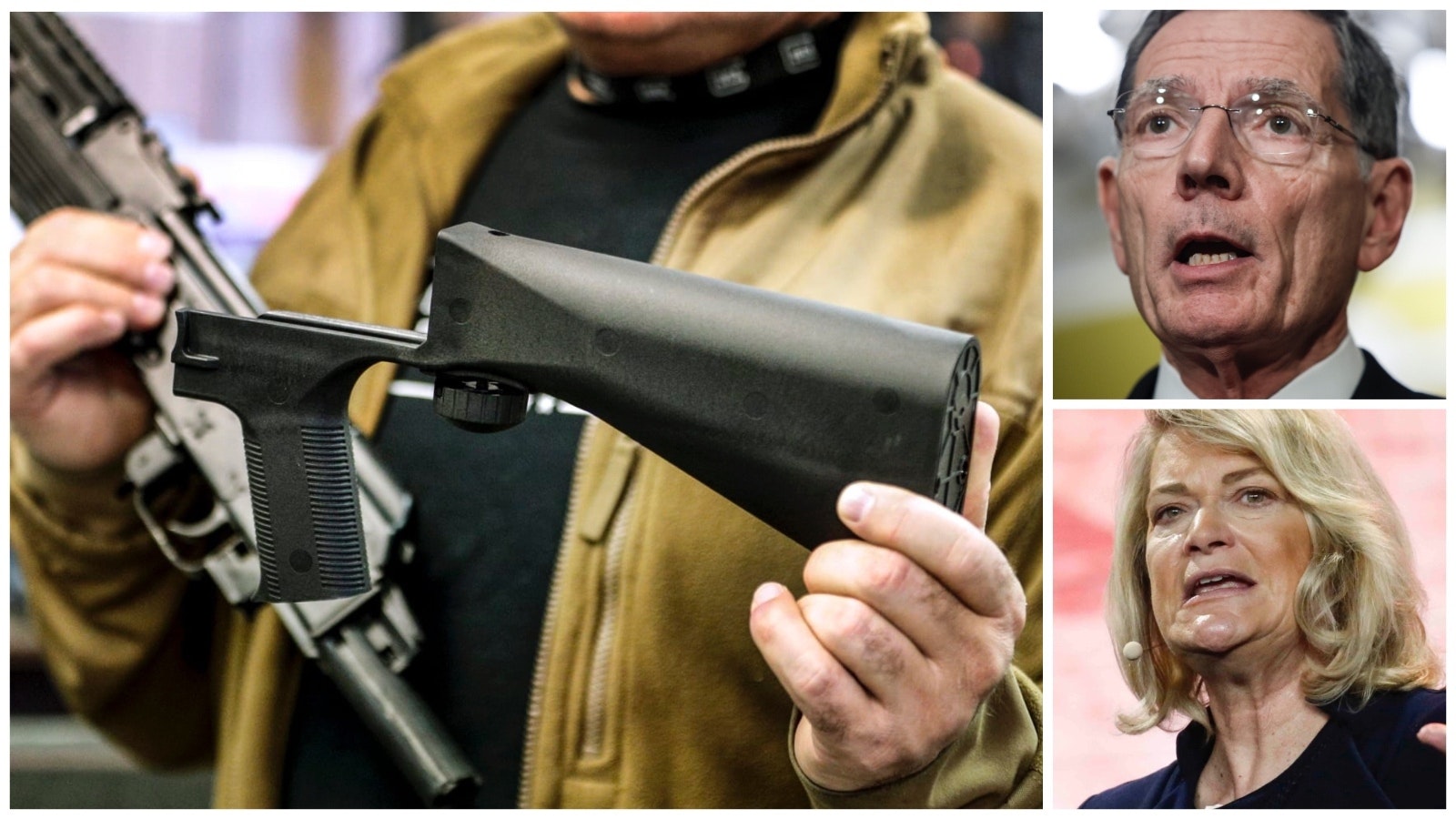
Wyoming’s U.S. senators are teaming up with a Laramie-based firearms law expert in arguing that the federal government can’t tighten gun-control laws without Congressional action.
Sens. John Barrasso and Cynthia Lummis filed an amicus brief Friday in the U.S. Supreme Court case of Garland v. Cargill that’s not just a gun-rights argument. It’s also the latest in several recent attempts to chip away at the executive branch’s authority to interpret the laws it prosecutes.
“Congress, not the executive, is responsible for making laws,” says the brief.
It challenges the use of an executive-enabling legal precedent called Chevron deference, which tells courts to defer to executive-branch agencies’ interpretations of the laws they’re enforcing.
It’s wrong to let federal agencies craft interpreting rules that can put people in prison, the brief argues, citing the U.S. Constitution’s emphasis on governmental restraint in the area of criminal law.
The brief calls it tyranny to let agencies craft and interpret rules with criminal penalties attached, because the rules can change every time there’s a new president.
“It is unsettling to think that something that is legal one day can be subject to criminal sanctions the next with no intervening act of Congress,” says the brief. “Such changes are characteristic of the legal environment of an authoritarian regime, not the United States.”
Just How Automatic Is That?
Wyoming’s two senators signed onto the amicus brief with seven other Republican senators, the Independence Institute and a slate of law and history professors. Co-authoring their brief as legal counsel is George Mocsary, a professor of law at the University of Wyoming and a firearms law expert.
The case contemplates whether a Texas man (and by extension everyone else) is allowed to have bump stocks, or whether they’re tokens of illegal automatic weapons.
A bump stock is a device that bumps a trigger back to its neutral position quickly, enabling a semiautomatic firearm to shoot faster.
The Bureau of Alcohol, Tobacco, Firearms and Explosives for years said bump stocks don’t make rifles automatic and therefore don’t make them illegal.
Trump After The Concert
But when a shooter with a bump stock unloaded into a Jason Aldean concert in Las Vegas and killed 58 people in 2017, then-President Donald Trump urged his ATF to take another look at that rule.
The ATF did, and declared following a 2018 rulemaking process that bump stocks do convert firearms into illegal automatic weapons.
Michael Cargill of Texas had bought two bump stocks that year. He turned over the devices to the ATF – but he filed a lawsuit. The Fifth Circuit Court of Appeals granted Cargill the win in a 2023 re-hearing of his case.
The leading judge on that opinion noted that the trigger does reset while the bump stock is acting on it, so the weapon isn’t firing multiple rounds with one action of the trigger.
The National Firearms Act calls weapons automatic if they fire multiple rounds automatically with a single function of the trigger.
A lower court earlier in the case had sided with the government, saying the shooter doesn’t have to keep pulling the trigger (though he does have to keep forward pressure with his non-trigger hand) and therefore the trigger only functions once – from the shooter’s perspective. And that makes his weapon automatic, the lower court concluded.
The ATF is now bringing that argument back to the U.S. Supreme Court in the hopes of overturning its court loss.
The Agency Changes Its Mind
The agency acknowledges that its rule banning bump stock disagrees with its earlier position, but says it has finally gotten the issue right.
“(The) ATF had ‘applied different understandings of the term “automatically” over time in reviewing bump stocks and (found) the agency had “authority to reconsider and rectify” potential classification errors,’” says the ATF’s petition to the high court.
Lummis, Barrasso and the others signed onto the brief scoffed at this, writing, “It seems surprising that a bureau would neglect plain statutory text 10 out of 10 times, and then get things right on the 11th try.”
The rule-making about-face reflects, rather, an ambitious executive branch determined to squeeze all its policy goals into the populace through agency rule, the brief argues.
And These
The other senators arguing with Lummis and Barrasso are:
Sen. Mike Lee (Utah)
Sen. Kevin Cramer (North Dakota)
Sen. Pete Ricketts (Nebraska)
Sen. Steve Daines (Montana)
Sen. Cindy Hyde-Smith (Mississippi)
Sen. Mike Rounds (South Dakota)
Sen. Markwayne Mullin (Oklahoma)
Clair McFarland can be reached at clair@cowboystatedaily.com.