Drone companies that have successfully threaded the FAA’s certification needle are few and far between.
But one of them is now located in Wyoming, and that could help speed beneficial uses of drones for folks in the Cowboy State.
GT Aeronautics, which moved to the Cody-Powell area in 2016, has not only won a coveted certification, but FAA has approved a 3-square-mile area up to 8,000 feet for the company’s GT380 drone to fly in regular commercial space. This is a commercial certification that’s different from the FAA license people need to pilot drones.
That will be key to researching and improving that line of drones for future manufacture of drones that could do things like drop blood to people living in rural areas for emergency care, company CEO Thomas Rullman told Cowboy State Daily.
GT Aeronautics has been working a long time to reach this milestone, and Rullman believes the FFA certification is a first for a Cowboy State drone company.
“Ours may not be the first one in the country, but it’s darn close,” he said. “And it certainly is a first for airports like Powell Municipal. They have never had anything like that, and there isn’t an airport in Wyoming, I don’t think, that has anything like that.”
A Bigger Sandbox
Drones have had a turbulent flight path in the United States since taking off in commercial popularity with the general public.
While they are a little like radio-controlled airplanes of old, their technology is a lot more sophisticated and their capabilities — as well as potential for danger when flown in commercial air spaces — is much greater.
The FAA initially balked at the idea of including drones in the National Air Space system because of safety concerns, but in 2015, Congress passed a mandate requiring drones’ integration.
That led to some rules for smaller drones. They could fly up to 400 feet during daylight hours, as long as they didn’t exceed 100 mph and weighed less than 55 pounds. They also have to stay within visual line of site of the operator.
“We call that the sandbox,” Rullman told Cowboy State Daily. “And the sandbox is for toys. So that’s what the FAA did. They told Congress, ‘Ok, we did it. We integrated unmanned aircraft.’”
But rules for toys don’t really cover the kinds of applications that drone companies like GT Aeronautics envision, with the kinds of aircraft they expect to need. Things like flying miles and miles of oil and gas pipelines to check for leaks, surveying ranches for herbicide-resistant weeds or sick cattle or dropping blood off to rural medical facilities for emergency care.
For that, the sandbox has to get bigger. A lot bigger.
And that’s what the FAA certification GT Aeronautics has been able to win is all about.
Not All Drones Are Tiny Little Things
Most people think of something tiny when they think of drones, but many of Pullman’s drones look just like small-ish airplanes.
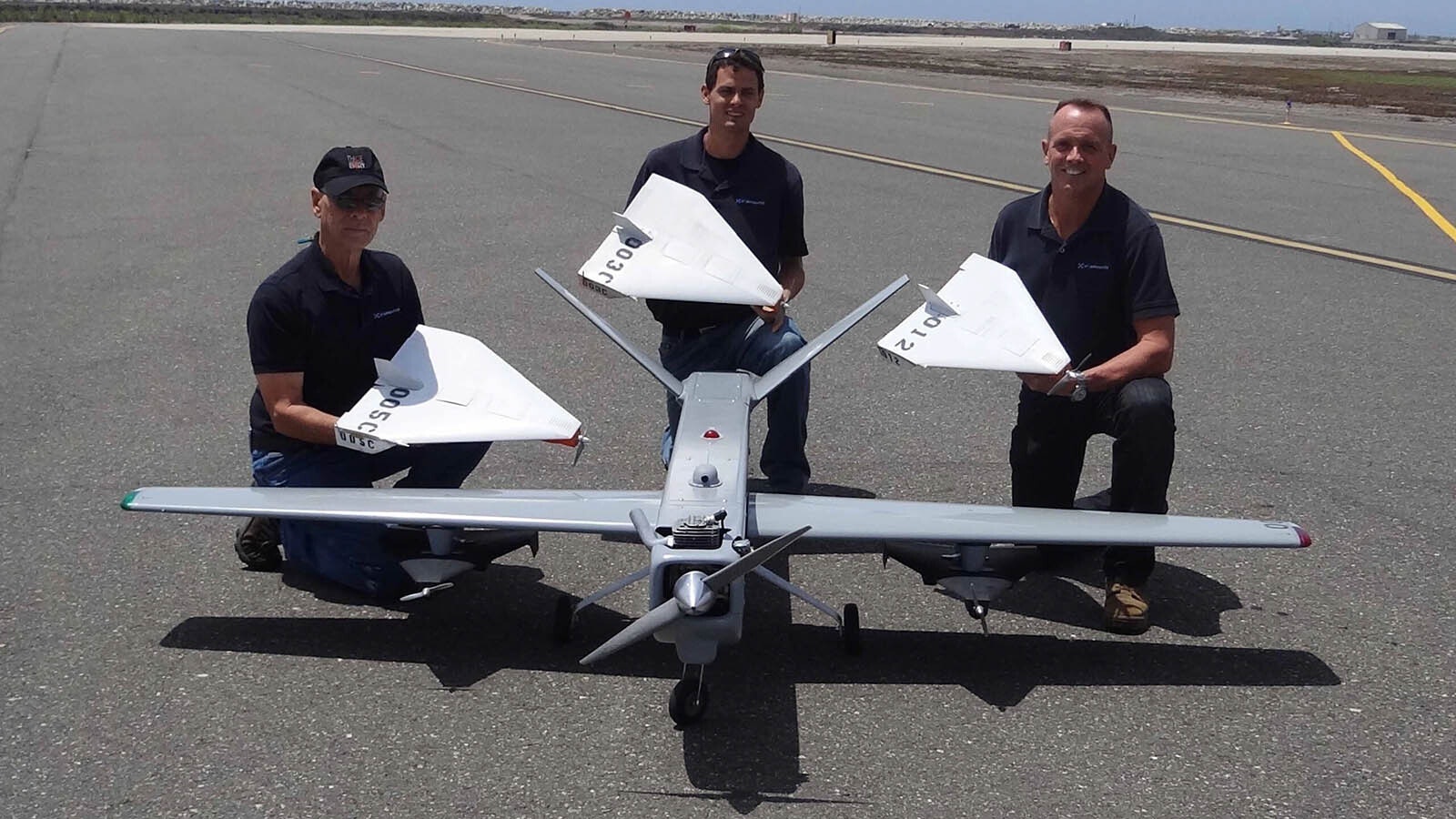
The GT380, which is the drone that has become FAA certified, has an almost 9-foot wingspan and can cruise at altitudes up to 5,000 feet at a speed of 180 knots.
That’s still pretty small when compared to a regular jet. The Boeing 367-80, for example, has a wingspan of 130 feet and travels at 506 knots. A private plane, like the Cessna 150, is around 33 feet and goes up to 109 knots.
Drones like Rullman’s are huge compared to what most people expect a drone to look like.
Rullman still recalls the time passersby stumbled across a couple of his drones during a test. They asked what was going on, and when Rullman told the couple he was testing some drones, they looked all around and said, “Where are they?” in spite of the fact the drones were right there in front of them.

Anything But Toys
The passersby were looking for toys, but the kinds of drones GT Aeronautics manufactures are anything but toys. These are the kind of drones that would be used commercially for things like monitoring pipelines and utility lines, dropping payloads to rescue victims, hospital, and military soldiers, or other practical and useful applications like that.
The trouble is, though, for those kind of drones to work they need to fly beyond visual line of sight, which the FAA’s initial framework didn’t allow at all.
The pressure to open up the skies for commercial drone use in sectors like agriculture and oil, where all of the applications basically require beyond visual line of sight flying, has forced the FAA to slowly but inexorably consider new approaches to integration.
Among these has been the development of beyond visual line of sight networks in six states, including nearby North Dakota. There are also some limited opportunities at military test ranges.
But both of those are very expensive options, particularly for startup companies. The fees required to use such facilities are far too cost-prohibitive for most companies wanting to test a simple idea or for long-term commercial applications.
“We used to fly at China Lake down to California, and their rate on that military test range is $60,000 a day,” Rullman said. “We ended up establishing a contract with the Navy so we didn’t have to pay that, but how is anybody gonna get unmanned aircraft integrated (that way)?”
Getting the special airworthiness certificate, even if it’s just for the one drone, and having a 3-square-mile, 8,000-foot high flying space, is a game-changer. It’s a much more cost-effective means of researching and improving the drones GT Aeronautics makes.
Life Savers
Long-term, GT Aeronautics hopes to acquire a broader classification from the FAA called type certification.
That’s the kind of certification all the big airline manufacturers like Lockheed Martin and Boeing have. With type certification, a manufacturer doesn’t have to certify individual aircraft.
Rather, the manufacturer follows a certified set of specifications in the manufacture of each plane. As long as the company adheres to those standards, the type certification will cover every aircraft built.
That’s the end-game for GT Aeronautics, and will ultimately be key to developing all kinds of drone flight services that can help humanity, Rullman said.
“Right now, I have two aircraft that are kind of dedicated to Park County Search and Rescue going out, looking for people,” Rullman said. “They can fly for two hours, and we can use them to go search, you know, for a victim or a lost hiker or whatever.”
The GT380, meanwhile, is part of a game plan Rullman has been asked to develop for dropping blood bags in rural areas where people need immediate emergency care.
“So many places in (Wyoming) are rural,” he said. “They have no airport. So, what happens to Farmer Joe or Rancher Joe out there when he needs blood, and he can’t get to a hospital because it’s snowing too much, and things like that?”
The GT380 could eventually carry blood to such areas, and Rullman has a couple more of them on assembly lines, which he plans to certify individually.
But for the manufacture of those to really take off, Rullman will eventually need certification for the entire line of drones, not piecemeal certification one plane at a time.
“As an aside, these are also the aircraft we’re using under contract with the Department of Defense right now,” he said. “And they can carry these pods underneath the wing, and you can drop them. They have a little parachute on them.”
Rullman has been testing those pods with another concept in mind — search and rescue missions.
“Last year, up in the Beartooth Mountains, we dropped a pod to a victim on the ground, and it had a little radio in it,” Rullman said. The victim “was able to talk to the helicopter crew and tell them what his injuries were and all that. So, it could be a very useful tool to go out there and help with search and rescue in that way.”
Renée Jean can be reached at renee@cowboystatedaily.com.