Somewhere in Casper where an alley meets Center Street marks the spot where a drunk running from the sheriff met his match.
The Friday night escapee, as reported in the Natrona County Tribune in September 1908, was promptly grabbed by a passerby who gave him a “hip lock that sent him to the ground.” That passerby sat on the man until the sheriff arrived.
So go the stories of William “Missou” Hines, who not only grabbed scofflaws, but during his time in Wyoming was reportedly a cowboy for the Swan Land and Cattle Co., O7 Ranch, Goose Egg Ranch and the CY Ranch.
He became foreman at the CY in 1888, according to his obituary, and then a livestock agent for the Northwestern Railroad in 1890.
In his later years, Hines promoted sheep dip, became an oil company teamster and apparent enforcer, community entertainer and successful oil entrepreneur.
Hines, by any standard, was a colorful Wyoming character, and is said by some to have been the man Owen Wister had in mind when he wrote “The Virginian.”
While living, Hines denied it. However, his obituary states that he “was assigned to accompany” Wister around the state while Hines worked for the railroad.
What appears to be true is that one of his many noted pranks did become part of the famous novel.
A Colorful Life
Born in Missouri in 1865, the year the Civil War ended, Hines died at age 78 in February 1943. He received his nickname, “Missou” because he was from Missouri.
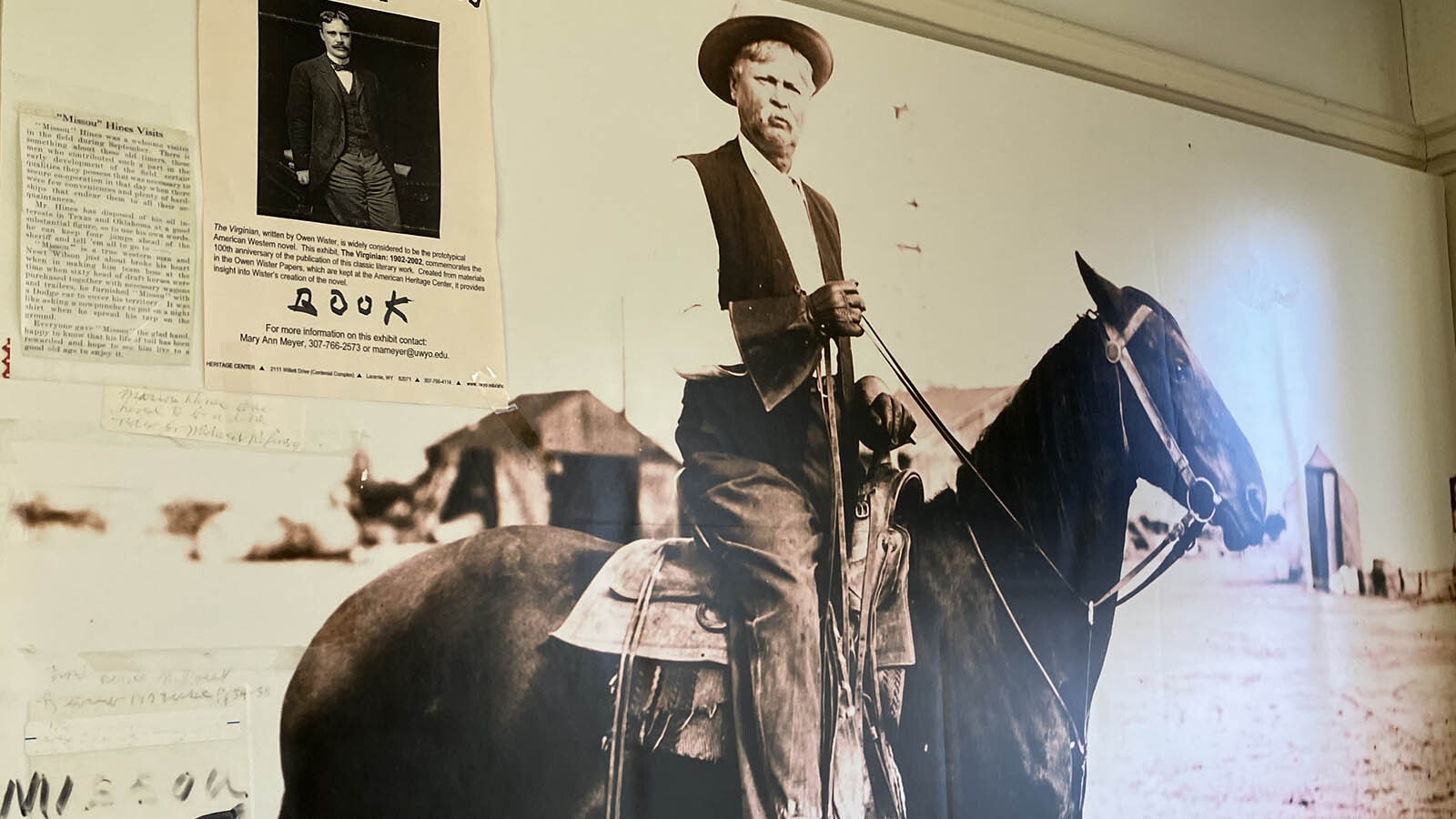
He is listed among Natrona County’s pioneers and is reported to have been a friend of Buffalo Bill Cody. Hines’ photo looms over a room at the Salt Creek Museum in Midwest. It shows him in his role as an enforcer of Midwest Co. oil claims.
“He knew how to use a gun and he wasn’t afraid to use it,” said Everett DeWitt, Salt Creek Oil Field historian. “He was a trick shooter. He was quite the guy.”
Newspapers across Montana published stories in 1920 about how Wister took a Hines’ prank and incorporated it into his novel.
The story goes that a dance at a ranch house during Hines’ cowboy days was attended by cattlemen from the region, including two couples, one that brought their son, the other that brought their daughter.
“The babies were left to play by themselves while the young couples danced. ‘Missou,’ in a mild state of inebriation, conceived the idea of changing the clothing of the babies. The next day when the parent had time to give their darlings the once over, they found that their babies had been changed. … Eighty miles separated children and parents,” the Flathead Courier published on March 18, 1920.
The article says the notoriety of his prank, immortalized in “The Virginian,” went to Hines’ head and he became a gunman and “in a short time he had earned a reputation, through several shooting scrapes, that he considered in keeping with the notoriety Wister had given him.”
Hines is alleged to have been involved in actions against cattle rustlers in “Casper country” and “being quick on the trigger … sustained his reputation and helped to drive the cattle thieves out of the state,” the Courier reported.

Always A Prankster
Even after Hines was having success as an oil man, his name was still in the papers as a rowdy prankster.
The Stockman’s Journal on Jan. 1, 1934, wrote about Hines as someone well known around Wyoming, and “when he had a few drinks under his belt you could expect him to pull most any kind of reckless or daring stunt.”
The newspaper describes an incident with Hines and a Texan named Charley Stuart, who was nicknamed “Red River.”
“After the town of Casper was started, Missou, Red River and some others were riding down the street,” the newspaper says. “Missou, noticing that Red River was riding a horse that had the reputation for being a hard bucker, asked if the Texan could ride him. Red River replied, ‘You bet your life, every jump in the road.’
“Just then Missou whipped out his gun and shot under the horse’s nose. The old bucker went after Red River in earnest and threw him off in the street.”
Another incident showed Hines’ humor when he was watching a magic act and one of the stunts involved the performer “catching” a bullet between his teeth.
“Of course, this was hooey as his partner in the audience was supposed to do the shooting, changing to a blank cartridge,” the Stockman’s Journal reported. “Just as the head performer got through with this explanation, Missou got his gun out and hollered, ‘Are you ready?’ The fellow took one look at Missou and bolted for the door, but Missou punctured the coat tail as he went out.”
Fact Or Myth
The real William “Missou” Hines is hard to separate from the fictional one.
Casper historian Tom Rea told Cowboy State Daily that Hines was an oil man. The Casper College Western History Center librarians found Hines in photos related to Natrona County pioneers.
“The History of Natrona County Wyoming” centennial edition lists Hines along with Wyoming’s fifth governor, DeForest Richards, and others as giving short addresses at an early pioneer event. Richards died in office in 1903.
The name “William Hines” can still be found on an oil lease from 1940 in Natrona County records.
Newspapers beginning in the mid-1890s through his death continue to name him in various contexts.
The first mention of Hines in newspapers in the region comes in 1895, when a story in the Salt Lake Herald states that Hines planned to put 18,000 head of sheep on the NH Ranch.
“It looks like the Powder River country is destined to be one vast sheep pasture, to the great disgust of small cattleman who are running their stock on that range,” the Herald reported.
In 1907, Hines became sheep inspector for the Wyoming Woolgrower’s Association, and there are articles about him promoting the raising of sheep. There are several ads in newspapers advocating a sheep dip that tells readers to contact “Missou Hines.”
A Key From Lander
In 1906, another article mentions Hines as receiving a 14-foot-long key presented to Casper from Lander. He is in another article during the century’s first decade, named with a group of prestigious bachelors in Casper celebrating a song-filled Christmas season meal.
In still another article, he is mentioned as leaving town, but telling a female acquaintance to send some “fat” ladies to their favorite restaurant and he will pay the bill.
As a storyteller, he was apparently sought out by many friends in the Casper community. One journalist recorded Hines’ story about how he came to Wyoming by following a wagon because he wanted to see how long it would take the back wheels to catch up with the front ones.
In 1916, a Natrona County Tribune article has him resuming “his duties in the Salt Creek field.” His official title was “head teamster” for the Midwest Oil Co. That decade was filled with oil claim disputes and opportunities for his “enforcer” role.
The Hinsdale, Montana, paper in 1917 wrote about a confrontation Hines had with a Montana oil man named Colonel Price.
“Missou tried to transfix the Colonel with his withering glance the other day,” the paper reported. “The Beaverhead (Montana) man, contrary to Wyoming precedent, did not wither. Then Hines made a Virginian motion. Price picked him up by the shoulders and shook him so hard that three gatling guns dropped out of his pockets. This disarmed Missou, and he asked a parley. Mutual friends, acting as mediators, patched up a peace, the honors of which were largely on the side of the Montanan. The incident has made the Beaverhead individual a marked man in Casper and has hurt the prestige of Missou appreciably.”
It is likely that his work and connections in Midwest led to opportunities for him to invest in the oil business.
Oil Man
By the mid-1920s, Hines’ connection to the oil business apparently was paying off.
His obituary states he bought an interest in the E.T. Williams Co. However, a photo in the Fort Worth Star-Telegram on Aug. 3, 1924, shows Hines, then in his 50s, with a white shirt and tie. He is described as the president and owner of the Strawn Petroleum Co. and “an outstanding example of unheralded small company success in smaller Texas fields.”
After Hines started gaining wealth, he moved from a ranch he was reported to own outside Casper to Denver. Casper paper community pages have him coming back to town frequently for visits.
In 1927, he and his wife are mentioned in a Washington, D.C., newspaper as visiting his nephew and niece along with his sister.
Still, the legend of “Missou” continued. The Kansas City Star on Dec. 12, 1938, reported comments from a Missouri man related to a serialized version of “The Virginian.” The writer advocated that Hines was Wister’s model for the main character.
“Mr. Wister portrayed his character excellently and Missou is a credit to the state of Missouri,” he wrote.
Hines’ death Feb. 16, 1943, brought coverage in newspapers across the West.
The Austin American-Statesman and Corpus Christi Times had the headlines: “Buffalo Bill Cody’s Pal Dies in Denver” and “Friend of Buffalo Bill Cody Succumbs.”
The Casper Tribune-Herald had a front-page story with two-column headline announcing his death as a Natrona County pioneer.
“Mr. Hines was a colorful and familiar figure to Casper residents, with an unending store of tales of the early west,” the newspaper wrote.
Hines, the Wyoming pioneer, was buried in Denver.

Dale Killingbeck can be reached at dale@cowboystatedaily.com.