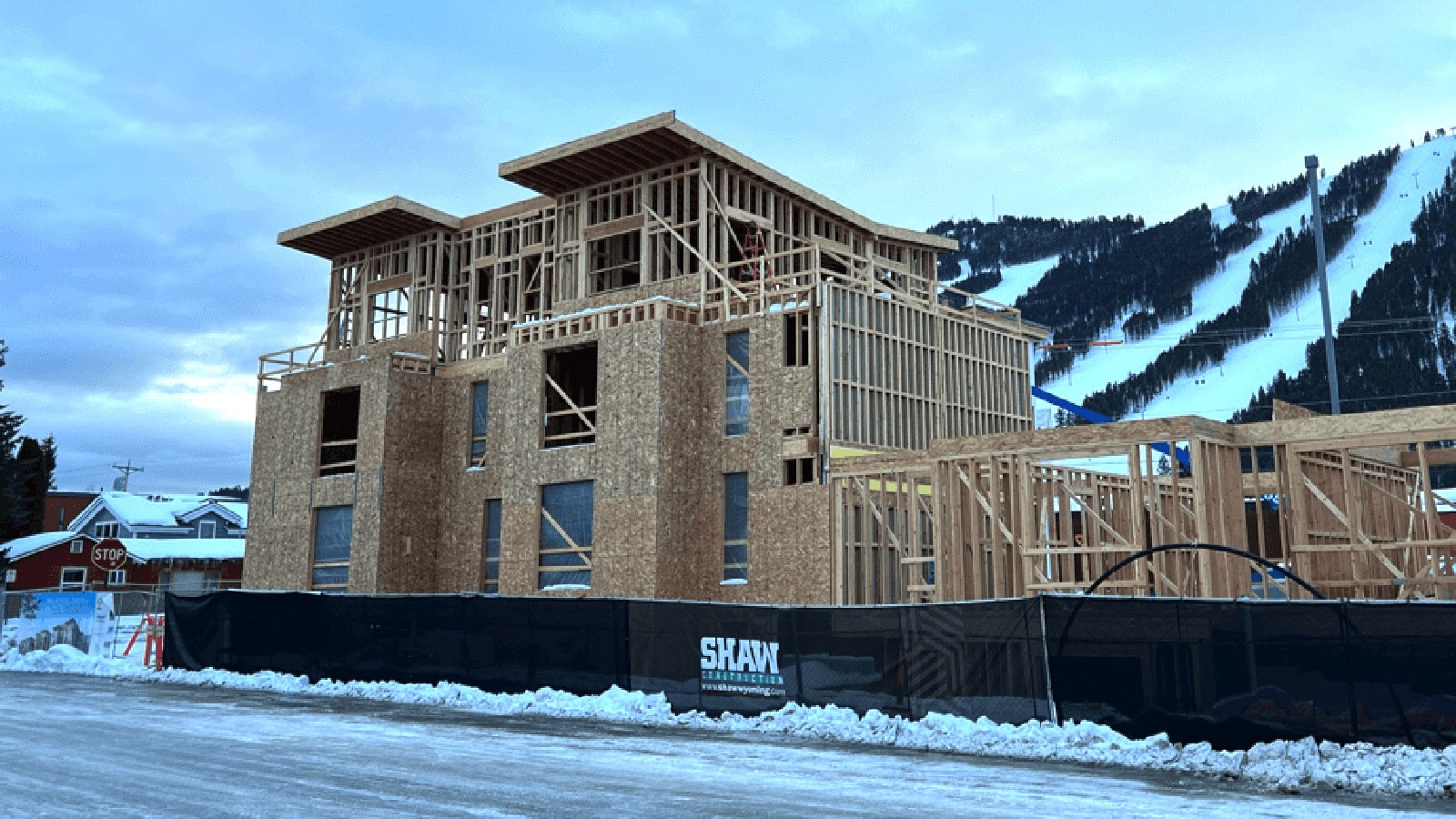
Someone who wants to build a 4,000-square-foot family home in Jackson, Wyoming, has to pay the local government $31,000 for the privilege.
To build a new, 5,000-square-foot restaurant in Jackson, the business owner can’t simply pay her government fees. She has to build three housing units with strict caps on what sort of money-earners can live in them, what she can rent them for and what she can re-sell them for.
These charges and obligations are called impact mitigation fees.
The local government’s theory is that if someone is going to build a new home in the ultra-wealthy region and its skyrocketing housing market, then he also must provide low-cost housing for the daily-grind workers that his existence demands – like waiters, nurses and teachers. That’s according to a July 2023 joint memo by the town of Jackson and Teton County governments.
‘Extortion’
The U.S. Supreme Court could make it harder for both Jackson and Teton County to defend their high impact mitigation fees.
The high court heard oral argument Tuesday in the case of Sheetz v. El Dorado. That case started in 2016 when George Sheetz tried to build what he calls a modest home on his land in El Dorado County, California.
The county charged him a $23,420 impact mitigation fee, purportedly to account for whatever impact Sheetz was going to have on the area’s traffic.
Sheetz was shocked at the idea that he could take a $23,420 toll on the local traffic. He paid the fee grudgingly and sued the county. His court arguments call the fee “extortion.”
Because, The Fifth
The Fifth Amendment to the U.S. Constitution says no private property shall be taken for public use without just compensation. Meaning, the government can’t take things from a person without paying him for them.
Courts have said governments can impose fees on people for the public impacts their projects cause, but only if the government can prove its fees are essentially connected and roughly proportionate to the actual impact.
If the government can’t pass that test, its impact fees may be unconstitutional “taking” under the Fifth Amendment’s Takings Clause.
Except A California Court …
A California appeals court decided the El Dorado county government didn’t have to show nexus and proportionality at all, because elected officials (not administrators) developed that fee through legislation or county resolution.
Some U.S. Supreme Court justices on both sides of the liberal/conservative divide disagreed with this take Tuesday.
“You don’t get a pass from unconstitutional conditions analysis just because you’ve passed generally applicable legislation,” Justice Elena Kagan said during the Tuesday hearing. “And that’s, of course, true in unconstitutional conditions analysis generally, and so too it’s true of unconstitutional conditions analysis in the property area.”
Justice Neil Gorsuch said it seems there’s “radical agreement” that the government can’t dodge the Fifth Amendment’s requirements simply by having elected officials pass laws.
Kagan, however, indicated that holding policy-makers to such constitutional scrutiny could open up a pandora's box.
Could Be More, Though
When it rules on this case, the high court could stop with that issue: It could announce that crafting high fees legislatively doesn’t automatically make it constitutional.
And it could send the deeper issue — of what makes a fee connected and proportionate to the impact someone is having on societal infrastructure — back down to the lower courts.
Then local authorities and courts would get to decide if it’s fair for the town of Jackson to impose a $31,000 fee on new homeowners in Jackson to make them pay for others’ homes.
Or if it’s fair for George Sheetz to pay $23,420 to help the county handle traffic.
But the high court could delve into that deeper issue if it wants to, and develop clearer standards for connecting fees to their supposed impact.
How We Got Here
Attracting lower-income workers to serve the generally wealthy residents of Jackson and Teton County has been a struggle for decades. And it’s getting worse.
In 2018, the town re-zoned itself to build more deed-restricted, or price-capped, homes for workers. And since that year, rental rates on family homes have doubled, Jackson Town Manager Tyler Sinclair told the legislative Regulatory Reduction Task Force in September.
People who are in favor of the high fee scheme say the fees are directly connected to the government’s goal of increasing housing. The fees are needed to attract workers who can’t afford to live in Teton County without a hand-up from the government or from richer residents, proponents theorize.
Detractors, however, say the town and county government are worsening the worker housing shortage with schemes like impact mitigation, tight zoning restrictions and other building policies. They theorize the heavy hand of government throttles the free market, widening the price divide.
“It seems like (these policies) have evolved to use zoning regulation and fees to slow down the residential and commercial market, to catch up on (building price-capped homes),” said Ruthann Petroff, a former Wyoming House representative who is now chairwoman of Jackson Hole working.
The policies, she added, are a “minor inconvenience for the ultra-wealthy, but they’re giant steel walls for the middle class.”
Petroff pointed to years of real estate data showing 943 home listings on average in the 1990s and early 2000s, but just 122 homes listed for sale at the end of 2021 in the Jackson area.
The decrease in home listings correlates with the ever-growing “labyrinth” of Jackson and Teton County zoning and fees, Petroff indicated.
Rich Transplants, Actually
Sinclair disagreed, telling the task force that the “extreme housing costs are largely, in our opinion, due to external demand and wages coming from outside our community.”
In other words, an influx of global wealth is pluming the market.
“It’s a complex mixture, but the external forces we have in Teton county (are) things that are largely out of our control (and) that can be dealt with through regulations at some level,” Sinclair said, adding that he believes Jackson has been mostly successful in balancing and stabilizing the housing market since 1990.
‘Keeping The Lights On’
April Norton, director of the Jackson and Teton County Housing Department, also disagreed with Petroff’s characterization.
She told the task force that the affordable housing program helps lower-income workers who could never afford a home otherwise. It's about “creating neighborhoods, maintaining a stable workforce, keeping the lights on, making sure we have nurses, plumbers, teachers, plough drivers and volunteers to sustain our community.”
Norton said her children’s teachers are living in the homes designated under the “affordable” program.
Government Vs. Government
Eli Bebout, a task force member and former state senator from Riverton, questioned Norton on the legality of deed-restricted housing.
Deed-restricted homes remain generally stagnant in price. A $2 million free-market home may look identical to a $500,000 deed-restricted home, and the owner of the restricted home will also pay less in property taxes, Norton said.
Bebout puzzled over how it can be legal for the government to declare that one home is worth less than its structural twin, and tax it less.
“Our (Wyoming) Constitution says uniform and equal (taxation),” said Bebout. “You subsidize another house next door and say it’s only going to be half a million — I mean, you’re doing it, but I don’t know how it works.”
Bebout characterized the consequent cap on property taxes as the government robbing the government. He hinted that the caps cheat the state’s schools of needed money.
What A County Can Do
Bebout also questioned Jerimiah Rieman, executive director of the Wyoming County Commissioner’s Association, on how Teton County can charge its high impact mitigation fees without authorization from the Wyoming Legislature.
Rieman quoted a state statute authorizing counties to craft policies to promote their residents’ health, safety, morals and general welfare.
Bebout gave a wry response: “It’s really interesting what the word ‘mitigate’ means to you, to me, to different people,” he said.
The statute Rieman quoted has also come to play in a year-long lawsuit in which Wyoming has taken the pro-business side and sued Teton County over a zoning disagreement. Teton County has taken the "health, safety, morals and general welfare" side in that battle.
Probably Not The State
Ultimately, Petroff told the task force that she wasn’t advocating for a specific policy, but she hoped to see a more “balanced” approach to these issues.
She also said she doubted the Legislature could fix the issue, but that it would still be useful to get elected officials engaged on it.
The Wyoming Constitution bars the Legislature from targeting one county or town with "special" laws.
Clair McFarland can be reached at clair@cowboystatedaily.com.