CODY — Yogi Berra, the legendary catcher for the New York Yankees famous for his backward quotes, once quipped, “I really didn't say everything I said.” That might be debatable for Berra, but it’s definitely true for many wrongly attributed quotes to famous people.
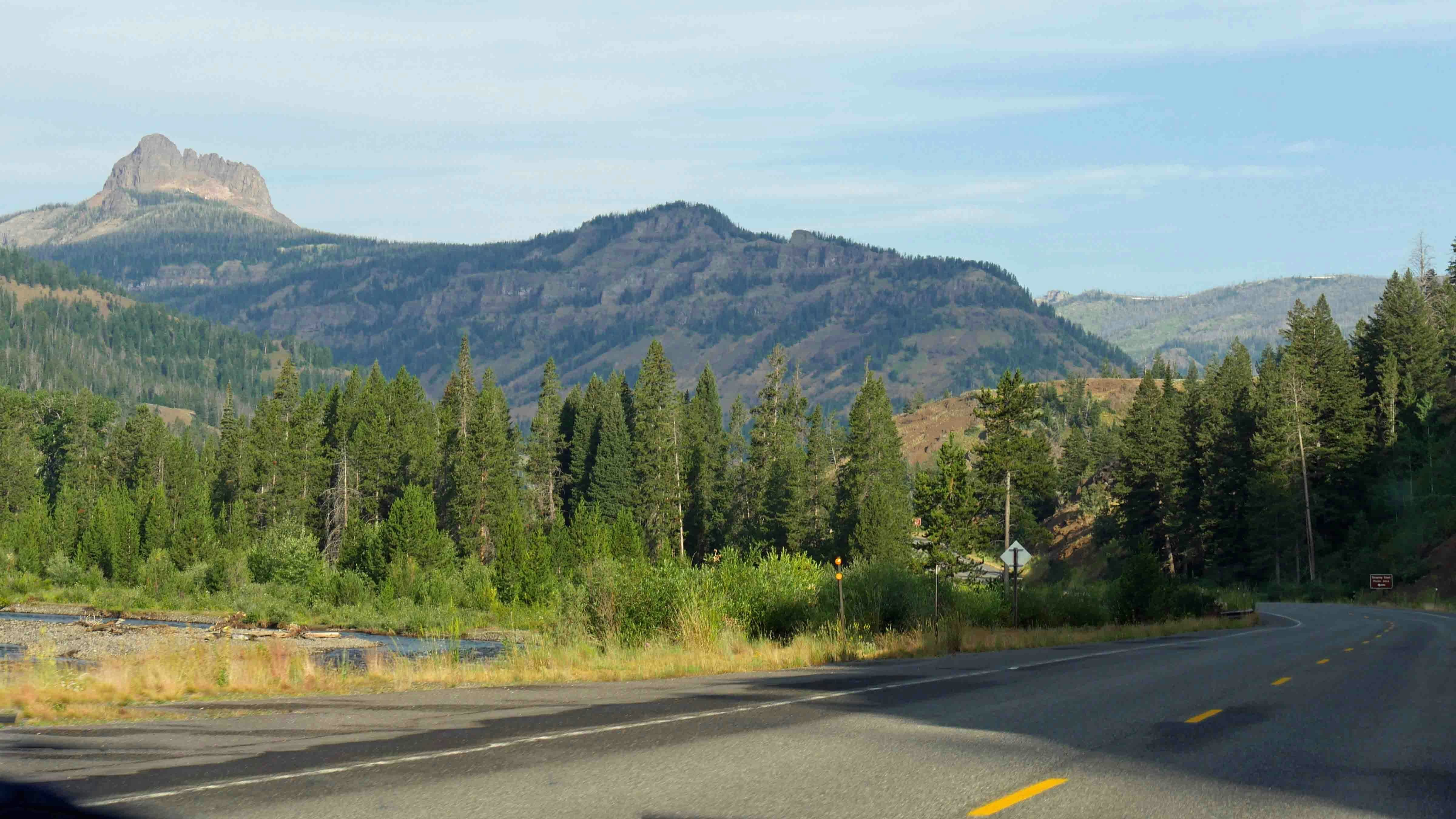
When U.S. President Theodore Roosevelt traveled along the North Fork of the Shoshone River between Cody and the East Entrance of Yellowstone National Park, he was moved by its beauty. That's why he designated the route “the 50 most beautiful miles in America.”
The statement from one of the nation’s most revered and conservation-minded presidents is quite an endorsement, and Cody has been reveling in it for decades. The off-repeated quote has become a popular marketing tool for businesses, blogs and people promoting the scenic ride between Cody and Yellowstone.
Trouble is, Roosevelt didn’t really say everything he said.
North Of The Truth
Cody historians Lynn Houze and Jeremy Johnston are on a mission to correct this misconception of Cody’s history. Teddy Roosevelt said many amazing things in his career, but he never said anything about the Cody-Yellowstone route.
Roosevelt was a skilled and prolific writer who never passed on an opportunity to immortalize nature with his words. After combing every possible source, Houze and Johnston realized the oft-attributed quote had nothing to do with Roosevelt.
“You want to get the facts straight,” said Houze of the Cody Heritage Museum. “The more it's been mentioned, the more it gets repeated. There's just no proof of President Roosevelt, or even private citizen Theodore Roosevelt, being here.”
“Believe me, I have looked for it,” added Johnston, curator of the Buffalo Bill Museum at the Buffalo Bill Center of the West. Roosevelt “never traveled to Cody, Wyoming. Cody, Wyoming, did not exist when he was around in that area. Nor did he travel up the Shoshone Valley on any route.”
The facts speak for themselves, but that doesn’t explain how Teddy Roosevelt became the accepted source of the quote.
Words On The West
Let’s start with the truth. Teddy Roosevelt loved the American West. He owned a ranch in North Dakota and traveled all over the Western states on hunting trips and sightseeing vacations.
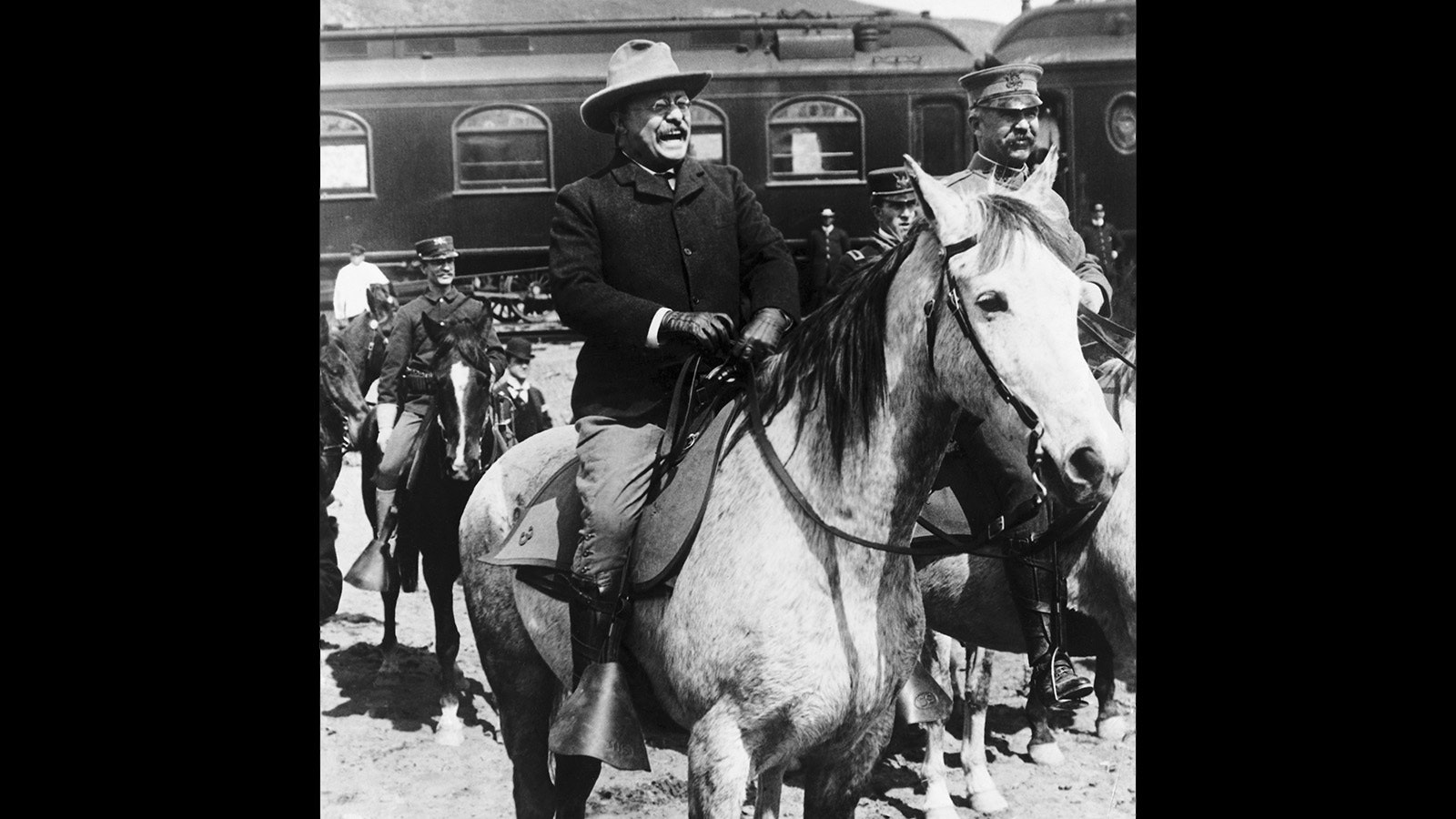
And Roosevelt loved Yellowstone. He famously visited for a two-week camping adventure in 1903 while President of the United States. His visit culminated in the dedication of the Roosevelt Arch at the park’s North Entrance on April 24.
But the 1903 visit wasn’t Roosevelt’s first time in Yellowstone.
“His first trip to Yellowstone was with his wife and some other friends and family in 1890, and he returned again in 1891,” Johnston said. “He hunted around in the Jackson Hole and Two Ocean Plateau areas. He possibly hit the headwaters of the Shoshone River, but he certainly didn't travel the entire course of the river, which is implicated by that quote.”
The headwaters of the Shoshone River in the Absaroka Mountains are probably as close to Cody as Roosevelt ever got. Cody didn’t officially exist until 1895.
Johnston had a personal investment in the legitimacy of the quote. His great-great-grandfather, Johnny Goff, was a hunting guide who led Roosevelt on two hunting trips.
“Growing up, I just always assumed that had happened in the Cody area around Goff Creek (in Shoshone National Forest) because of that quote,” he said. “I've spent more than enough time, professionally and personally, trying to verify if he ever said.”
Much to Johnston’s disappointment, he discovered that the Roosevelt/Goff hunting trips were actually in northern Colorado. Further research cemented his doubt about the legitimacy of the quote.
“As a professional, looking at the material available, there's no indication whatsoever,” he said.
PR Or TR?
Houze was familiar with the quote for years before she heard it attributed to Teddy Roosevelt. A similar quote appeared in one of CBS television’s “On The Road” segments in the 1970s when Charles Kuralt declared the Beartooth Highway “the most beautiful drive in America.”
Travel decals from the 1930s promoted “the Cody Road to Yellowstone National Park” by grandiosely declaring it the “Most Scenic 70 Miles In the World.” Buffalo Bill’s portrait was included on the decal, but Teddy Roosevelt was nowhere to be seen (or heard).
Houze believes the quote gained its attachment to Roosevelt around 2007 when a housing development near Wapiti started using it in their marketing.
“Copperleaf started using that slogan,” she said. “It was never promoted or widely said until Copperleaf started trying to sell their lots (in Wapiti). I can’t prove it, but I think somebody’s PR department decided they wanted to link (the quote) to Teddy Roosevelt.”
A crucial clue was found in a memorial Houze uncovered. It was written to honor Dave Jones, an important figure in the early history of Cody.
Jones moved to Cody in 1904 and spent the next several decades helping to establish many of Cody’s enduring legacies. Jones was “a leading contributor” to the Cody Stampede Rodeo and the Buffalo Bill Museum, now the Buffalo Bill Center of the West.
“I guess you could call him ‘Mr. Chamber of Commerce,’” House said. “He was just very adamant about promoting the town of Cody.”
Jones’s memorial, partially written by his daughter Eugenia, says he “almost alone induced the moving of the Cody-Yellowstone Highway to its present location.” That move established the new route of U.S. Highway 14/16/20 between Cody and the East Entrance of Yellowstone.
There, Houze found the “smoking gun.” The memorial claims Jones “authored the slogan, ‘The Most Scenic 70 Miles in America’ for the road.”
Houze noted that the 53-mile route that exists today wasn’t established until the 1920s when the national parks opened to motor vehicles. The “old Yellowstone Road” would have been much longer, crossing over the Shoshone River multiple times.
Seeing as Teddy Roosevelt died in 1919, you can do the math.
By finding no evidence Roosevelt was behind the quote, Houze and Johnston found all the evidence they needed to prove that he wasn’t. They’ve spent the last several years trying to correct the error in the public discourse.
No Silent On The Subject
Both Houze and Johnston will admit their disappointment that Roosevelt isn’t responsible for the quote and that he never visited Cody. But even the disheartening discoveries can have a consolation prize.
In his research, Johnston made a surprising discovery: A real quote from the real Teddy Roosevelt mentioning the Cody region.
In May 1897, Roosevelt wrote a letter to his friend Frederick Courtney Selous, the famous British hunter and conservationist. Roosevelt had been asked about the hunting possibilities in northwest Wyoming east of Yellowstone National Park.
“I have never come into the country quite the way in which you will have to come into it,” Roosevelt’s letter reads, “but Archibald Rogers has two or three times been over the stinking water with a pack train so that I know you could get in from that side. I have not shot on the Bighorn Mountains for 13 years.”
Johnston said the Bighorn Mountains are where Roosevelt “spent most of his time hunting in Wyoming,” and Col. Archibald Rogers was another sportsman and a member of the Boone and Crockett Club, a wildlife conservation organization cofounded by Roosevelt.
It’s not the most eloquent description of the area that would become Cody, and certainly not as marketable as “the 70 most beautiful miles in America.” But it’s the truth behind the history.
Houze and Johnston feel it's important to distance the quote from the iconic president. Roosevelt didn't really say everything he said, but sometimes it's best to let the landscape speak for itself.
“I always felt our history is exciting and dynamic enough as it is,” Johnston said. “It doesn't need to be dressed up by tall tales. And certainly, our scenery in the Cody area doesn't need to be beefed up with a false statement made by Theodore Roosevelt. I think our country and our history sells itself.”
Andrew Rossi can be reached at arossi@cowboystatedaily.com.