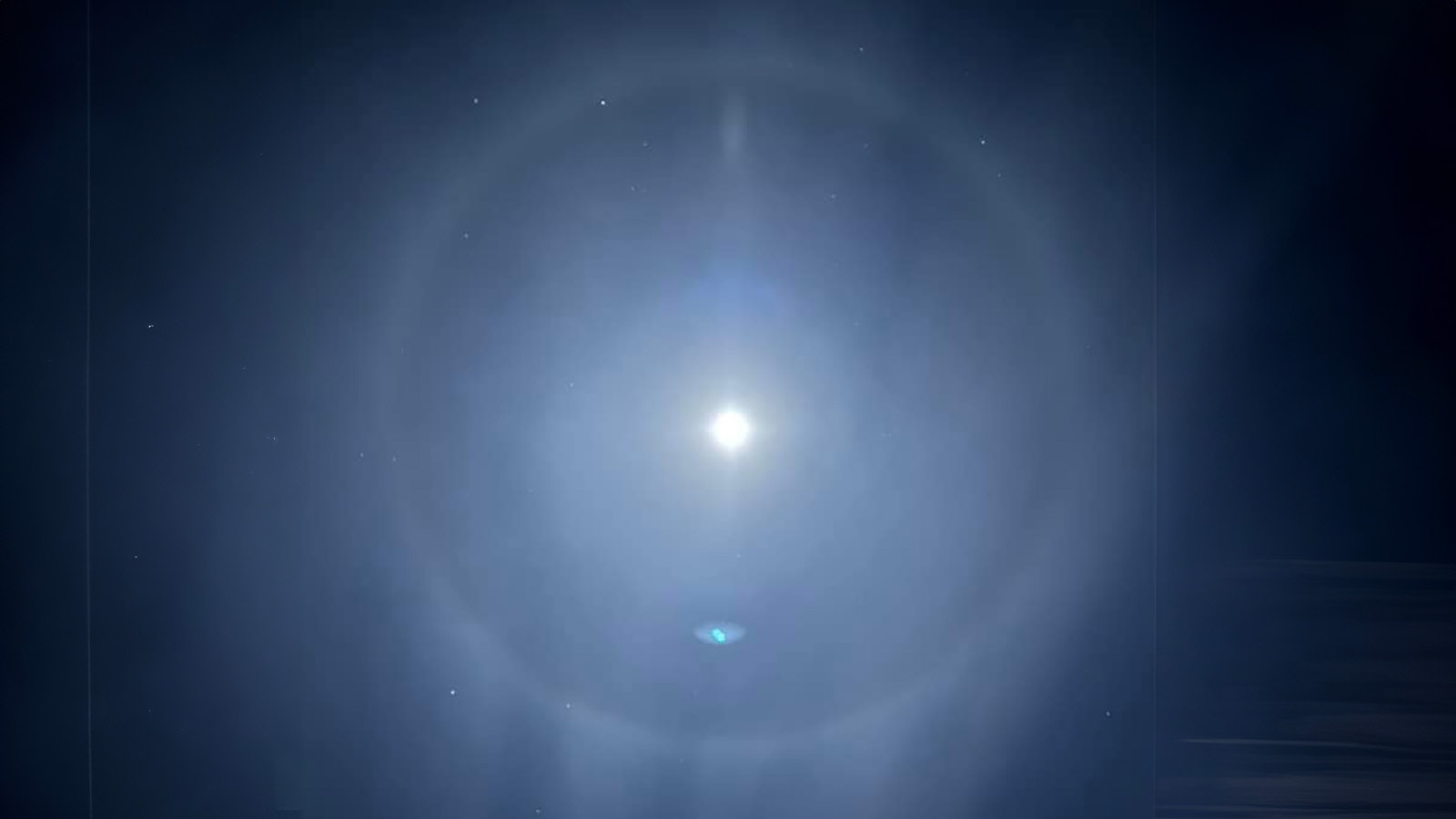
The Bible says shepherds and wise men were awed by the Star of Bethlehem in the skies over Israel on the first Christmas. The same day more than 2,000 years later, Wyomingites were dazzled by a spectacular “moon halo.”
Anyone brave enough to endure the subzero temperatures Monday night might have glimpsed a halo surrounding the nearly full moon.
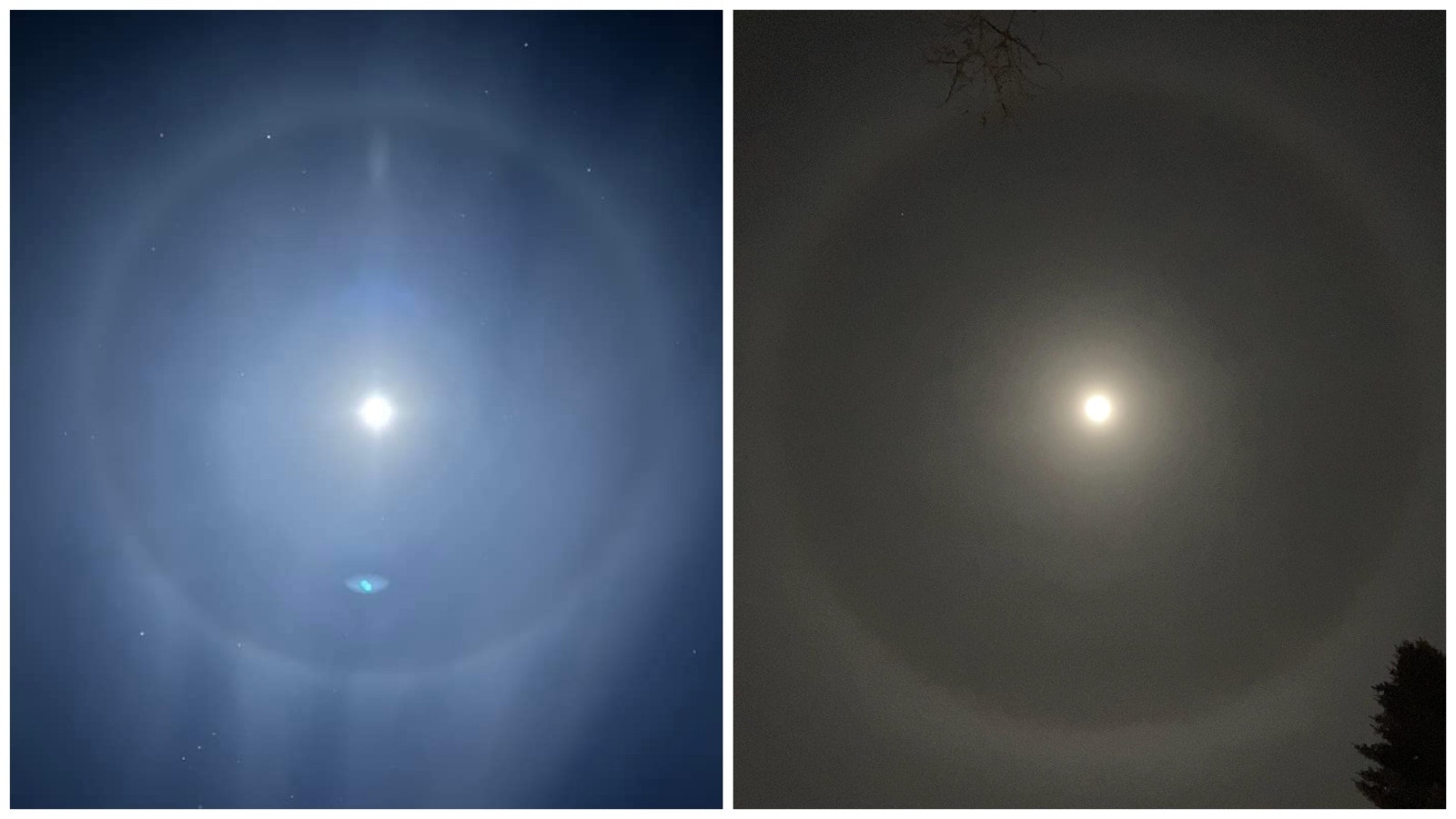
A photo posted on the Wyoming Through the Lens Facebook group shows the moon glimmering over Sheridan, shining through a cold mist within a perfect ring of light.
Moon halos are somewhat rare, given the conditions needed for the vision to manifest. It’s not a heavenly apparition, but it's worth another look.
Wrapped In A Bow
Cowboy State Daily meteorologist Don Day moon halos are rare, but not exceptional. It’s essentially the moon’s version of a rainbow.
“It's basically light getting diffractive through ice crystals,” he said, “either from high thin cirrus clouds or maybe a layer of moisture off the ground where there's ice crystals in the air. So, it's the same effect you get with the sun and rainbows, but the moonlight will diffract and cause that halo effect.”
All rainbows are halos, though they appear as arcs from the ground because the light is diffracted from droplets above the ground (so no, there’s no gold waiting at the end.) When the moon creates its bow, it’s usually high enough in the sky that the entire halo is visible.
Day said light diffraction is common enough. The novelty of a moon halo comes from the conditions needed for it to manifest, which can be tricky.
“It’s usually small water droplets like in the fog, ice crystals from clouds, or just ice crystals from it being really cold in the air,” he said. “Either you need that high, thin cirrus layer, or it needs to be a cold night with enough moisture for those ice crystals,” he said.
A moon halo differs from a corona, where water droplets diffract into a cloud of several colored rings of light and create an aureole, a circle of blue-white light, around the moon. That optical phenomenon is quite different from the single halo of light seen above Sheridan on Christmas.
What Was The Star of Bethlehem?
While explaining the moon halo on Christmas Day 2023 is easy enough, scholars and scientists haven’t reached a consensus explanation whether that’s the explanation for the biblical Star of Bethlehem. The star is only mentioned in the New Testament’s Gospel of Matthew, part of a prophecy foretelling the birth of the Jewish Messiah.
In 1614, astronomer Johannes Kepler speculated that the Star of Bethlehem resulted from a planetary conjunction when Jupiter and Saturn were close enough in the sky to appear as a single bright light. There were planetary conjunctions in the first years of the new millennium, but Kepler’s theory has since been ruled out.
A more recent theory from 2014 suggests the star resulted from a planetary occultation when one object in the sky is hidden from the observer by another object that passes between them. This is the same concept as a solar or lunar eclipse.
Other candidates for the Star of Bethlehem include Halley’s Comet (visible in 12 B.C.), a flyby by some other comet or meteor, and a supernova recorded by Chinese astronomers in 4 B.C.
In modern times, astronomers can readily explain and predict most astronomical phenomena. A moon halo isn’t an extraterrestrial phenomenon, so it probably isn’t an explanation for the Star of Bethlehem,
That’s good news for Wyomingites. Some might be disappointed it wasn’t a divine sign in the heavens on the holiest day for Christianity, but Day said spotting another moon halo can be difficult, but isn’t impossible.
“You don't see him very often,” he said. “Conditions need to be right. I got an email from somebody in Laramie that hit 15 below Sunday morning, and everything was covered in frost. There were a lot of small ice crystals in the air from it being so cold. So, it was a good setup for that.”
Andrew Rossi can be reached at: ARossi@CowboyStateDaily.com
Andrew Rossi can be reached at arossi@cowboystatedaily.com.