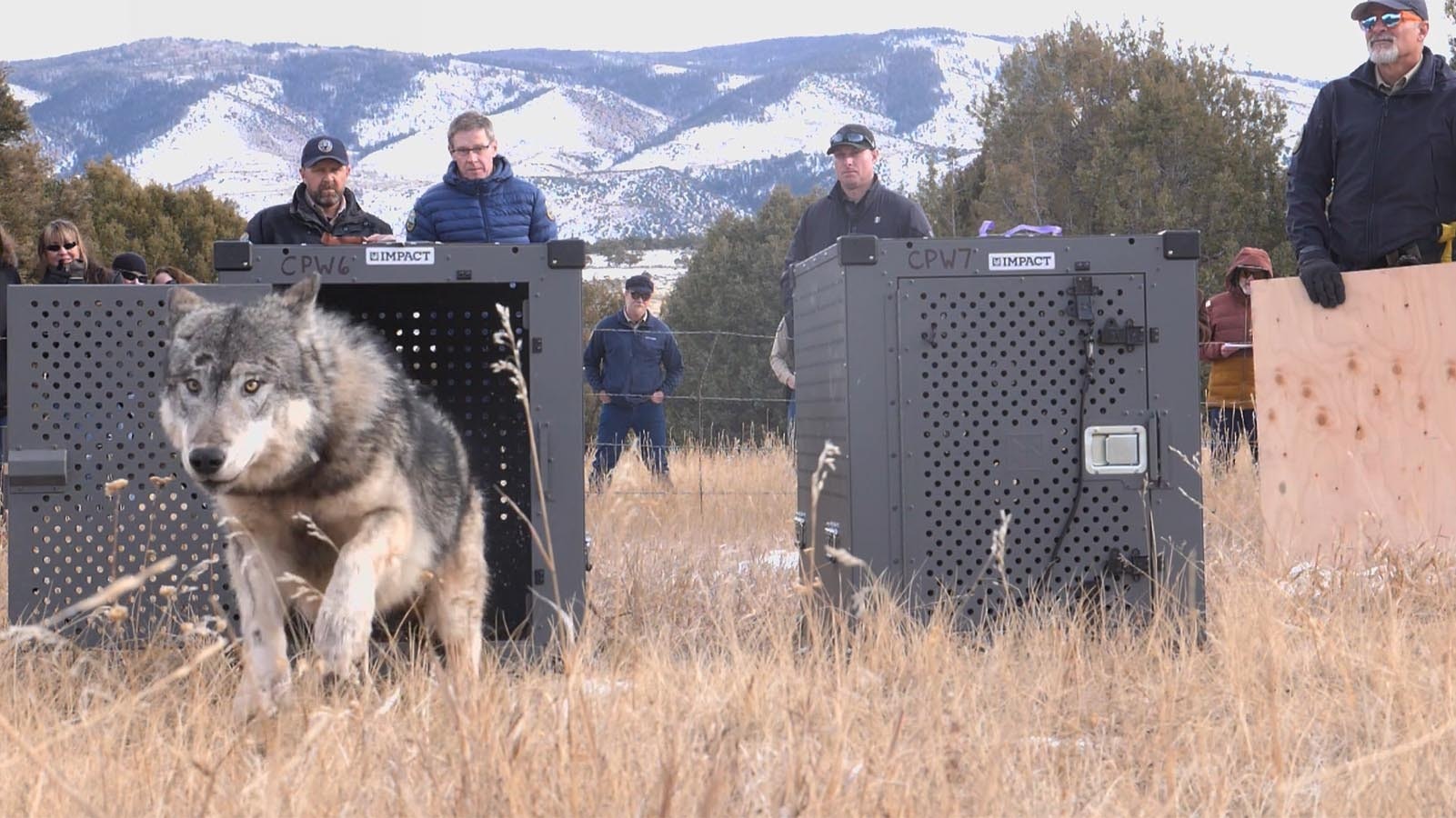
Colorado’s long-anticipated wolf reintroduction program got underway this week, as wildlife agents released five wolves on state land in a remote section of Grand County in northern Colorado.
The wolves were captured after being shot with tranquilizer darts from the air in Oregon on Sunday. They were placed in crates, flown to Colorado, and then trucked to the release site Monday.
Colorado Gov. Jared Polis was on site to personally open one of the crates and release the wolf inside.
Not Everyone Excited
During a virtual press conference late Monday, Polis said these initial releases came roughly 80 years after wolves in Colorado were essentially wiped out. He hailed the initiation of the wolf reintroduction program as a success.
“Our ecosystem will be healthy and balanced again,” Polis said.
However, a former Wyoming legislator who ranches on the Wyoming-Colorado state line told Cowboy State Daily that he and many other rural Coloradans on the other side of the state line aren’t happy to see the wolves coming back.
“People on the Western Slope of Colorado, the rural people (there) are angry,” Pat O’Toole said Tuesday.
O’Toole’s family runs the Ladder Ranch, which straddles the Wyoming-Colorado state line roughly 50 miles north of Steamboat Springs, Colorado. It’s about four hours from the general area of the wolf release site.
Three Yeas In The Making
Colorado’s wolf reintroduction program was initiated by Proposition 114, which Colorado voters passed in 2020 by the slimmest of margins, 50.91% to 49.09%.
The program set a Dec. 31, 2023, deadline to begin the first round of wolf releases.
After Wyoming and other neighboring Rocky Mountain states refused to provide wolves for Colorado’s program, Oregon this fall agreed to give up to 10 wolves for the initial round of releases.
Releases should continue in small batches, with perhaps 15 wolves being reintroduced to Colorado over the next two or three years, officials said during the virtual press conference.
They also acknowledged that the vote on Proposition 114 was divided along Colorado’s urban and rural lines – with rural residents being overwhelmingly opposed to it.
Even so, rural people won’t be forgotten, said Colorado Commissioner of Agriculture Kate Greenberg.
“We’ll be standing side-by-side with our rural communities,” said Greenberg, who is a non-voting member of the Colorado Parks and Wildlife Commission.
Colorado will encourage “non-lethal” methods of keeping wolves away from livestock, but will retain the option of wildlife agents shooting wolves that repeatedly attack livestock.
There won’t be public wolf hunting seasons in Colorado anytime soon, as there are in Wyoming, Montana and Idaho.
Colorado will also offer monetary compensation to ranchers who lose livestock to wolves.
But Will They Stay Out Of Wyoming?
As to how Colorado plans to keep wolves from crossing over into Wyoming, where they can legally be shot on sight, CPW Director Jeff Davis said in the short term, his agency is banking on a 60-mile “buffer zone.”
Meaning, the release sites in Colorado will be at least 60 miles away from Wyoming, the Utah state line and sovereign Native American tribal lands.
In the long term, Davis said he plans to stay in touch with “my counterparts in Wyoming” in tracking the wolves’ possible movements between the states.
O’Toole said that despite wildlife agents’ best efforts, he doubts that the Colorado wolves will stay out of Wyoming, Utah or the Colorado Eastern slope region.
He also thinks it’s only a matter of time before the Colorado wolves venture into Wyoming, where they can legally be killed.
“That’s not how wildlife works. It just doesn’t work that way,” he said. “Wolves don’t stay put, and neither to elk or antelope or anything else.”
The Colorado wolf reintroduction won’t affect wolf management in the Cowboy State, Wyoming Game and Fish Department spokeswoman Breanna Ball told Cowboy State Daily.
“We are cognizant that wolf populations now exist in bordering states and respect their right to manage populations under their state management plans,” she said. “Wyoming will continue to manage wolves within our borders in accordance with the Wyoming Game and Fish Department’s wolf management plan. Wildlife managers manage wolves in biologically and socially suitable habitats and have multiple regulatory mechanisms in place to ensure we maintain wolf populations.
“We are committed to staying in communication with Colorado Parks and Wildlife and will be happy to share insight and provide recommendations on how to deal with conflict.”
Political, Not Biological
O’Toole said that Colorado’s wolf reintroduction was more about politics than biology, and highlights that state’s urban Front Range vs. rural West Slope divide.
“This isn’t a management-driven deal. This is a political-driven deal,” he said.
He said if the vote on Proposition 114 were taken today, the measure would likely fail. That could be due in large part to the troubles caused by the North Park wolf pack.
That pack of northern Colorado wolves was founded in 2020 by wolves that traveled on their own into Colorado from Wyoming. Some of those wolves might have been shot in fall 2022 after crossing back over into Wyoming. CPW officials said earlier this year that the North Park pack has effectively ceased to exist.
But while it was active, wolves from that pack killed several livestock animals, as well as at least two dogs.
Setback For Game Herds
Big game herds on both sides of the Wyoming-Colorado state line are still reeling from the devastating effects of the winter of 2022-2023, which killed tens of thousands of deer, antelope and elk.
O’Toole said in light of that, it’s a bad idea to bring apex predators such as wolves back when those herds are still struggling to recover.
“It could be a generation or more before we get the wildlife back that we had here before,” he said.
Mark Heinz can be reached at mark@cowboystatedaily.com.