Wyoming’s leadership sparred Thursday against a handful of pro-choice women and organizations seeking to overturn the state’s two abortion bans – one barring nearly all abortions and one barring the use or marketing of chemicals for preforming abortions.
The Wyoming governor and attorney general’s offices asked Teton County District Court Judge Melissa Owens to decide the case early in their favor by dismissing the plaintiffs’ case attacking the two bans from multiple constitutional angles.
The plaintiffs in turn asked Owens to judge the case early in their favor by dismissing the state’s arguments and therefore declaring the bans unconstitutional.
If Owens grants a complete summary judgment to either side, the case would not have to go to trial.
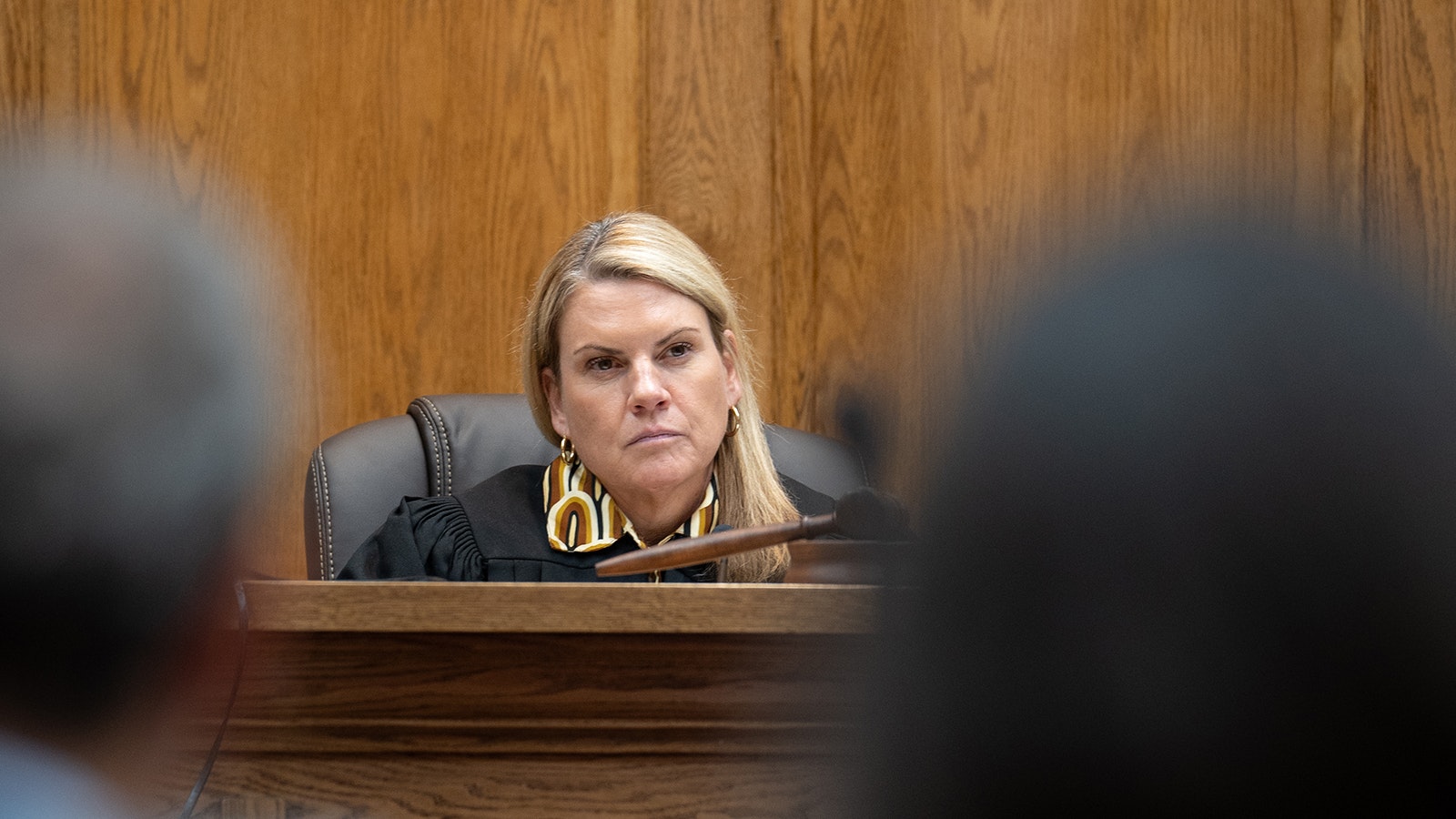
Owens was clear she wouldn’t have a decision Thursday.
“There’s no way I’d be ruling from the bench today,” she said.
The case contains complex constitutional issues, Owens had said earlier.
Wyoming’s two abortion bans are not enforceable now, as Owens has blocked them while contemplating this case. Abortion is legal up to the point of viability in Wyoming.
These Are The Main Arguments
The first attorney to speak for the plaintiffs, Peter Modlin, said the bans violate freedom of religion and the Establishment Clause; they’re unconstitutionally vague and violate the Wyoming Constitution’s promise of health care autonomy.
Secondly, John Robinson insisted that the bans violate Wyomingites’ unenumerated rights, which he claimed include the right to be left alone by government, the right to privacy and the right to determine the formation of one’s own family.
He emphasized that the Wyoming Constitution makes more promises to individuals about their rights than the U.S. Constitution does. This is significant in light of the 2022 U.S. Supreme Court’s Dobbs ruling, in which the high court determined that abortion is not an unenumerated right under the Constitution.
Other states have relied on the unenumerated rights sections of their constitutions to preserve women’s access to abortions. Robinson said he hopes Wyoming will soon join them.
Marci Bramlet also argued that the abortion bans violate the Wyoming Constitution’s guarantee of equal protection, by targeting women and procedures that apply uniquely to them.
Wyoming Attorney General Deputy Jay Jerde countered all three attorneys’ arguments and insisted that banning nearly all abortions would return Wyoming to the status quo of its laws from before the U.S. Supreme Court crafted a federal right to abortion in 1973 and barred the state from banning the procedure.
He also said Wyomingites’ right to make their “own” health care decisions delineate between a woman’s health care and an unborn baby’s.

First, Health Care Autonomy
Modlin discussed briefly the legal standards the plaintiffs would like the court to employ in each of their different arguments against the bans.
Then he launched a discussion on the Wyoming Constitution’s Article 1, Section 38, which guarantees Wyoming residents the right to make their own health care decisions. That section contains its own test of justice: The Legislature can regulate people’s health care decisions when reasonable and necessary to protect public health and welfare.
The Legislature can’t claim its two abortion bans are reasonable, Modlin argued.
“The state has tried repeatedly to prevent us from presenting (case) evidence. They want the court to blind itself to the devastating real-world impacts,” said Modlin. “The evidence shows that the abortion bans are not reasonable and necessary to protect public health and welfare. (They) do unduly infringe on the right to make health care decisions.”
Modlin pointed to data showing that mental health conditions are “the highest” contributor to maternal mortality, and noted that the abortion bans don’t carve out exemptions to address mental health crises – and the ban on chemical abortions specifies that mental health conditions do not generate an exemption.
He alluded to the state’s earlier arguments, that the two bans are intended to protect women.
“From what?” Modlin asked. “From the right to make their own decisions?”
‘Own’
Jerde rebutted, saying the word “own” is the key.
“Whenever a pregnant woman decides to get an abortion, it’s never a decision that affects only her health care,” said Jerde. “It affects the health or health care of the unborn baby.”
Jerde said the Legislature in making abortion bans with exceptions to preserve the life and health of the mother is balancing the rights of the mother, and of the unborn baby.
Conversely, he said abortion “is going to kill the unborn baby. I don’t think there’s a dispute about the fact that abortion would kill the unborn baby.”
Elective abortions are not health care, Jerde also argued.
He said the bans contain exemptions allowing abortion for health crises; and in those cases abortion would be health care.
But “if a pregnant woman is getting an abortion and it’s not related to her health, it just isn’t health care. You’d have to find that (pregnancy) is either a disease or sickness to find (abortion) is health care under the plain meaning,” said Jerde.
He argued further, saying the Legislature when it prompted the 2012 passage of the health care amendment to the state’s Constitution didn’t mean to sign away its ability to regulate the medical industry, which is why it inserted the amendment’s Section C, saying lawmakers can still make reasonable laws to protect the people’s welfare.
Because, Religion
Modlin said the two bans exist because of religion and to advance Christian beliefs on people.
“It’s fundamentally a religious question. We know that the views of different religions vary dramatically on the question of what is the status of the fertilized egg,” he said, listing how various faiths differ on the topic.
On behalf of the Jewish woman in the plaintiffs’ group, Modlin the state is forcing “some legislators’ sectarian viewpoints” onto her, stifling her religious liberty.
Jerde said abortion is not fundamentally religious, and the pro-life stance is supported by science.
Judge Owens voiced doubt.
“I’m not sure all science points to that,” she said.
Jerde clarified, saying it’s a substantial topic in science and veers beyond the realm of theology. He called the pro-life stance “the traditionalist view of abortion.”
Establishment Clause
Turning to Modlin’s argument that the bans violate the Establishment Clause, or the mandate barring the state from adopting a state religion, Modlin cited two specific provisions in the Wyoming Constitution: one barring the state from funding religious institutions and the other prohibiting religious teaching in public schools.
“The Life Act and the chemical abortion statutes don’t have anything to do with state funds (or education),” said Jerde.
“It seems that’s a pretty straightforward argument,” said Owens.

‘Impossibly Vague’
Modlin called the bans “impossibly vague.”
He said they put doctors in fear of breaking laws they can’t always understand in medical crises whose outcomes they can’t anticipate, harming their mental health and deterring them from staying in Wyoming.
He pointed to differences in the chemical abortion ban’s exemptions and the Life Act’s exemptions, saying there are situations where women will be protected by the latter but not the former and will be forced to have a surgical abortion when a chemical one would have been less invasive.
The Life Act’s exemption for rape is “exceedingly difficult to invoke,” and the exemption for incest requires a family member – possibly the perpetrator – to sign off on it when the victim is a minor, Modlin said.
Modlin pointed to expert testimonies filed earlier by doctors in support of the plaintiffs, attesting that these laws are too vague to direct them professionally.
He also pointed to the logical mismatch created by the rape and incest exemptions – one that could cripple the state’s reactive defense of the bans if Owens finds them unconstitutional.
“The state claims the purpose of these laws is respect for and preservation of prenatal life. Yet in its discovery, we asked the state to acknowledge that fetuses conceived in sexual crimes where abortion is permitted are no different than other fetuses,” Modlin continued. “The state is saying not all fetuses deserve respect and protection. Only some.”
The Life Act left the Wyoming House this year without rape and incest exemptions, but some in the state Senate demanded the exemptions, so the Senate added them.
This Last Resort
Jerde characterized the vagueness attack on the two bans as a last resort, a controversy Owens should consider after going through the other arguments and deeming the bans constitutional under those.
The plaintiffs can’t prove a law vague by summoning doctors who say it’s vague to them, Jerde said.
The general rule for vagueness is whether a person of ordinary intelligence could read the statute and comprehend what conduct is prohibited, Jerde said. There’s also case law saying statutes can be tailored to the professions they address.
“What they’re trying to get this court to do is … (use three physicians’ testimony as) evidence of vagueness because they say that they can’t understand it,” said Jerde. “But vagueness is at its core an objective legal determination to be made by the court.”
Unenumerated
Robinson argued that Wyoming protects the unenumerated rights of privacy, the right to be left alone, and the right to form one’s own family.
They include “a woman’s right to make decisions about her body – about whether to terminate a pregnancy,” Robinson said.
He quoted John Locke in insisting that autonomy over thought, body and movement are the essence of freedom. He noted that Wyoming’s Constitution protects the pursuit of happiness, while the U.S. Constitution does not – and he pointed to other areas where the Wyoming Constitution promises individuals more protections than the federal one does.
He also referenced a Wyoming Supreme Court case where the justices referenced a “right to be let alone.”
Letting Alone
Jerde said the case Robinson cited referenced a right to be let alone in a footnote, linking to the Wyoming Constitution’s promise against unreasonable searches and seizures.
“No Wyoming case has recognized a general right to privacy under the (state) Constitution,” he said.
As for the right to familial association, the U.S. Supreme Court has recognized that, said Jerde. But the high court isn’t using it to confer a right to abortion.
He said the plaintiffs can’t argue that the family association right confers a right to abortion, because families are deeply rooted in both humanity and the nation’s traditions, while abortion is “not deeply rooted in the history of this country.”
The U.S. Supreme Court conducted a lengthy analysis on that in its 2022 ruling, saying abortion didn’t qualify as an unenumerated right because it’s not deeply rooted in the nation’s tradition.
Also, Women
Marci Bramlet told Owens she believes the promise of equal protection under the law is the central issue to the plaintiffs’ bid for a state abortion right.
“I’m the beneficiary of decades, if not centuries, of advocacy by women in order to create an equal position in society that allows me to do exactly what I do now,” she said.
Bramlet quoted the late U.S. Supreme Court Justice Ruth Bader Ginsburg, who said she didn’t want special privileges for her sex, only for men to take their feet off women’s necks.
She said the abortion bans specifically target women and procedures unique to women.
She said they violate both the constitutional right of equal protection and create a “suspect class” or a class designation under the law.
Either violation would invoke a legal standard called strict scrutiny, making it harder for the state to defend its bans in court.
“(The law) makes women inferior to men,” Bramlet added.
Except Women Have Uteruses
Jerde said the law doesn’t create a gender class. It addresses a procedure that happens to be unique to women.
The lynchpin in the test for whether laws violate equal protection is whether they treat people differently who are otherwise similarly situated.
The plaintiffs failed to show how women are “similarly situated” to men with respect to abortion, Jerde said.
“You just don’t have an equal protection argument. They just didn’t make that,” he added.
The Pro-Choicers Vs. The State
The plaintiffs are: Danielle Johnson; Kathleen Dow; Dr. Gioviannina Anthony, OB/GYN; Dr. Rene Hinkle, OB/GYN; nonprofit abortion-funding group Chelsea’s Fund; and Circle of Hope, the parent group of a Casper abortion clinic.
The defendants are Wyoming Gov. Mark Gordon; Attorney General Bridget Hill; the Jackson chief of police; and the Teton County Sheriff.
Neither the chief of police nor the county sheriff advanced defenses in court Thursday, or at any point during the case, letting the attorney general's office do the arguing.
Gordon appointed Judge Owens. She serves in Wyoming's most pro-choice county, the legislative record indicates.

Clair McFarland can be reached at clair@cowboystatedaily.com.