Any Wyoming angler will say that patience and technique are among the keys to catching fish. But most wouldn’t spend more than a few hours at a spot with bad prospects.
So, what would they say about someone who spent more than 500 hours at the same spot with all to show for it was a handful of beyond rotted fish?
Most anglers would call it insanity. Casper resident Dwaine Wagoner calls it “something to do.”
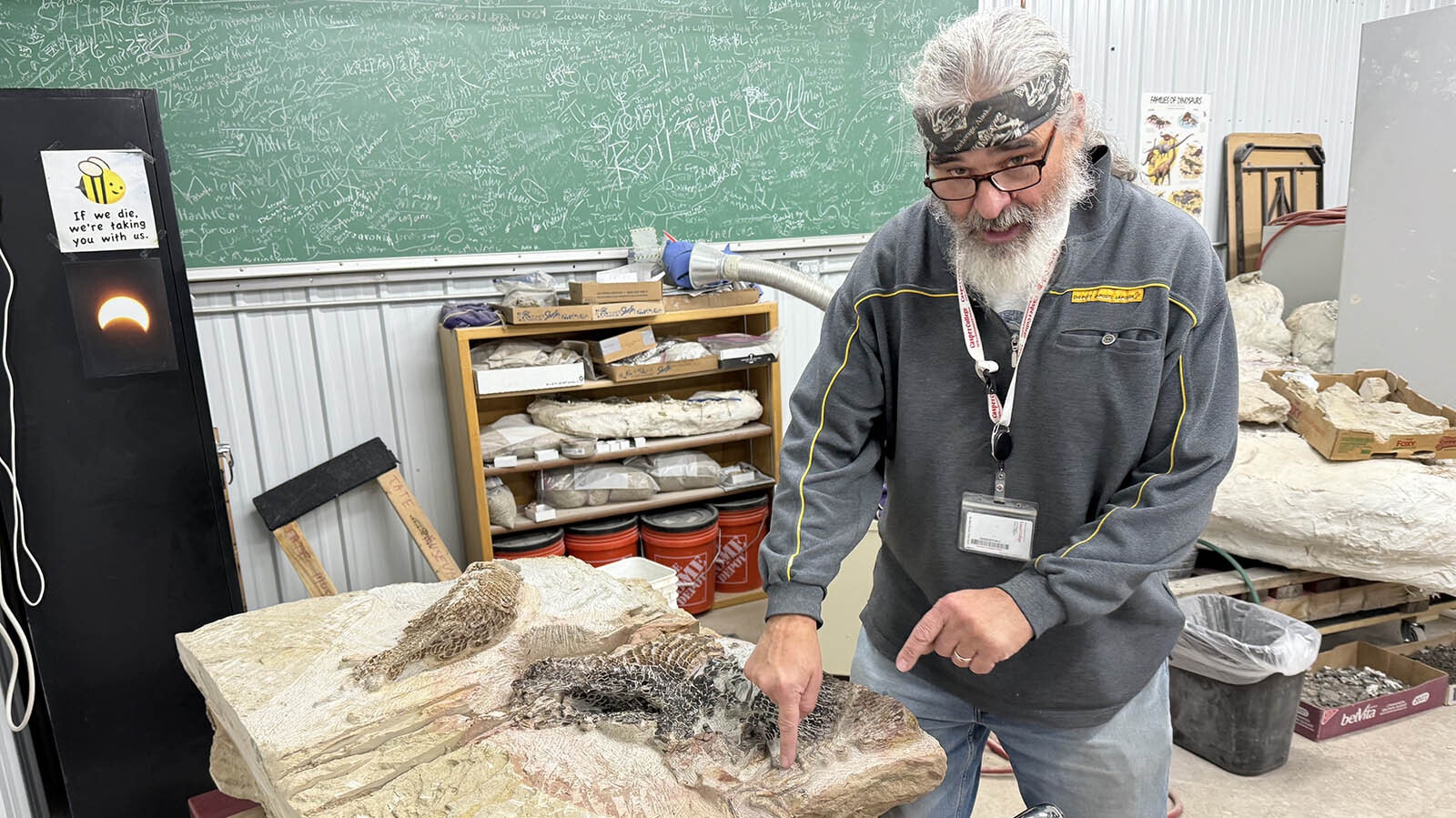
Wagoner isn’t a traditional angler. He’s one of the volunteer fossil preparators at the Tate Geological Museum at Casper College.
Wagoner’s latest project was cleaning up a sandstone block that contained the fossilized remains of several large fish. Now the block and its story are on display in the museum, and it’s clear Wagoner has uncovered an exciting fishing spot.
Gone Fishing
J.P. Cavigelli, museum collections specialist at the Tate, said he got a call from a rancher at an undisclosed location in Converse County who had found something interesting in rocks turned up by an oil company’s bulldozer.
“He found some bones in rocks on an oil well pad,” Cavigelli told Cowboy State Daily. “He sent me some pictures, and it was obviously a lot of gar bones and scales. That’s pretty cool.”
Gars are fish with long, skinny bodies and long snouts. No gars live in Wyoming today, but their fossils are plentiful in several formations.
Cavigelli went to the site immediately and saw several large blocks of sandstone pushed to the side of the well pad. Inside one of the blocks was the three-dimensionally preserved skull of a gar. Based on the location and the rock from this find, Cavigelli determined the fossils were from the Wasatch Formation from the early Eocene Period, making them between 50 and 55 million years old.
Cavigelli used a rock saw to cut the gar skeleton from the sandstone.
That’s when things got interesting.
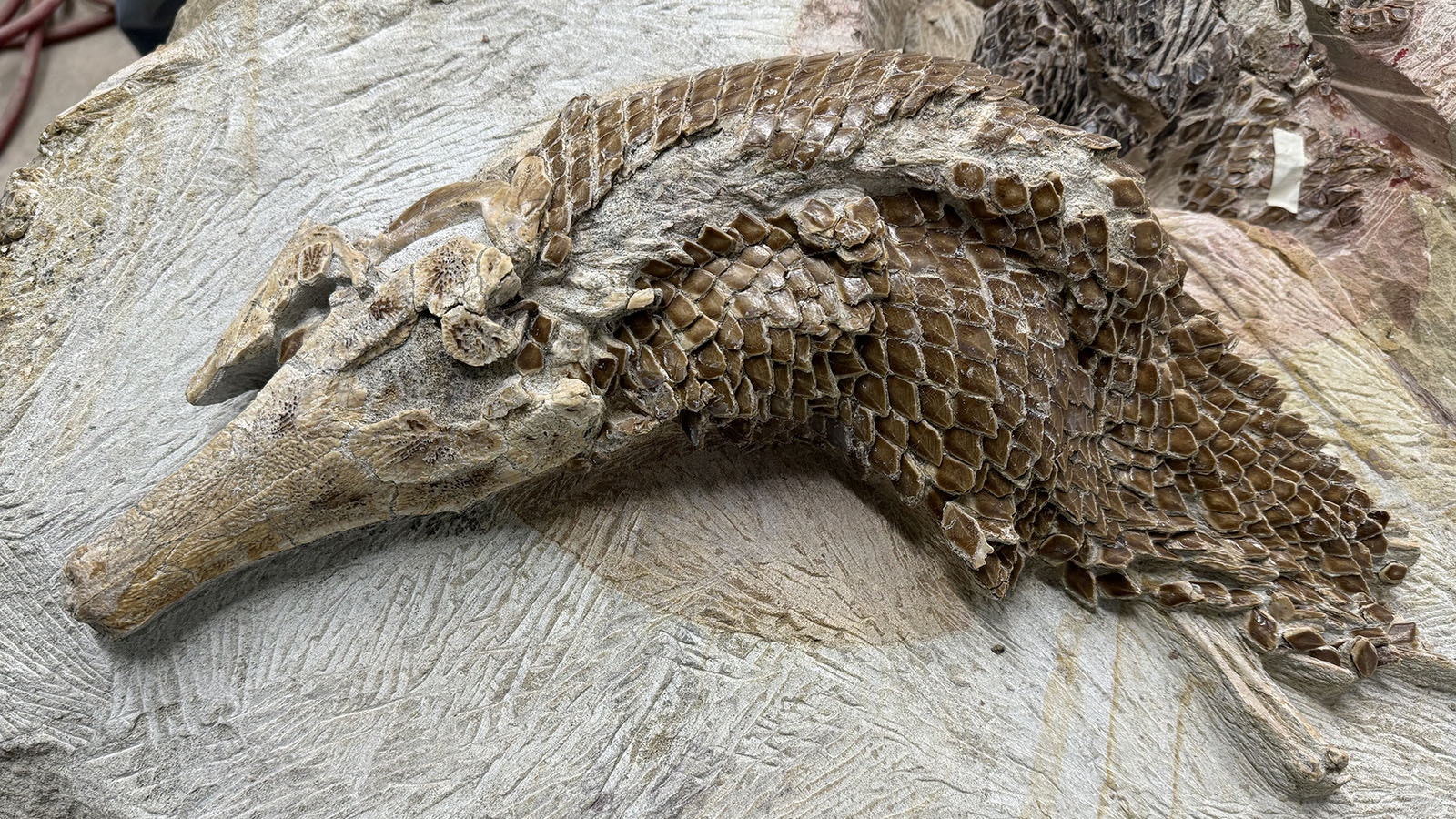
The skull and body of a prehistoric garfish. Dwaine Wagoner prepared this fossil, which was preserved three-dimensionally, making it an exciting and unique fossil discovery. (Andrew Rossi, Cowboy State Daily) 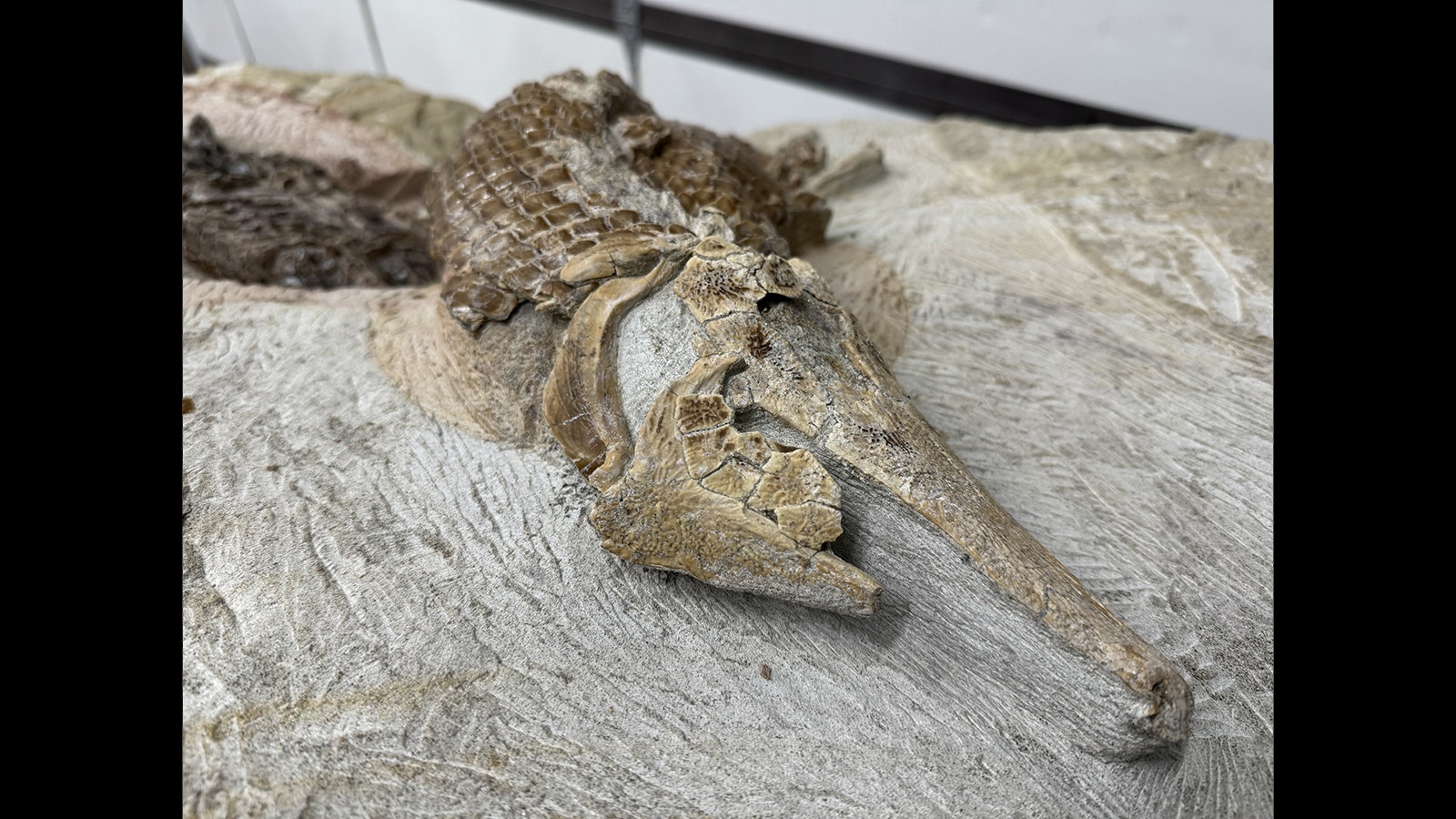
The skull and body of a prehistoric garfish. Dwaine Wagoner prepared this fossil, which was preserved three-dimensionally, making it an exciting and unique fossil discovery. (Andrew Rossi, Cowboy State Daily)
A Productive Fishing Hole
“As we were sawing it out, we found a second specimen,” he said, pointing to the deep cuts left behind by the rock saw. “Then we sawed it out on the other side, and we didn’t see the third specimen.”
It was like sawing fish in a barrel full of cement.
Realizing they had more than one specimen, Cavigelli and his team brought two sandstone blocks back to the museum. That’s when Wagoner embarked on his marathon fishing expedition, spending hundreds of hours doing meticulous work.
“We looked at it and said, ‘It’s a stubborn rock. Dwaine will do it,’” Cavigelli said.
Something To Do
Wagoner has been volunteering at the Tate Museum for 24 years. He’s a volunteer fossil preparator, using pneumatic air scribes to remove the hard rock surrounding fossils collected by museum excavation teams.
Anyone who’s visited the Tate has seen Wagoner’s work, which includes several of the museum’s most impressive displays.
Wagoner prepared the skulls and skeletons of ichthyosaurs found near the Alcova Reservoir and a giant freshwater turtle, another rare and unusual find from the Wasatch Formation. He was also one of the preparators of Lee Rex, an exceptionally well-preserved Tyrannosaurus rex skeleton and the only Wyoming T. rex to stay in its home state.
When Cavigelli commended Wagoner as one of the main preparators of Lee Rex and “a good man,” Wagoner responded with the sincere humility that has endeared him to the Tate’s staff and volunteers.
“I helped with it,” he said.
Wagoner’s well-earned reputation as a dedicated, excellent preparator made him the ideal person for this fishing project.
“I’ve been finding gar scales in the field for over 24 years,” he said. “Individual scales is all we find. Finding something as complete as this is pretty exciting. It’s something I haven’t seen before.
Wagoner spent over 300 hours preparing the first block, exposing three gar skeletons. He spent another 240 hours on the second block, which revealed four more gars for a total of seven mostly complete skeletons.
Any paleontologist knows an hour of work excavating fossils in the field means another six or more hours preparing it in the lab. Wagoner usually comes in for four hours every morning and makes what progress he can in that time.
“It’s a labor of love,” he said. “And it's something to do.”
Exciting, Rotting Fish
The sandstone block containing the four gar skeletons is now displayed in the Tate Geological Museum’s main gallery. The block with the three-dimensionally preserved skull is behind the scenes for more preparation and scientific study.
“I’m still putzing with it,” Wagoner said.
Cavigelli is eager to learn from the expertly prepared fish. While the Wasatch Formation is well known for its high fossil density elsewhere, these gars come from a location that hasn’t produced anything as exciting as this.
“In southwestern Wyoming, (the Wasatch Formation) is very rich and very well-known,” he said. “Up here in the Powder River Basin, from Casper north into Montana, it’s not as rich. To find articulated gars is pretty exciting.”
All seven specimens are remarkably well preserved, but they’re all missing their fins and tails. Cavigelli realized that was a clue about the prehistoric environment and that the gars were probably rotting at the edge of a lake when they were covered with sediment and fossilized.
“I’ve been sent pictures of dead gars rotting on the edges of lakes,” he said. “And what are they missing? Their tails and fins.”
Future Fishing Trips
After finding a lucrative spot, any angler would mark its location and be sure to return. Cavigelli intends to do just that, and the rancher has extended an open invitation for the museum to return.
“We need to find an alligator out there. Or a giant turtle. I bet you could go out there, Dwaine, and find the rest of this rock,” he said, pointing to the section where half of a gar is missing.
Wagoner laughed. He knows the next massive discovery from the Wasatch Formation would probably end up at his workstation once it's out of the ground.
Despite the wonders of a prehistoric world he’s spent thousands of hours uncovering a millimeter at a time, Wagoner’s just happy to help. Even with prehistoric gars, ichthyosaurs and a T. rex on his resume, he doesn’t dwell on the past.
“I enjoy most things I work on,” he said.
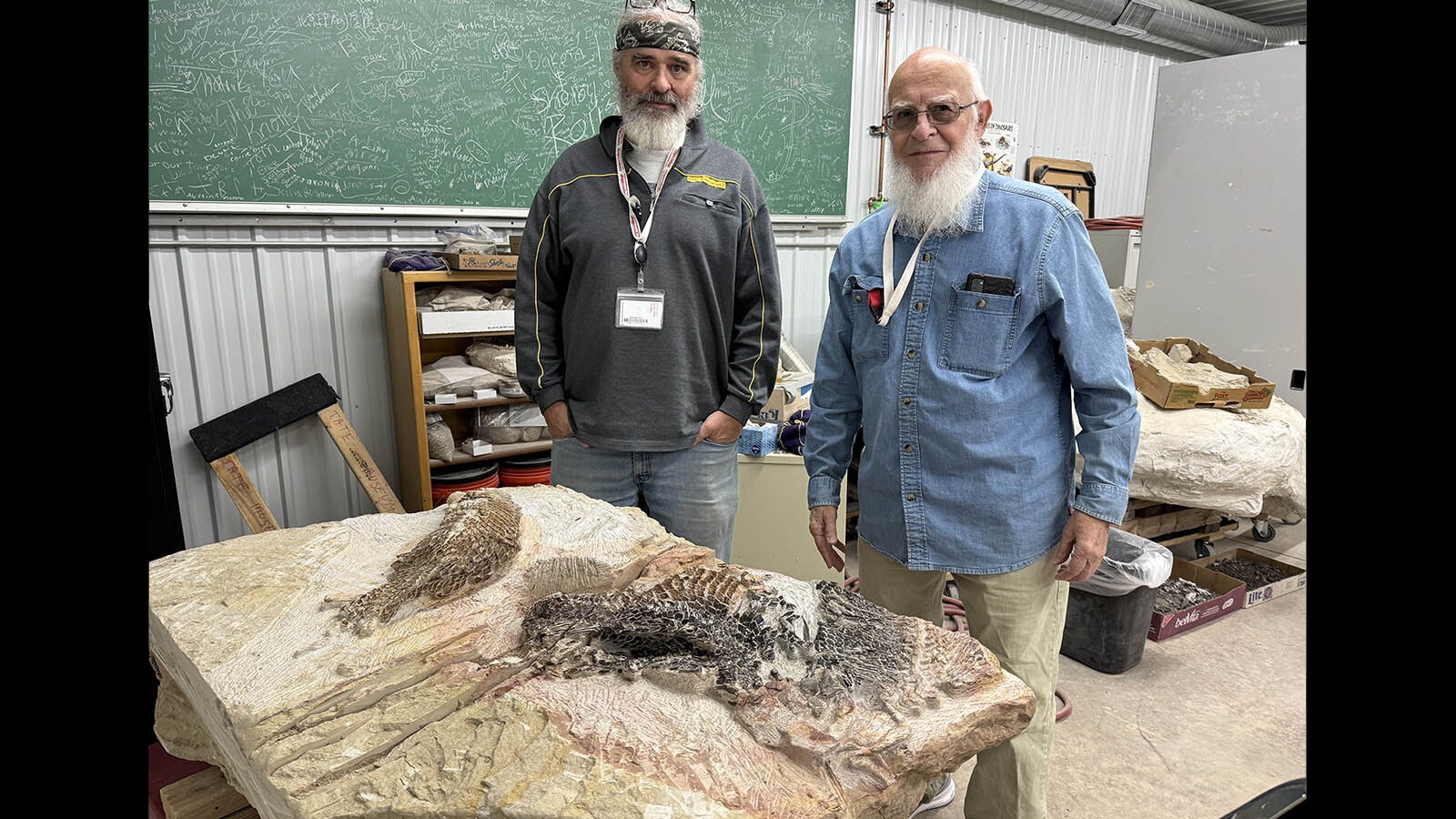
J.P. Cavigelli and Dwaine Wagoner with a sandstone block containing three 50 million-year-old gar skeletons from the Wasatch Formation. Wagoner spent 300 hours removing the sandstone encasing the remarkably well-preserved fossils found on a ranch in Converse County. (Andrew Rossi, Cowboy State Daily) 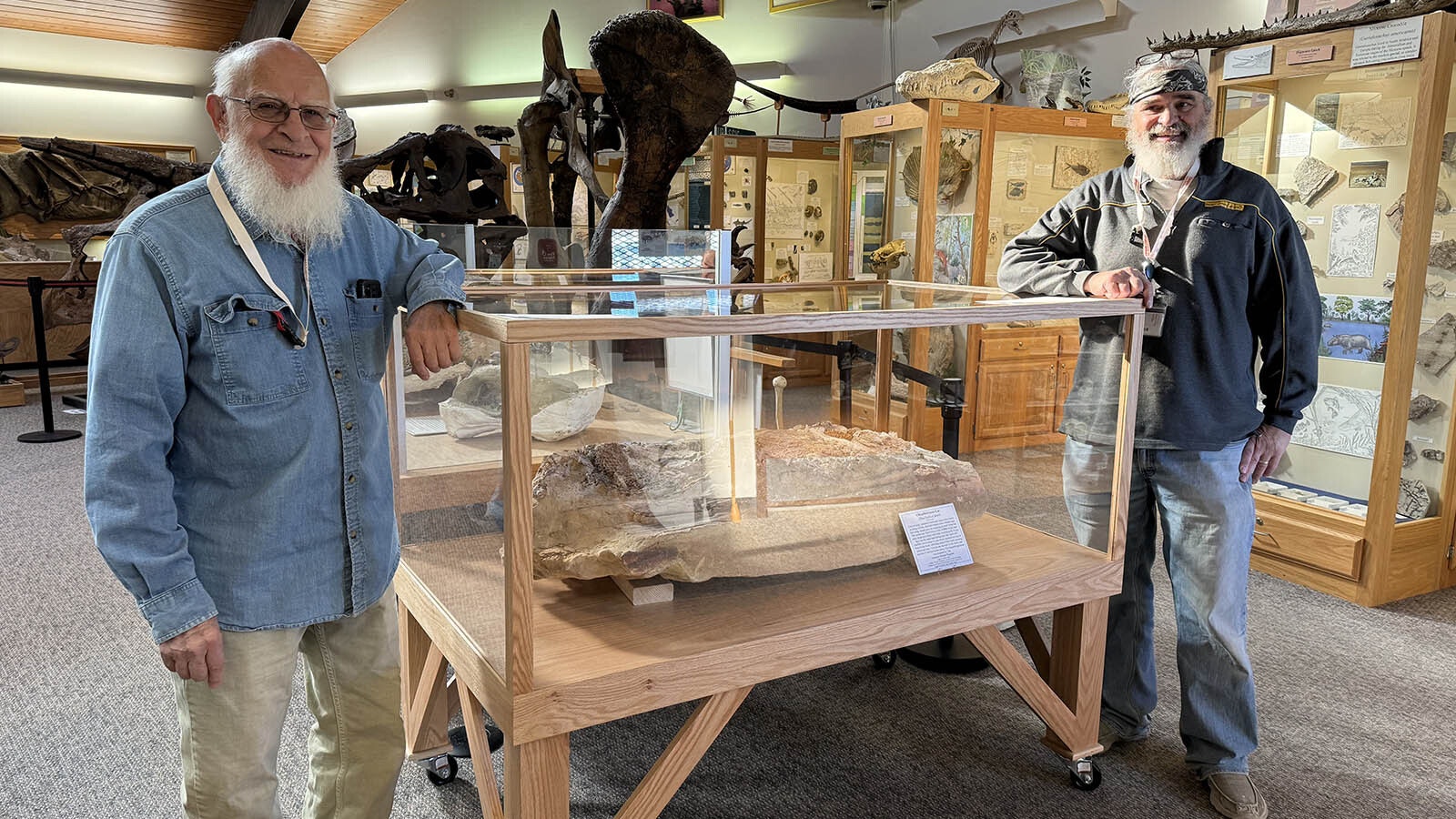
Dwaine Wagoner, left, and J.P. Cavigelli pose with a sandstone block on display in the Tate Geological Museum. Wagoner spent over 200 hours preparing this block that contains four well-preserved skeletons of rotting garfish. (Andrew Rossi, Cowboy State Daily)
Andrew Rossi can be reached at arossi@cowboystatedaily.com.