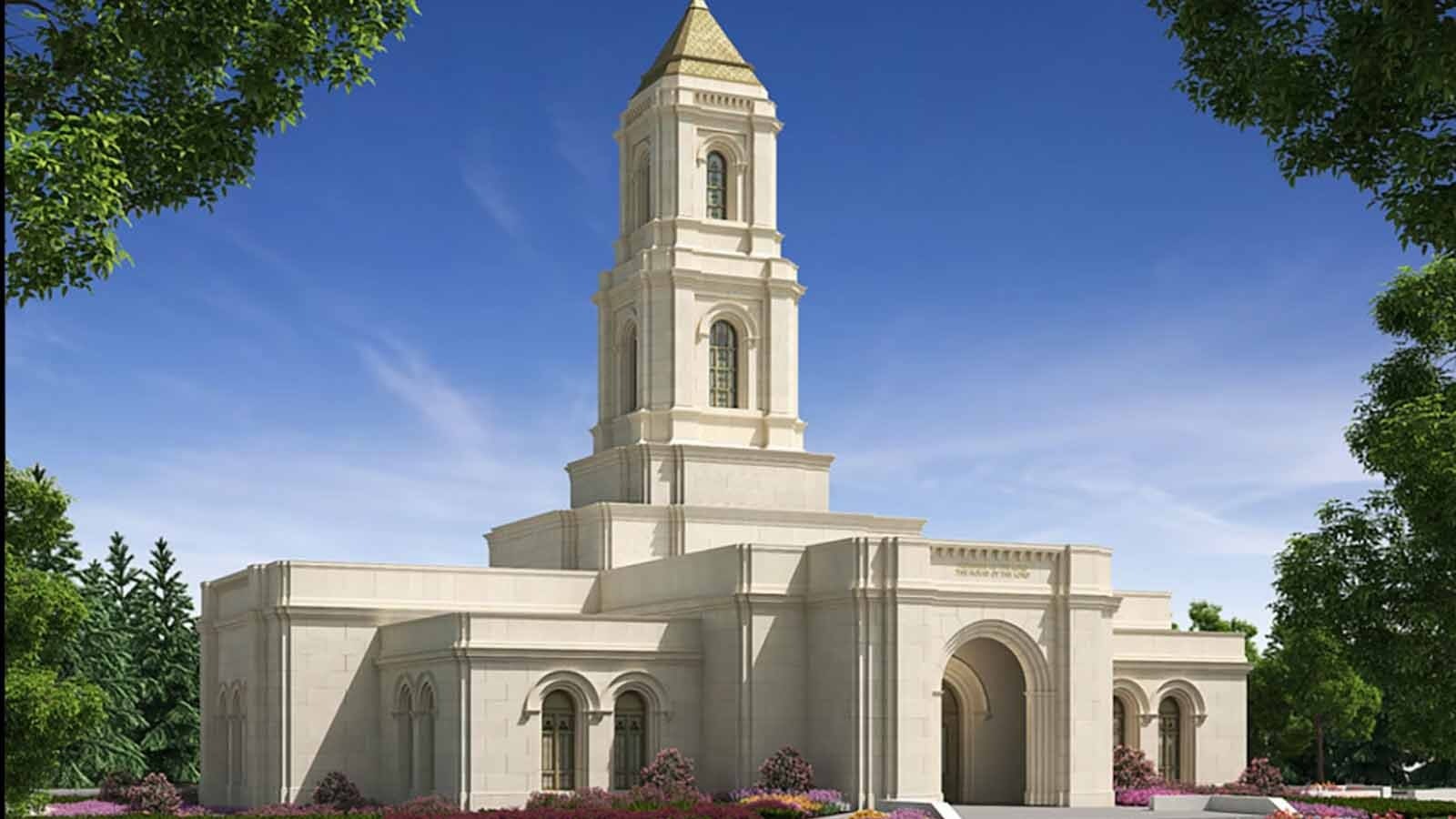
Latter-day Saints have constructed a great mythology with regard to LDS temples and property value. In June, that mythology came to bear on Cody, invoked by proponents of the controversial proposed temple location. But the facts are not as rosy as the stories would have us believe.
Similarly contentious municipal decisions are under consideration in Utah, North Carolina and perhaps elsewhere, with long-lasting and far-reaching effects. The stakes are significant. The truth matters, and the myths must be roundly rejected.
I’m thankful Leo Wolfson’s recent piece created a space for dialogue on the issue. I’d like to rebut a few statements from the piece that reiterate the property value myth, then examine its source.
“One of the few issues those against it haven't raised is how the temple could impact neighboring property values. That may be because …”
Neighbors opposing Cody’s Skyline temple location have indeed raised the issue. It’s not a current focus, but not because they anticipate gains.
First, reliable data suggests values don’t increase. Second, even if they do, increased property values mean higher taxes. But most importantly, the entire proposition ignores “Economics 101.”
Higher values benefit sellers. That’s no consolation for Skyline residents who don’t want to move and aren’t looking to sell. It’s why they’re opposed to this facility in this location: it will materially harm their current quality of life through light pollution, traffic levels that exceed infrastructural capacity and profoundly altered viewscapes.
“The temple in Cody is similar [to Billings], planned for placement in an already existing rural-residential neighborhood …”
While both sites may have “rural” and “residential” qualities, in Cody, as in municipalities across the U.S., “rural residential” isn’t simply a description, but a legal designation with specific restrictions. The area in Billings is not equivalently zoned. Billings’ analogous zone, agricultural-residential, is so restrictive that neither temple would be permissible.
Zoning regulations are a mechanism for protecting property value. They help residents know what to expect from their neighbors. Haphazard application of land use regulations, or outright circumvention as the LDS church is attempting in Cody, leads to uncertainty about permitted uses. Market uncertainty doesn’t increase property values, it destabilizes them.
“[Billings homebuilder Steve Wells] said homes in the neighborhood of the temple are now valued in the $800,000 to $3 million range, while properties of similar size and quality in other parts of the city are closer to $500,000 to $800,000. … In the next neighborhood over, Wells said home values dropped to the $500,000 to $900,000 range.”
If these numbers are accurate, any number of plausible explanations exist. Fortunately, Mr. Wolfson helps readers judge Mr. Wells’ claim for themselves by noting that the area is generally affluent and has various amenities, which may also raise prices. Alternatively, residents in the next neighborhood over might place a negative value on the nearby temple.
Or perhaps, instead of choosing the next neighborhood over from the temple, where prices are about average for Billings, some LDS residents paid a premium of 60% to 230% to live that much closer to the temple. In that case, their higher prices result from the fact the homes were built after the temple. Those happy homeowners had a choice. They didn’t have the neighboring temple imposed on them against their will, unlike Skyline neighborhood residents in Cody.
“A 2003 study by The Foundation for Apologetic Information and Research …”
Steven J. Danderson’s “The Impact of LDS Temples on Local Property Values” is the heart of the matter. It is repeatedly cited by temple proponents as authoritative proof and appears to have singlehandedly generated the widespread misconception that temples raise property values.
Except Danderson claims nothing of the sort. His sole claim is that proximity to a temple does not cause homes to become “unmarketable.”
“… found that in 95% of observations, a temple added between $29,455 and $77,445 to a neighboring property value.”
While Mr. Wolfson accurately quotes this statement, it applies to only one of the three cities analyzed, and the author’s formulation itself is misleading. The data indicate that for any single property, there is a 95% chance that proximity to a temple affected its value within the given range.
This is very different from saying existing properties’ values increase after a temple is constructed nearby. Danderson’s paper only looks at home prices after a temple is built. The most it could show is that when new homes are constructed near an existing temple, those closer might be worth more.
But it’s more likely the data is nonsense, because it also indicates that number of bedrooms, lot size and inflation have no statistically significant effect on observed home prices.
At best, the study shows fairly conclusively that temple proximity has no statistically significant effect on property value. If there is an effect, a nearby temple could lower values by more than $20,000 ($33,800 in today’s dollars). And ultimately, the author's only actual conclusion is that “the presence of [a] temple does not make a house unmarketable,” defined as a decrease of $56,000 ($94,800 today).
Yet one can hardly fault Mr. Wolfson or the many Latter-day Saints who cite this paper as evidence temples increase property values. The paper purports to be written for a lay audience yet contains a dizzying array of poorly explained statistical charts that would require hours of commitment for a lay reader to independently assess.
What’s more, the paper is not a legitimate research study, despite its deceptive appearance. The publisher, FAIR, is an advocacy group exclusively publishing works “that defend the LDS church” (which Wolfson notes). No independent scholars vetted the data. Its sample sizes are indefensibly small, and its mathematical calculations are not repeatable using its own data.
Thank heavens for science. Reliable sources exist. And while supporters of Cody’s Skyline temple location may not be familiar with them, I hope the following might change that.
In 1994, in response to national debates about churches in residential neighborhoods, economists studied a sample more than twice as large as Danderson’s and concluded that proximity to a church likely had a negative impact on home prices.
That conclusion was understandably controversial. With a sample size 20 times Danderson’s, another group of economists refuted the earlier study, concluding churches increased nearby home prices. Notably, they found LDS stake houses had a greater positive impact than churches of other denominations. (Danderson doesn’t mention this, or any other, peer-reviewed research).
Still, neither scholarly study answers the crucial question, the one temple proponents erroneously claim Danderson’s paper proves: Does building a temple near existing homes increase their value?
As luck would have it, economists Eric Thompson, Roger Butters and Benjamin Schmitz studied price effects in Omaha, Nebraska, where a temple was announced in 1999, completed in 2001, and constructed in an existing, stable neighborhood.
“The Property Value Premium of a Place of Worship.” published in 2012 in Contemporary Economic Policy, analyzes a data set 14 times the size of Danderson’s, including price data from 1990 to 2007. It provides unparalleled insight into how construction of a temple affects nearby existing home values.
Thompson, Butters and Schmitz concluded that using only post-temple prices would have mischaracterized the temple’s impact — making it appear that temple proximity caused higher property values (as some believe Danderson claimed). But when including historical data, they found price changes were independent of distance from the temple (as Danderson’s data actually indicated).
When Cody’s Planning and Zoning Board held its public hearing on the temple proposal, supporters offered Danderson’s paper as factual evidence that temples increase property values. At best this misstates the conclusion of a flawed study, and it is contradicted by unbiased scientific research.
The simple truth, for those interested, is that building a temple near existing homes has not been shown to increase their value.
Colin Pitet
Cody