The Bureau of Land Management’s decision to close 317 miles of roads and single-track motorized trails in Utah’s hugely popular Moab region could have implications for similar restrictions in the Rock Springs area, a public land access advocated says.
“Moab sets this huge precedent (for the BLM to say) ‘even if an area isn’t designated wilderness, we can still close roads and create wilderness in a roundabout way,’” Utah resident Simone Griffin told Cowboy State Daily on Tuesday.
Griffin is the policy director for BlueRibbon Coalition, a group that advocates for multiple-use access to federal lands.
The group contends that BLM policy on about 303,000 acres in the Moab region was too heavily skewed toward advocates of nonmotorized use, and that pattern could be repeated in Wyoming and across the West.
“The reasonings for the closures (in Moab) are just outrageous,” Griffin said. “The claim is that motorized use is going to affect river rafters’ experience. The BLM is supposed to manage for multiple use, not just one group’s experience.”
The BlueRibbon Coalition has filed an appeal and a motion to stay the road and trial closures in Moab, she said.

Even E-Bikes Got Shut Out
The Moab closures include roads that have been used “for generations” by visitors, as well as locals such as her family, Griffin said.
Popular motorized single-track trails are also slated to be closed,including routes called “The Tubes” and “Dead Cow Loop.”
“I would say that these are some of the most famous single-track trails in Utah, and possibly even the entire West,” Griffin said.
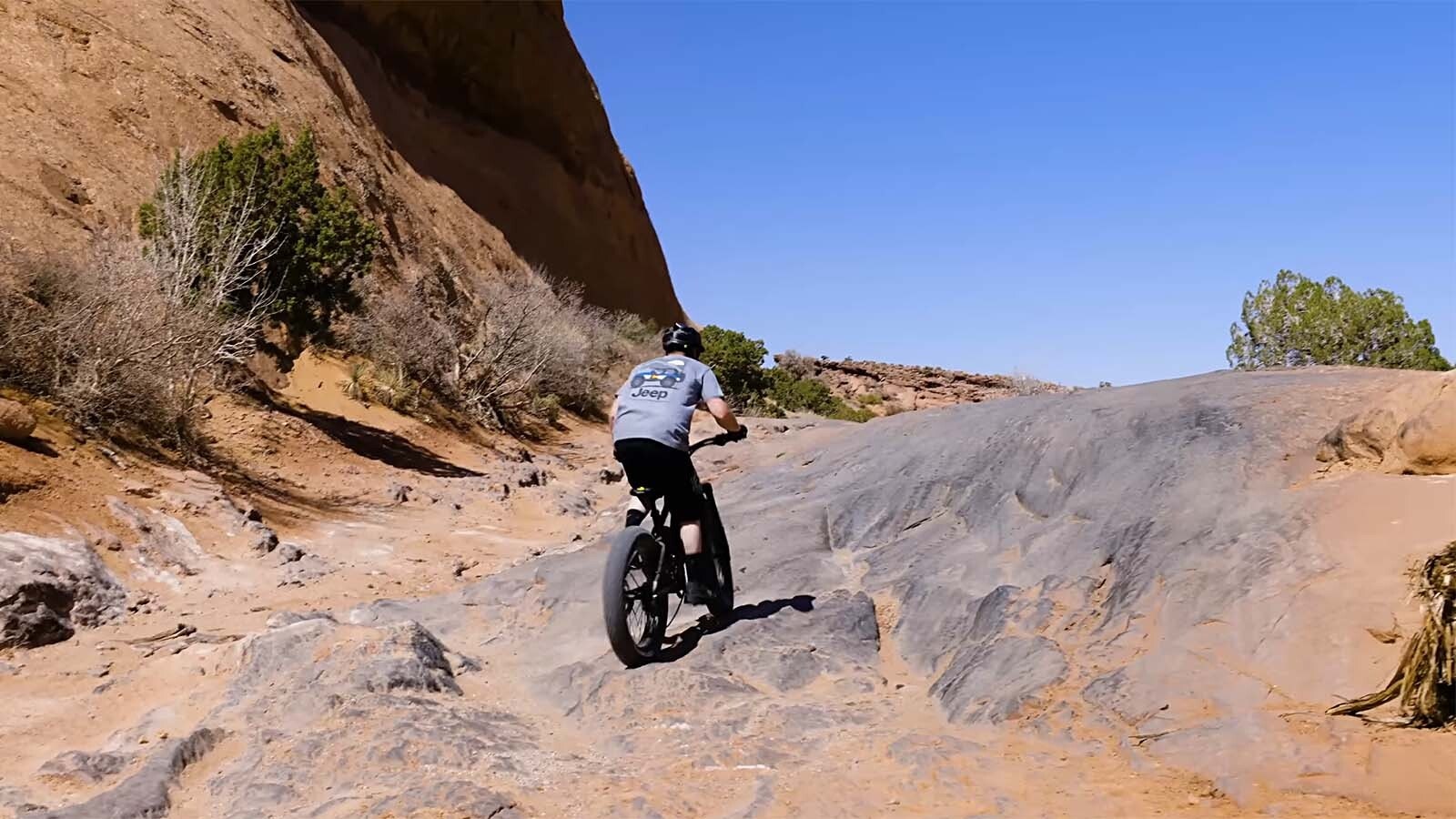
Moreover, the BLM has classified electric bicycles, or “e-bikes” as motorized vehicles, also forbidding them on the trails, she said.
There’s an ongoing debate in Wyoming and across the West over whether e-bikes should be classified as motorized vehicles in relation to their use on public land trails.
Griffin said she thinks they shouldn’t count as motorized vehicles.
“Studies show that E-bikes don’t have any more environmental impacts than human-powered bikes, and yet the BLM classifies them as motorized,” she said.
That can amount to age discrimination, Griffin said.
“Many older people use e-Bikes to continue to enjoy trails,” she said. “The fact is we’re discriminating in limiting the older generations from accessing these trails when there’s no scientific backing for that.”
Bad For The Economy
Recreation on public land is a multibillion-dollar-per-year industry, so shutting down motorized access in Moab, and possibly in Rock Springs,could have a huge effect on local economies, Griffin said.
“Recreation is this massive economic pool, and agencies typically don’t give recreation the status it deserves,” she said.
Limits on recreation could be coupled with the effects of possibly limiting mineral mining, gas and oil and gas development, cattle grazing and other uses in the Rock Springs, she added.
“Just from an economic standpoint, this is going to be catastrophic on local economies,” she said.
The Rock Springs BLM field office oversees roughly 3.6 million acres in Wyoming. The preferred alternative for the draft Resource Management Plan (RMP) designates 1.8 million acres of that as “areas of critical environmental concern” (ACES).
As the BlueRibbon Coalition sees it, the land falling under “ACES” designation could be up for restrictions, including road and trail closures, Griffin says.
BLM officials have stated that the status of roads and trails in the Rock Springs area won’t be part of the current RMP draft. Instead, a “travel plan” for the area will be handled later as a completely separate matter.
The agency also contends that there won’t be any access lockdowns for the 1.8 million acres in question.
‘It’s Just Too Massive’
If the proposed “ACES” designations lead to any restrictions, or the forthcoming travel plan closes roads and trails in the Rock Springs area, such measures might be impossible to enforce anyway, Griffin said.
“The Rock Springs plan is one of the biggest plans. To have something that’s over 3 million acres, that’s too big,” she said. “It’s going to be too hard for the BLM to do something accurate in that large of any area. They will have an enforcement issue. They’re not going to be able to enforce restrictions on that much land. It’s just too massive.”
Sweetwater County Sheriff John Grossnickle has stated that if the current preferred alternative RMP passes, he won’t cooperate with BLM law enforcement in enforcing it.
Mark Heinz can be reached at mark@cowboystatedaily.com.