One of the front-and-center exhibits in Monday’s Rocky Mountain Power rate increase hearing, which is on day four of testimony in what promises to be at least an eight-day marathon, was a resolution from the Joint Corporations Elections, and Political Subdivisions Committee.
It rebukes Rocky Mountain Power’s almost 30% rate increase proposal and calls upon the Wyoming Public Service Commission to hold the utility’s feet to the fire as it reviews the case.
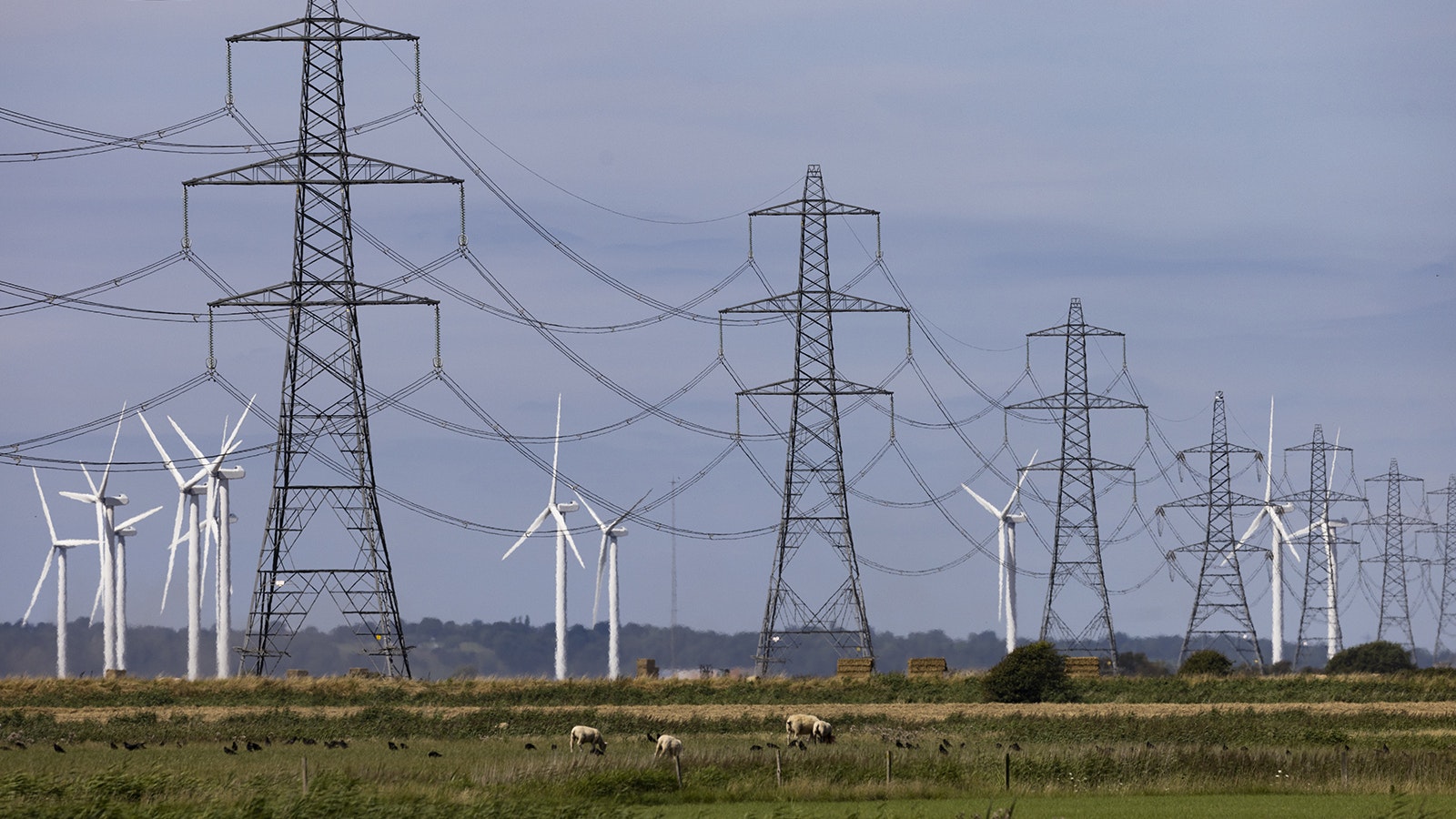
The resolution mentions the ongoing pain of inflation on Wyoming residents, as well as housing costs and the growing inequity between howmuch power Wyoming uses, versus how much it produces for other states. It also decries the impact to Wyoming viewsheds when so many renewable energy assets — primarily wind towers — are popping up across the state in its high-wind corridors.
State Sen. Cale Case, a specific signatory on the resolution, told Cowboy State Daily the company’s in-depth analysis of the issues ahead of it, as provided in the testimony of Rocky Mountain Power Vice President of Resource Planning, Procurement and Optimization Rick Link, were eye-opening.
“He was talking about modeling the most unlikely scenario, which would be there’s a carbon tax of zero, which is equivalent to John Bear’s view of the world that, you know, where he’s criticizing the governor for even entertaining thoughts that carbon will be some kind of problem,” Case said. “And the company has dialed in some pretty significant impacts of carbon regulations that forced them into these new ways of doing business.
“And I just thought, ‘Wow.’ I mean, there’s a story there about two different views of the world.”
Five Carbon Price Scenarios
Link’s testimony detailed how the company fares in five carbon price scenarios, including what he said is the least likely scenario — zero costs for carbon.
Earlier this year, the Wyoming Public Service Commission issued a memorandum that said costs for federal or state carbon taxes not a measurable standard, and shouldn’t be used for resource planning.
That was pointedly highlighted during cross examination.
Link said the company’s carbon cost metric is more complicated than just measuring the specific costs of carbon. It includes likely federal regulations that are ahead, like limits on nitrous oxides or NOx emissions, or sulfur dioxide emissions.
“Whatever the emittent might be, this could really cover a wide range of outcomes,” he said. “We really don’t try to forecast what the specific policy itself might be.”
Instead, the metric takes in all the market trends, all the tools available to federal agencies like the EPA. All of that suggests higher costs ahead for the use of fossil fuels.
Prudence demands planning for that, Link said, regardless of political ideologies.
Among rules that have concerned the company recently was an Ozone Transport Rule that was ultimately stayed in Utah and removed in Wyoming.
That was a welcome reprieve, Link said, but there’s already more ahead.
“EPA has since issued a different rule to take effect in the 2030s,” he said.
Link calls it the greenhouse gas rule, but it’s part of the Clean Air Act, and would limit output from coal facilities.
Coal facilities, however, aren’t the only power plants facing obstacles.
“Hydrofacilities are limited by water in a particular season or year, depending on the asset,” Link said.
And relicensing processes often open a door for even more constraints.
Talking About Reliability
Renewables are making Wyoming’s energy grid more reliable at very low costs — significantly lower than other alternatives available to the company, according to the scenarios Rocky Mountain Power examined, including the zero-carbon cost, Link said.
Rocky Mountain Power isn’t planning for a scenario where it would need to reverse the direction of power flow due to an outage, but the new transmission lines being built to carry renewable energy could enable that, if it were ever needed.
“It’s pretty difficult to quantify and assume would happen in a 20-year forecast going forward,” he said. “Nonetheless, they do provide pretty substantial reliability value across the board.”
Without the gateway transmission line projects, Link said the analysis shows the company would have to rely more often on getting power from the market at higher cost.
But PSC Chairwoman Mary Throne pointed out the Corporations Committee’s resolution, which she said “represents skepticism on the part of one committee as a Legislature that the transmission projects, and I’ll just focus on those, provide any value to ratepayers in Wyoming.”
Constrained System
Link’s response took a deeper dive into power constraints the company has been experiencing on the grid.
“I think we’ve testified across the company with many witnesses that this part of our transmission system is, and has been, a constrained element of the grid for any number of years,” he said. “And that has resulted in limitations for Wyoming to continue to move or for us to move power out of that part of the state.”
It’s also led to inefficiencies in how the grid is operated, something that the new transmission lines will alleviate.
“It allows for more output that’s got no fuel cost, that has a production tax credit value that we pass back through to customers — essentially negatively priced energy — for at least the PTC window over the years, plus it allows for more output of Wyodak and Dave Johnston in the event that we can rely on those facilities. That provides a substantial value to Wyoming customers.”
More than that, however, with the need for resources growing of late, Link said the company has gone through multiple summers where it has “run up against the wire” when it comes to providing the power that customers needed in Wyoming.
These were brought on by what Link said were “abnormal weather conditions” in the service territory and throughout the Western region.
“We were challenged on some pretty key days to ensure we had sufficient supply,” he said. “Had these resources not been procured and were available to us, I don’t know how those days would have turned out. But they were already stressful enough.
“I couldn’t imagine losing another 1,000 or so megawatts or whatever was operating in those windows from those resources. So, highly valuable.”
Given that carbon dioxide prices are more broadly reflecting what’s going on in the world around Wyoming, Link said he believes the company’s renewable assets have even more value for continuity of service in Wyoming.
“We have been a participant in the Western Energy and Balance Market since 2014,” he said. “And we are anticipating broadening participating in a broader, enhanced day-ahead market, or EDM, where these kinds of day-ahead and broader regional benefits of these types of assets will only add even more value than we’ve been able to capture in our analysis.
“Anecdotally, when I look at how the planning environment or the world around us has evolved since we’ve been making these decisions to build transmission, and you pair that with zero fuel cost, PTC eligible resources are all lining up. In my view, at least, the majority of items are lining up to suggest the value is being realized, not coming in higher than maybe we would have anticipated.”
Summer Power Crunches
Case told Cowboy State Daily he was surprised to hear how close the company had come to a scenario where it might not be able to supply enough power to its customers.
“I’ve never heard him quite say how close it was,” Case said. “But he also said in developing projects and rehabbing coal plants that they’re having trouble finding financing for those things.”
Case was also interested in the part of Link’s testimony that pointed to high temperature events as part of the cause of issues delivering power.
“The guy admitted it,” Case said. “The guy just admitted it. But the trouble is, in that scenario, with these new transmission lines to Wyoming and wind coming on in Wyoming, the wind may not be blowing on those days. And it’s likely hot days and very cold days (that) they tend not to.”
Shutting down all coal plants, though, isn’t a viable solution, Case added, and not something Wyomingites will support.
“I have some climate concerns, but I don’t buy the climate hysteria that says we have to rush into closing coal plants in three, four or five years and bring on a technology that has no storage,” Case said. “They can’t deliver energy and, when it doesn’t deliver energy, people die.”
Case also is concerned about how Wyoming appears to be shouldering a disproportionate share of renewable infrastructure like wind towers to provide renewable power to other states. The proliferation of so many wind towers could have an impact on the viewshed that so many tourists mention and value in their travels to the Cowboy State.
“If you have a populated state to the west of us, and you have political influence, you might prefer to put it in the least populated state,” Case said. “At least with the most federal land and with a friendly administration that wants to see it develop, because you can’t do it in your own.”
But Oregon, Washington and California with their coastlines, all have areas that could be fantastic wind resources, Case added, suggesting it shouldn’t all be on less-populated Western states to provide.
Renée Jean can be reached at renee@cowboystatedaily.com.