Witnessing an eruption of Steamboat Geyser is on the bucket list of many Yellowstone National Park visitors.
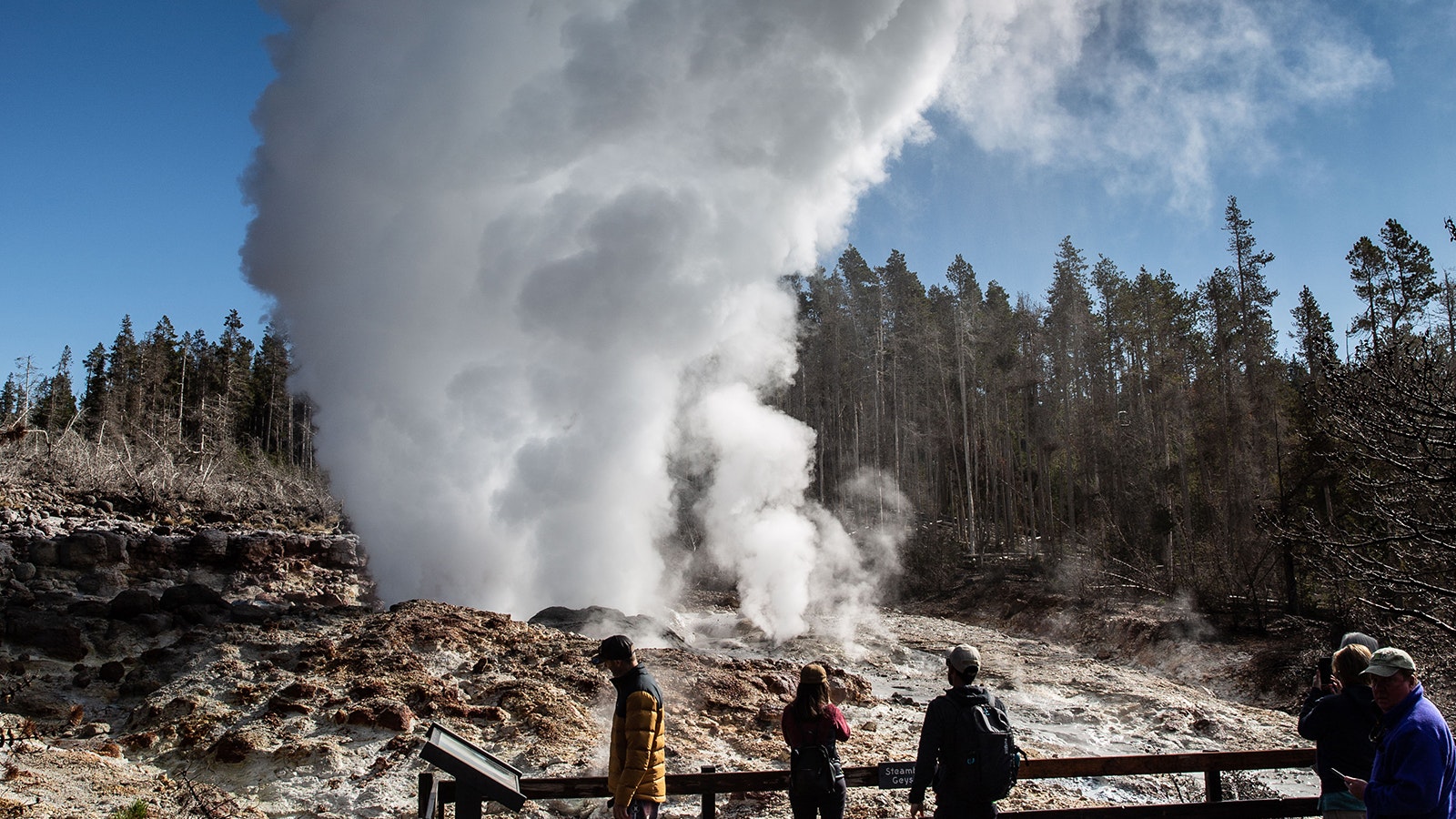
Kathleen Rynkiewicz-Stuby was lucky enough to cross that one off last weekend when the world’s tallest active geyser violently spewed hot water and steam up to 400 feet into the sky.
Rynkiewicz-Stuby captured video of the irregular event. It shows a column of steam being forced out of the geyser, with a sound reminiscent of a jet engine.
Steamboat Geyser is the undisputed king of the Norris Geyser Basin and is in its most active period in recorded history. Unlike the predictable Old Faithful, visitors have to be extremely lucky to see Steamboat in all its glory, but there are signs to look for that can improve those chances.
Water And Steam
Mike Poland, a research geophysicist with the Cascades Volcano Observatory and the scientist-in-charge of the Yellowstone Volcano Observatory, confirmed that Steamboat Geyser erupted at 2:46 p.m. Oct 8. He said Rynkiewicz-Stuby’s video was taken during the second and much longer phase of a typical Steamboat eruption.
“Steamboat behaves in an interesting way,” he said. “The first few minutes of the eruption are what we call ‘the water phase,’ when you have water shooting out, going 300 to 400 feet high. After 10 to 30 minutes, the geyser starts to enter ‘’the steam phase,’ which can last up to 24 hours with diminishing intensity.”
Poland has witnessed the steam phase of a Steamboat eruption and described “the roar” of the steam as it’s forced out of the geyser’s plumbing. The steam phase served as a timestamp for the video, showing it must have been filmed not too long after the water phase ended, given the intensity of the steam.
“The water phase is spectacular, but the steam phase is no less spectacular,” he said.
Steamboat Isn’t Faithful
Each geyser in Yellowstone has its own personality and timeline for eruption. Unlike Old Faithful, Steamboat Geyser erupts on its own erratic schedule, and nobody knows why.
Poland says part of the reason Steamboat is so erratic could be that it hasn’t isolated itself, like Old Faithful and the Lone Star Geyser. Its unpredictability makes it a typical geyser.
“There are some suggestions that geysers that are very isolated will have a more periodic or predictable behavior. Old Faithful is pretty isolated from its surroundings and erupts very reliably. Most geysers tend to be more erratic and some, like Steamboat, are completely random,” he said.
It’s another possible explanation for the frequency of eruptions, but scientists don’t know enough to definitively answer “the $64,000 Question,” as Poland puts it, of how geysers work and the differences that make Steamboat erratic and Old Faithful timely.
When will Steamboat erupt next? Anyone can wait for its next eruption, as it could happen at any time. It could also could take several years.
An Active Period
Fortunately for geyser enthusiasts, Steamboat is more active now than at any other point in recorded history. The Oct. 8 eruption was the seventh recorded in 2023, 43 days after its last eruption on Aug. 25.
Before 2018, the average period between Steamboat eruptions was two years. Then, the geyser erupted 32 times in 2018 and another 48 times in 2019 and 2020.
Poland says Steamboat has scattered periods of frequent eruptions. One was recorded in the 1960s and another in the 1980s. Despite intense research and observation of Yellowstone National Park and its geysers, the reason for these high-activity periods is a mystery.
“There was a study done earlier this year that tried to answer that question,” he said. “They looked at rainfall data, earthquake data, groundwater levels, the chemistry of the subsurface, and thermal emissions. And they saw nothing that would suggest that anything had changed.”
Another possible explanation for the frequent eruptions is a change to the geyser’s plumbing.
“Something about the hot water plumbing system changed. Maybe a new conduit opened up, or some other conduit necked down a bit, allowing pressure to build to feed more frequent eruptions. We don’t really know the answer to that question yet,” he said.
Despite the shows Steamboat has been giving visitors, that time may be ending. The frequency of Steamboat’s eruptions has been diminishing in the last few years. There were 20 eruptions in 2021 and 11 in 2022. Poland says they’ll be lucky to see 10 eruptions by the end of 2023.
Nobody knows why the eruptions peaked in 2019 and 2020 and have been tailing off since. Still, 10 eruptions in one year is better than waiting two years or longer. Steamboat has gone over a decade between eruptions before.
“If you told anyone in 2017 that we’d have 10 eruptions in one year, people would think that’d be spectacular. Unbelievable. But now we’re like, ‘10 eruptions a year? That’s disappointing.’ I suppose it’s all relative,” Poland said.

How To Spot Steamboat
There isn’t a giant countdown clock for Steamboat Geyser, and there likely never will be. But Poland says there are telltale signs an eruption is imminent.
“The signs (to look for) are an increase in minor activity. As an eruption gets closer, it will start having minor water eruptions. A few feet or maybe tens of feet. Those will become more and more frequent until they’re nearly continuous,” he said.
That said, promising signs of an imminent major eruption don’t provide a timetable. Steamboat’s minor eruption activity can continue for days or weeks. Before the Oct. 8 eruption, several significant water eruptions stretched over several days before the sustained 15-minute water phase eruption.
“Over the course of the last five years, we’ve seen time periods where the minors have lasted hours, and we’ve seen them last over a month. The geyser’s just playing and playing, and then it finally has its major eruption,” he said.
Steamboat is also known to drain the nearby Cistern Spring during its major eruptions, as its water gets sucked into the geyser’s plumbing and erupts out of it.
Following the right cues doesn’t guarantee a viewing, but there’s always a chance to get lucky.
“If you go to Steamboat and you see constant splashing, that means we’re probably getting close to a major eruption,” he said. “But if you don’t see any minor eruptive activity or a splash every few minutes, we’re pretty far away.”
Poland shared another sign to look for when trying to see a Steamboat eruption: covered cars in the Norris parking lot.
“The prevailing wind direction usually sends the geyser’s spray toward the Norris parking lot. The water silica mud can really mess up paint jobs and windshields. There are some people who love watching geysers and spend a lot of time at Norris. If you go to the Norris parking lot and see a bunch of cars with car covers, maybe Steamboat’s starting to act up and could ramp into a major eruption soon,” he said.
Will Yellowstone Blow?
Whether it’s an earthquake or a noticeable change in a thermal feature, anything that happens below the surface of Yellowstone becomes more evidence for the sensational idea that Yellowstone, one of the world’s largest volcanoes, is close to an apocalyptic eruption.
With so much activity at the world’s largest geyser, that could be the most ominous sign the big blowup is coming soon. Are Steamboat’s erratic eruptions heralding impending doom?
No.
“The activity at a single geyser has nothing to do with the volcanic system,” Poland says. “The hot water plumbing systems are not directly connected to the system.”
Most of Steamboat’s plumbing is within a few hundred feet of the surface. That’s shallow in geological terms and far too shallow to reach into the depths of Yellowstone’s churning magma chamber.
“If that were responsible, we would expect park-wide changes and a lot more than just a single geyser,” Poland said.

The Notoriety Of Norris
Steamboat Geyser might be the most dramatic and temperamental thermal feature in Yellowstone, which means it often overshadows the remarkable basin it resides in. The Norris Geyser Basin is notable for being one of the most unique geyser basins in the world.
One trend amongst geyser basins is staying on one side of the pH scale. Old Faithful and the Lower Geyser Basin are on the neutral-basic side of the scale, which tends to produce vivid colors like those seen in Grand Prismatic Spring, which is also neutral-basic.
Meanwhile, Mud Volcano and its neighboring thermal features are on the acidic side of the scale. Poland says any thermal feature with bubbling mud, like the Artist's Paint Pots, is usually acidic (although most aren’t any more acidic than orange juice.)
Norris Geyser Basin, in contrast, has features on both sides of the pH scale. Steamboat Geyser is basic, but the Echinus Geyser, only a short walk away, has the same mild acidity of vinegar.
“Usually, you only see one type or the other. Norris has both,” Poland said. “Norris is an incredibly dynamic thermal area that changes more than any other thermal area in the park. It has a lot of heat; it’s one of the hottest areas of the park in terms of the temperature being emitted and has this mix of compositions.”
Perhaps the ever-changing nature of Norris can partly explain the erratic changes of Steamboat Geyser, but getting a definitive answer won’t change its personality. It takes more luck than patience to witness a major Steamboat eruption, which might be part of the reason it remains one of the most beloved features of Yellowstone National Park.
Andrew Rossi can be reached at arossi@cowboystatedaily.com.