Millions of Americans will be staring at the sky Saturday as an annular eclipse will be visible across the country. In Riverton, a small group of college students is collaborating with NASA to research the celestial event.
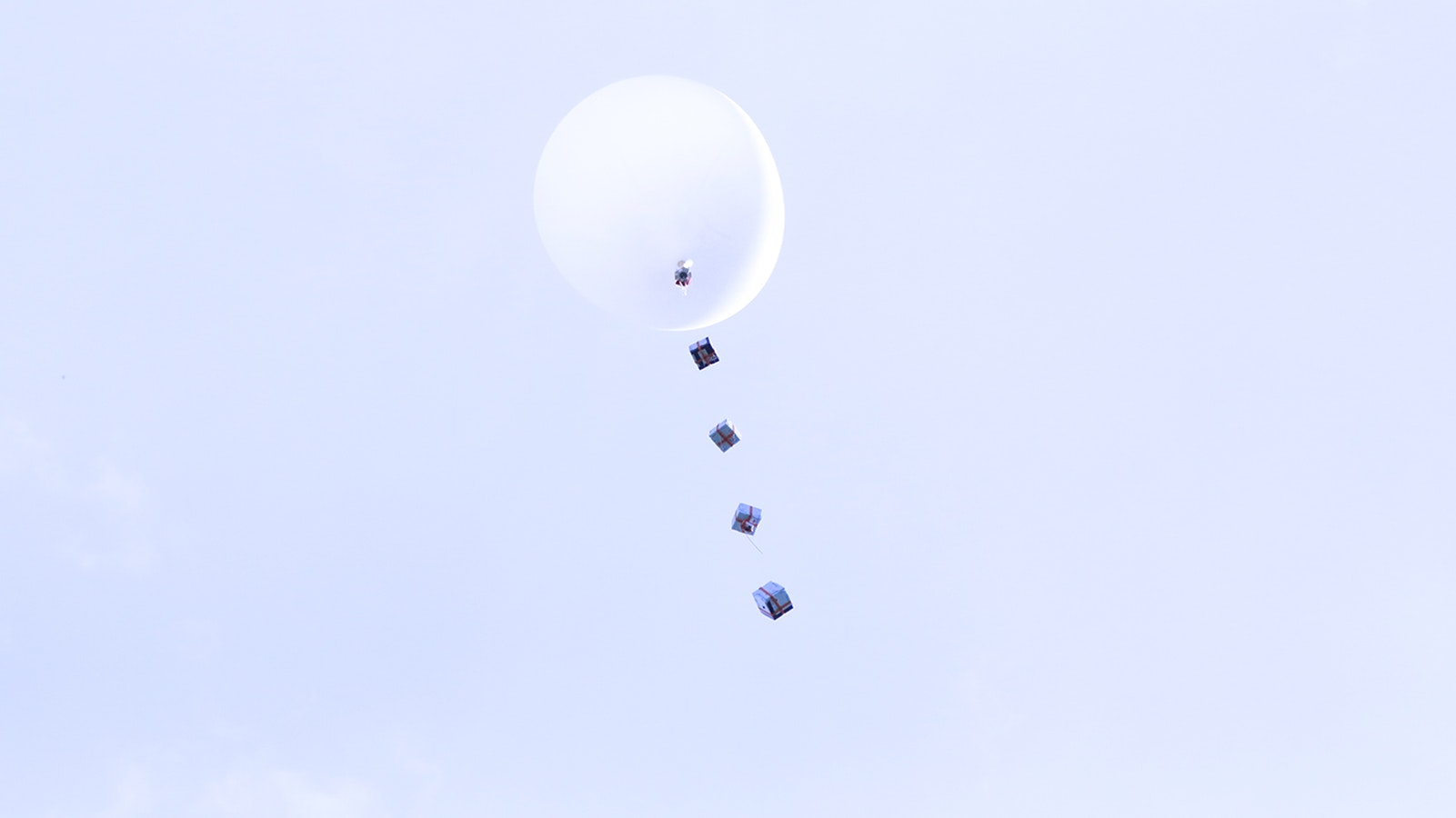
Central Wyoming College professors Bill Finney and Kate Patterson are mentoring a group of five students in a joint research project with NASA and Montana State University. During Saturday’s eclipse, the students will launch a balloon to capture video and scientific data that will contribute to an ongoing study of solar eclipses.
The study gives the students a chance to contribute to a significant scientific research project and experience (and something cool for their résumés) they can carry with them wherever they go.
Up And Down
Patterson, an assistant professor of mathematics at CWC, says Saturday’s experiment is part of the Nationwide Eclipse Ballooning Project, funded by NASA and the National Science Foundation. The experiment will gather data for a hypothesis that solar eclipses make gravitational pressure waves in the Earth’s atmosphere.
“The change in pressure waves track across the sky like ripples in a pond,” she told Cowboy State Daily. “We’re one of about 50 atmospheric and engineering teams funded by NASA to launch high-altitude balloons along the eclipse path trying to capture this (phenomenon) with all these balloons and prove it’s actually happening.”
Patterson’s students are “the worker bees” of an engineering team. Their balloon will carry a technology payload that will collect data on the balloon’s location, any movement it experiences, temperature and record video.
Once launched, the balloon will rise more than 17 miles above the Earth’s surface, gathering information as it goes. After staying at that height for a few hours, it will freefall back to the ground where its payload can be collected.
“Being able to see the eclipse while (the balloon) is 20 kilometers above the earth is pretty awesome,” Patterson said.

No Cost For Curiosity
The process started with a collaboration between the mathematics departments of CWC and Casper College.
Students from Casper College participated in the same experiment during the 2017 total eclipse. They recommended that CWC apply for a NASA grant to launch a high-altitude balloon during this year’s annular eclipse.
“(NASA) was specifically looking for younger researchers,” Patterson said. “They didn’t want upper-level undergraduate and graduate students as much as first- and second-year students, so they targeted community colleges. Casper College said, ‘We’re doing this and think you should too.’ So, we did.”
NASA awarded CWC a grant to prepare its high-altitude balloon and provide all technology for its payload. Moreover, Patterson said the grant is flexible enough that students could create their own experiments and do additional launches to collect data.
“In geology, you can take a core sample and see the different layers,” she said. “We get to travel through the air and see all the different layers and, depending on what equipment we have on (the balloon), the composition of those layers. We could look for plastic particles in the atmosphere or chemical distribution in the air. It’s up to them.”
The only cost CWC would need to cover is the helium to launch the balloon.
Student Decisions For Student Futures
Two of the five students participating in Saturday’s experiment are full-time CWC students. The other three are in concurrent enrollment, meaning they take college-level classes while still in high school.
“They’re hooked,” Patterson said. “This is intentionally a student-led project where they make the decisions. When to launch, what makes sense, analyzing results. They’re asking thought-provoking questions.”
Patterson and Finney, an assistant professor of chemistry and physics at CWC, are also learning. Both have Ph.D. degrees in their respective fields, but not specifically in the science that’s part of the NASA study.
“Bill and I don’t know any more than the students do. It’s about them,” Patterson said.
Patterson said the tactile experience is especially beneficial to the students. Her first experience with research was reading a lot of books as part of an undergraduate project. That eventually led to her doctorate research, which led to math modeling and living in New Zealand for three years.
The balloon project allows students to experience “the whole process” of research and scientific inquiry at the beginning of their college careers. Patterson knows that firsthand experience will do more than anything else to hone their perspectives on the scientific process.
“As an undergrad, it’s really hard to imagine what research might be,” she said. “It’s a foreign concept that seems like it’s just more studying. With this study, you get to ask questions and get these hair-brained ideas, and you’re not in the structure of a classroom, stuck with a curriculum set up before the class even started. It’s so much more interactive and exciting (and) a lot more exciting than reading a book.”
Regardless of what careers the students decide to pursue, one undeniable benefit of participating in the research is the networking they’ve already started. Patterson knows that will help them stand out wherever they go.
“They can say on résumés and future college applications that they’ve worked with NASA,” Patterson said. “They worked on a big group project. They’ve done research. And it develops connections outside of (CWC) for them. Academia works like a friendship network. This study makes (them) a little more connected for what’s next.”

Onward And Upward
The NASA experiment for Saturday’s annular eclipse won’t be the end of the process for Patterson, Finney and the CWC students. Next spring, they’ll repeat the experiment for a total eclipse crossing the eastern half of the United States on April 8.
“We will travel to Idabel, Oklahoma. It’s two days' travel to get there, but it's on the eclipse path,” Patterson said.
In the meantime, the rise and fall of the CWC high-altitude balloon will be livestreamed on YouTube. Viewers can see the annular eclipse from the 17-mile height the balloon will reach that morning from two 190-degree cameras on the balloon’s payload.
“The livestream will start around 9 a.m. and run for a few hours,” she said. “You’ll see the launch at 9:15 a.m., the lift up to the stratosphere, the eclipse, and then it will fall back to Earth. There won’t be any sound — just a lot of pretty pictures.”
It will be a memorable experience for everyone, especially for the CWC students participating in the Nationwide Eclipse Ballooning Project. For Patterson and Finney, that’s the most fulfilling part of the experiment.
"Our success isn’t the result of the project,” she said. “It’s the result of the student experience. They have the most to gain from it.”
Andrew Rossi can be reached at arossi@cowboystatedaily.com.