Grizzly bears may be the apex predators in Yellowstone National Park, but they weren’t always.
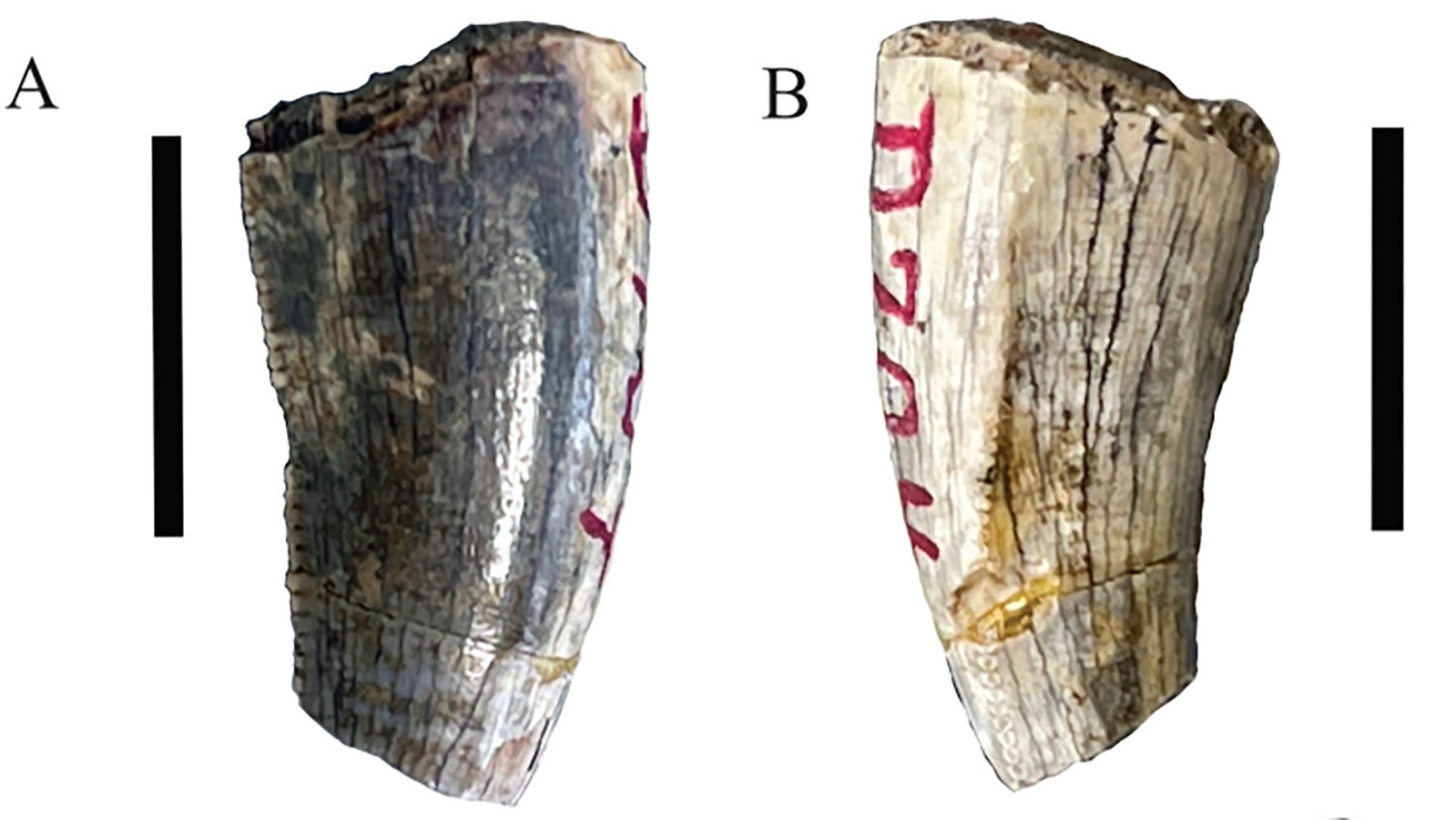
A new scientific paper published in the journal ResearchGate has identified a dinosaur fossil found in Yellowstone National Park as a tooth from a juvenile Tyrannosaurus. This makes Tyrannosaurus the first, but not the only, dinosaur that once called the nation’s first national park its home.
Discovered And Rediscovered
Dr. Matt Carrano is curator of dinosaurs at the Smithsonian Institution in Washington, D.C. He was one of the authors of the paper announcing the discovery of Yellowstone’s Tyrannosaurus from a single tooth found inside Yellowstone National Park more than 50 years ago.
U.S. Geological Survey geologist Joseph Leonard Weitz found the tooth in 1966 as part of a geologic team mapping Big Game Ridge near Mount Hancock in the southeastern corner of Yellowstone. Carrano said while many geologic surveys explored Yellowstone, there wasn’t much expertise or interest in fossils.
“People were out exploring in general or trying to understand the basic geology,” Carrano told Cowboy State Daily. “Along the way, they would stumble upon fossils, which they would collect.
“Usually, they’d make a brief note, ‘We found a tooth of a dinosaur,’ and then it goes into the geology collection and oftentimes gets overlooked. This is a great opportunity to rediscover it in the collections of the museum.”
The rediscovery of Yellowstone’s first dinosaur started when fossils from the U.S. Geological Survey were moved from a facility in Colorado to the Smithsonian’s collections. The fossil had been noted in a few geologic papers since it was discovered, but it had been misidentified or barely mentioned.
As Carrano and his team went through the newly acquired USGS collection, they were looking for the tooth. Once it was located, a team of paleontologists set out to redescribe the tooth and determine which dinosaur it belonged to.
“This is the first identifiable dinosaur fossil from Yellowstone that we are aware of,” he said.
Yellowstone’s Tyrannosaurus
While the USGS geologists might not have been interested in studying Yellowstone’s dinosaurs, Carrano said they thoroughly studied the rock layer where the fossil was found.
The Harebell Formation is roughly 68 million years old, from the very end of the Late Cretaceous Period.
“We’re getting into the time period where they don’t know that the asteroid is coming, but the asteroid is coming,” Carrano said.
The Harebell Formation isn’t exclusive to the park, but there have been no extensive excavations or complete skeletons found inside Yellowstone. Excavations in the same layer outside Yellowstone have produced fossils from horned dinosaurs, duck-billed dinosaurs and other animals that lived in Cretaceous Wyoming, like crocodiles and fish.
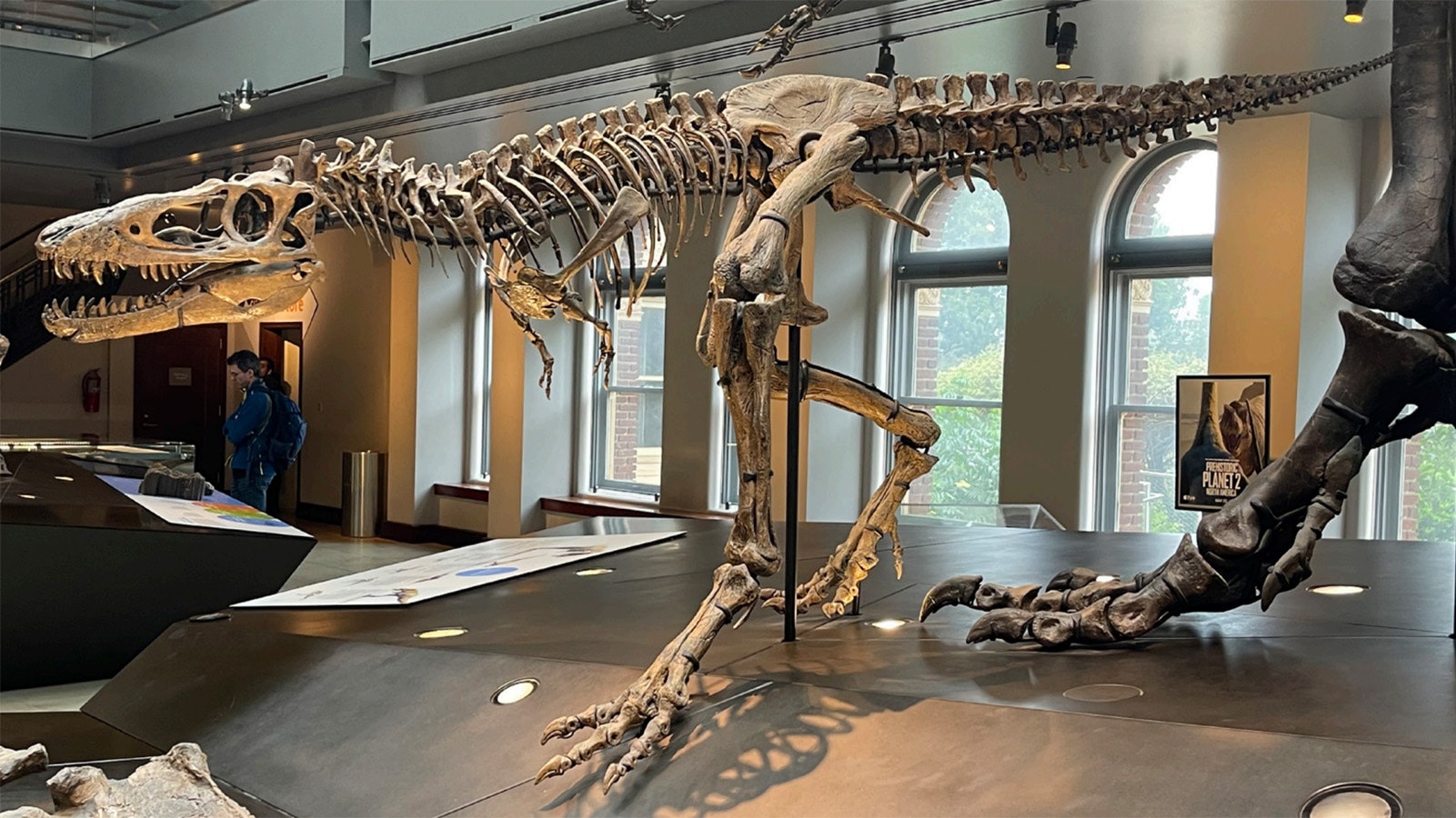
The tooth is only a few centimeters, but the teeth of tyrannosaurs are distinct. The paleontologists knew the tooth came from a tyrannosaur based on its shape and proportions, and the size determined the tooth came from the end of the snout of a young tyrannosaur.
The current scientific interpretation of North America at the end of the Cretaceous Period shows there was only one type of tyrannosaur roaming around 68 million years ago. For Carrano and other paleontologists, that leaves little doubt over the owner of the tooth.
“Most dinosaurs were only around for a couple of million years,” he said. “T.rex is very typical of the end of the Cretaceous. This is just a tooth, but it does have all the features of a tyrannosaur tooth. Because there’s only one tyrannosaur around at the end of the Cretaceous, we felt pretty comfortable referring this to Tyrannosaurus.”
The powerful symbolism isn’t lost on Carrano. Tyrannosaurus is the world’s most famous dinosaur, only found in North America.
“It’s a very appropriate first dinosaur for America’s first national park,” he said.
Bringing Dinosaurs Back To Yellowstone
Carrano and the other paleontologists who worked on the paper are still going through the USGS fossils, where they might find more from Yellowstone’s dinosaurs. But there is also a fervent desire to find more dinosaurs in the park.
“People haven’t looked very much, and they have found things. That’s a good sign that it’s productive. Two of my co-authors made an attempt but weren’t able to reach the spot. It’s a little out of the way, so it’s a commitment to get to where these exposed rocks are. But they seem pretty enthusiastic about giving it another go,” he said.
Those co-authors are John-Paul Michael Hodnett, a paleontologist and program coordinator for M-NCPPC Dinosaur Park in Prince Georges County, Maryland, and Vincent Santucci with the Geologic Resources Division of the National Park Service.
The Smithsonian Institution is full of Wyoming dinosaurs, including the first real-fossil skeleton of Triceratops assembled and mounted for display. Carrano sees the discovery of Tyrannosaurus in Yellowstone as a testament to the fantastic paleontological legacy of the state.
“Wyoming has a pretty incredible dinosaur fossil record. Some of the earliest discoveries of T.rex were from the eastern end of the state near Lusk and Newcastle. The whole state is bracketed by discoveries of this animal,” he said.
There are undoubtedly more dinosaur fossils in Yellowstone National Park, which presents a unique chance to add a new icon of nature to the nation’s most iconic national park. Carrano sees this small tooth as the first step toward bringing dinosaurs back to Yellowstone.
“You don’t think of fossils when you think of Yellowstone,” he said. “But it has incredible geology, not just the geysers. There are rocks of all ages in the park. It’s nice to remind visitors and even scientists that this is a place where we can be making these discoveries.”
Andrew Rossi can be reached at arossi@cowboystatedaily.com.