The most definitive sign winter is near in Wyoming isn’t what the Farmers’ Almanac says or grandpa’s trick knee, like the first robin of spring, it’s the first snowman in Yellowstone.
September is one of the best times to observe wildlife in Yellowstone National Park as the park’s animal menagerie prepares for the long winter ahead. It’s also growing colder, which means snow is possible at any time, especially at the park’s highest elevation areas.
There is one thing people don’t see much of in Yellowstone at this time of year, even though it’s observed in its native habitat and isn’t unusual to see in September. A photographer managed to get a rare photo of an early season Sylvan Lake snowman.
Spontaneous Snowman
Heidi Pinkerton lives in Minnesota, but visits Yellowstone National Park several times a year. Her 23-month-old dog has already visited the park three times.
Pinkerton was driving past Sylvan Lake on a snowy morning Saturdaywhen she stopped to give her dogs a brief walk. That’s when she spotted a tiny snowman being built near a pullout.
“I saw a family building a snowman,” she told Cowboy State Daily. “A mom, a dad and two kids in their late teens. Some of them were in shorts. I asked them if they wanted a family picture with their snowman. They said, ‘No, we’re from Maine. Our snow is coming.’”
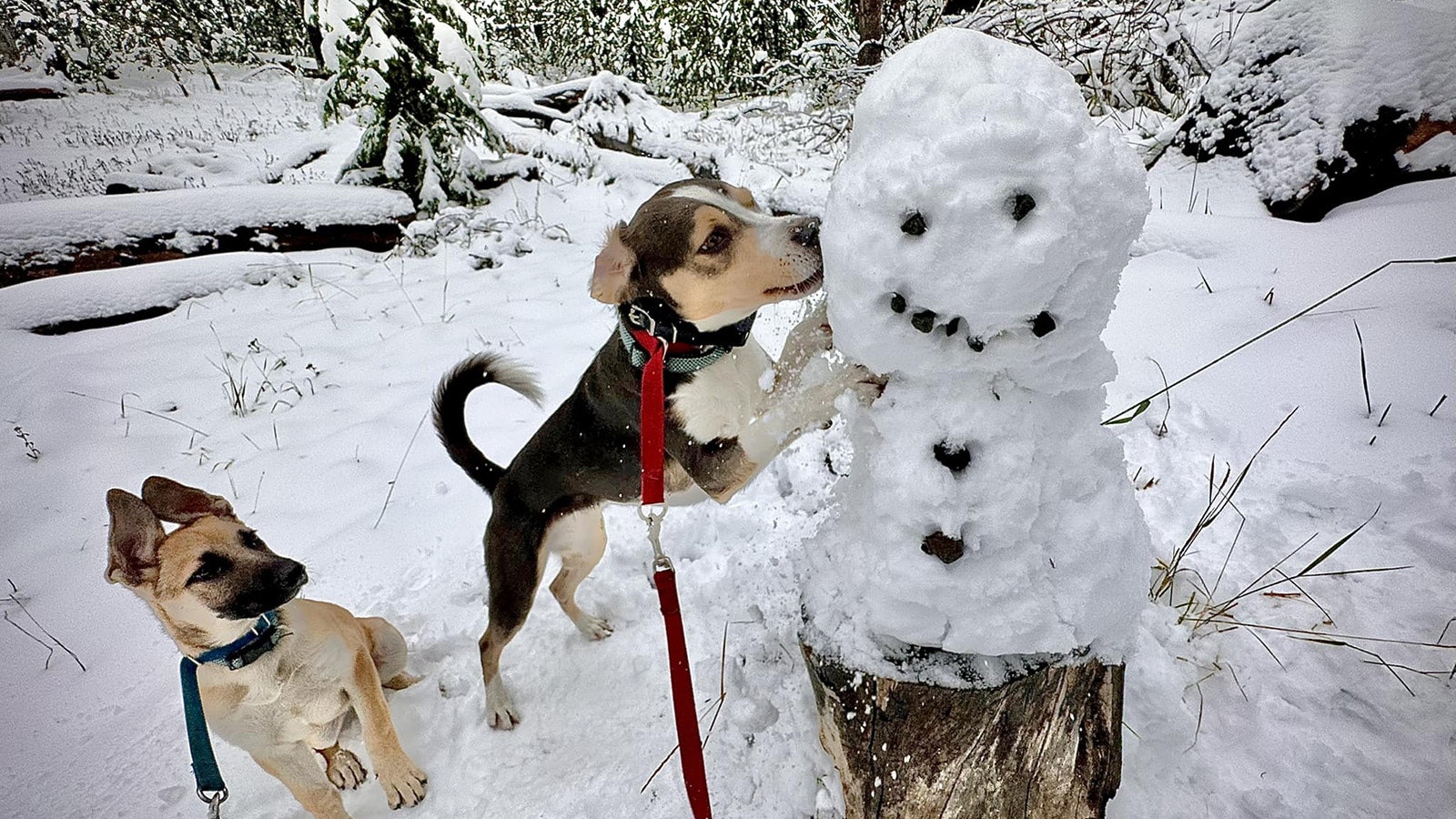
The first Yellowstone snowman of the season was perched on a tree stump near Sylvan Lake, sporting two buttons on its chest and a lopsided smile.
Several people stopped to have their photos take with the spontaneous snowman before Pinkerton let her dogs go in for a sniff and a quick photo. Despite being a professional photographer, she captured this highlight of her trip on her smartphone.
“It was a great highlight of the trip. I car-camp, so I wasn’t going to necessarily stay ’til the snow, but I love staying for it,” she said.
Snow Surprise To See A Snowman
Yellowstone snowmen are often overlooked by visitors, who favor seeing the park’s more charismatic winter animals like bison, elk and otters. Photos of snowmen in the park are a rarity, especially on Sylvan Pass since the high-elevation pass is closed for the winter season.
Cowboy State Daily meteorologist Don Day said there’s nothing unusual about someone being able to build a Sylvan Lake snowman in September. Several inches of snow fell at elevations over 9,000 feet over the weekend, enough to close the Beartooth Highway for a few days.
“It can snow any month of the year in Yellowstone, but in September you expect it,” he told Cowboy State Daily.
There are the kinds of conditions where Yellowstone snowmen can not only survive, but thrive. Sylvan Pass is a perfect habitat given its high elevation and persistent presence of snow, and the conditions of last weekend’s snowfall were ideal.
“I saw pictures of Yellowstone from the weekend,” Day said. “It looked like there were 3 to 4 inches of wet snow with the right consistency that the snow would ball up pretty quickly.”
Day sees an unpredictable pattern to the late September weather in the park.
“You start to see stronger fronts that give you a taste of winter, but winter doesn’t settle in yet,” he said. “You tend to have some nice weather between systems. That’s a trademark of late September and early October in Wyoming.”
Pinkerton knows this well. She’s learned in 13 years of regular Yellowstone trips to never go into the park without being prepared for a chilly change of weather.
“I always expect it to snow. It’s Yellowstone. One of my best pictures was on July 6, 2010,” she said. “We’d gone up Dunraven Pass, and a mother grizzly and two cubs crossed the road right in front of us. But there was a huge snowstorm, and they had to close the whole road.”
So Long, September Snowman
Tragically, this snowman appeared too early in the season. While its ultimate fate is unknown, Day’s professional opinion is that it’s unlikely the Sylvan Lake snowman survived for long after Pinkerton took her photo, even at the chilly height of Sylvan Lake.
“The way the weather’s been this week, that snowman’s gotta be gone,” he said.
The summer/fall transition is a dangerous time for Yellowstone snowmen. Many are lulled into a false sense of security once the snow starts falling,but melts shortly after that.
There’s also the danger of predators. Yellowstone snowmen have no natural enemies, but even Pinkerton’s dogs couldn’t resist taking a bite from the defenseless snowman’s head, which had no arms or legs to defend itself.
But there’s plenty of hope for more Yellowstone snowmen. Soon, the snow will start falling and building as the park gets deeper into autumn.
“The sun angle also makes a difference,” Day said. “Days are getting shorter and nights longer. When you start getting snow to fall on the north-facing slopes of the mountains, several inches of snow falls and stays in the shade all day. It’s not going to melt out.”
Soon, the conditions will be suitable for several more snowmen to spontaneously appear and survive in Yellowstone National Park. If Pinkerton’s experience is an indicator, many visitors enjoy getting a photo of the elusive Yellowstone snowman.
Unlike bison and elk, the National Park Service has no rules about maintaining a safe 25-yard distance from Yellowstone snowmen. Still, caution is advised when visitors find themselves in the presence of any of the park’s native wildlife, including immobile snow creatures created by families of Mainers in shorts.
Andrew Rossi can be reached at arossi@cowboystatedaily.com.