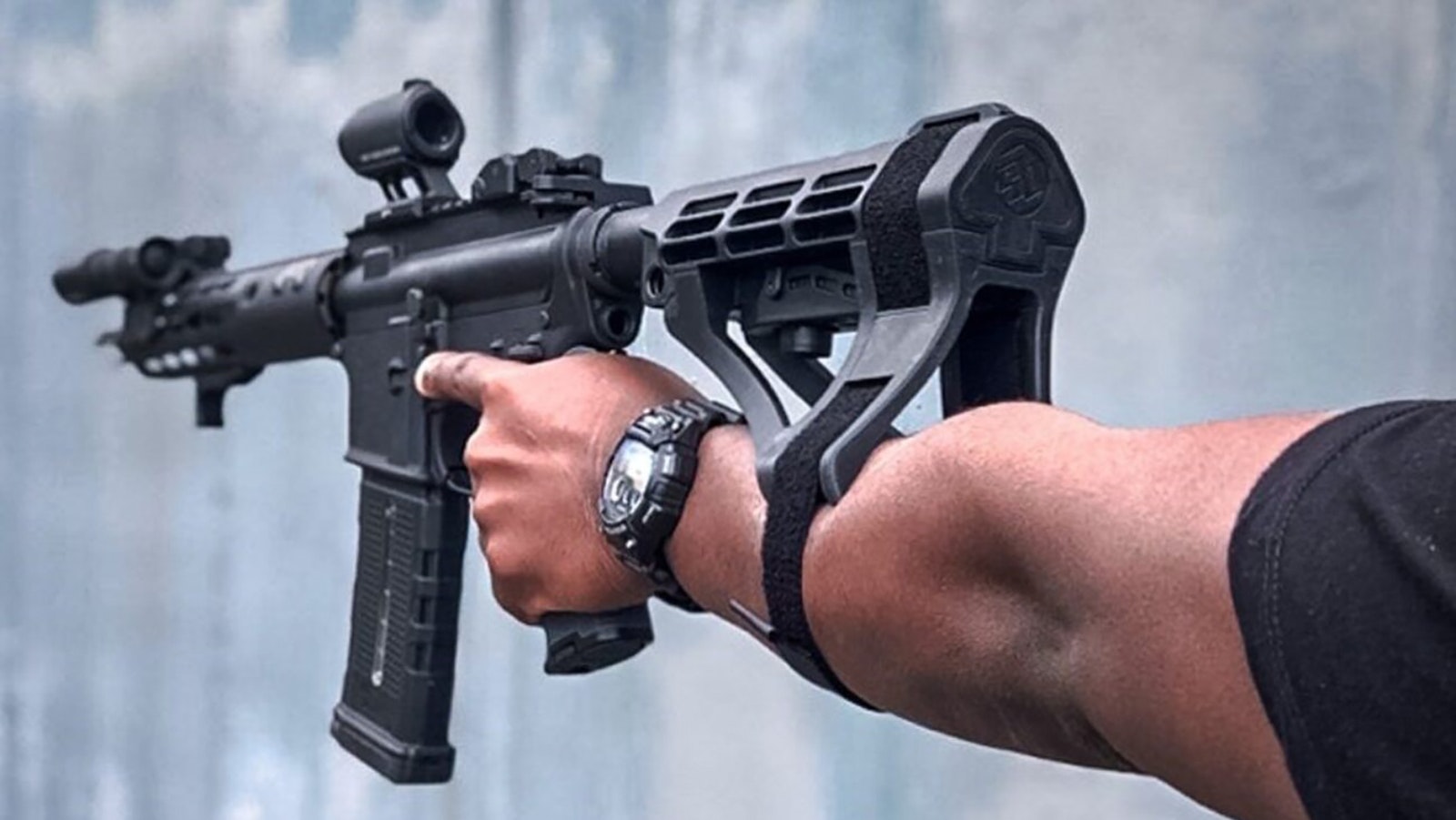
Wyoming, a handful of other states and a gun-rights group are waiting for a federal judge in North Dakota to decide whether to block the federal government’s sweeping restriction on pistols fitted with stabilizing braces.
The Bureau of Alcohol, Tobacco, Firearms and Explosives (ATF) in May started enforcing its new rule treating braced pistols as short-barreled rifles, meaning gun owners now have to register their pistols under the National Firearms Act, destroy their braced weapons or pistol braces, or face a felony punishable by up to 10 years in prison.
The rule sparked numerous lawsuits, including a Feb. 9 filing by Wyoming, other red states and the Firearms Regulatory Accountability Coalition Inc. These plaintiffs are calling the rule an arbitrary and capricious power flex by the ATF, and saying it raises “grave constitutional doubts under the Second Amendment.”
The law, wrote the plaintiffs, “will require millions of Americans to choose between the loss of their lawful — and lawfully acquired — firearms, the loss of their privacy and the risk of criminal penalties.”
Wyoming and its co-plaintiffs also asked U.S. District Court Judge Daniel L. Hovland, of North Dakota, to block the law during the case against it.
Hovland hasn’t yet ruled on that request.
But now the plaintiffs are pointing to a decision out of the American South, where the Fifth Circuit Court of Appeals ruled last month that the ATF’s rule appears to violate the Administrative Procedure Act by acting like a new law and departing from the rule the ATF originally proposed.
The court temporarily blocked the ATF from enforcing its rule in the circuit’s region: Texas, Louisiana and Mississippi.
That case, titled Mock v. Garland, also challenges the new rule as unconstitutional.
Its plaintiffs have launched “many of the same arguments” as Wyoming and its bedfellows in the North Dakota suit, says their Aug. 2 filing in the case, Firearms Regulatory Accountability Coalition v. Garland.
Not The Same Argument, Feds Say
The federal government countered, saying the Fifth Circuit’s recent extension on its injunction against the ATF uses different reasoning than Wyoming and its companions are invoking.
“The court found the plaintiffs (in Texas) were likely to succeed on their claim that the (ATF) Final Rule was not a ‘logical outgrowth of the Proposed Rule,’” reads an Aug. 4 response by U.S. Attorney General Merrick Garland and the ATF. “But the majority opinion ‘declined to address’ plaintiffs’ other statutory and constitutional arguments.”
The states didn’t raise that same “logical outgrowth” argument, notes the ATF’s filing.
Looking Ahead
The states are urging Judge Hovland also to consider Fifth Circuit Judge Don R. Willett’s concurring opinion in which Willett looked ahead to the constitutional challenge and pronounced the ATF rule problematic.
“I write separately because I suspect that the (ATF) Final Rule would likely fail constitutional muster even if it were a logical outgrowth of the worksheet idea that preceded it,” wrote Willett.
He said National Firearms Act the ATF is using to classify between 3 million and 7 million braced pistols as short-barreled rifles was authored to outlaw inaccurate and dangerous weapons that are easy to conceal.
Pistol braces, Judge Willett wrote, do the opposite by making pistols harder to conceal and by making them more accurate.
“These pistols are therefore lawful,” the judge said.
Just Sayin’
Again, the federal government disputed the states’ request, saying that Judge Willett was just speaking, not ruling.
“Plaintiffs point to statements of the panel majority and concurrence that are largely dicta,” reads the federal government’s filing.
“Dicta” is a legal term referring to opinions or beliefs issued by authoritative people. Not only are such statements not the same as a ruling, the federal parties reasoned, they’re also refuted by “the persuasive reasoning” of the Fifth Circuit’s dissenting judge, Stephen A. Higginson.
Not Safer, Says Judge
Higginson opined that the ATF didn’t break the Administrative Procedure Act by altering its final rule from its proposed rule. Rather, the judge wrote, the ATF was altering its rule in response to more than 200,000 negative comments against it, comprising 92% of all comments submitted.
Higginson also called the Texas plaintiffs’ argument that the ATF’s rule is a new law in disguise incomplete and claims the Fifth Circuit majority on this case “forgives the misfire and attempts to fill the gap itself. I would not do so.”
The majority created its own test for showing when an agency has spawned a new rule without Congressional authority, Higginson noted, saying that act goes against judicial restraint.
Higginson, like Willett, took his opinion a step further and looked at the Texas plaintiffs’ constitutional challenge to the ATF’s rule.
“I disagree that these braces are, in relevant regard, ‘safety-improving modifications,’” wrote Higginson, directly addressing Willett’s opinion. He noted that braced pistols have been used to kill 19 people in two recent mass shootings in Boulder, Colorado, and in Dayton, Ohio.
“They ‘are unusually dangerous because they can be easily concealed like a handgun but have the firepower and accuracy of a rifle,’” the judge wrote, quoting from public commenters who favored the ATF’s rule during its making.
Not Many Seem To Be Complying
A pistol brace is an attachment bracing a pistol onto someone's forearm, letting a shooter fire a pistol with one hand, which their makers tout as vital for some disabled shooters.
Braced pistols also may be shouldered, which prompts a controversy about whether they act like short-barreled rifles. People are required to register short-barreled rifles and pay a $200 tax on them, destroy them or submit to felony prosecution if they possess them illegally.
The ATF reported it received 250,000 applications from people seeking to register their braced pistols before the May 31 deadline. That means that, unless numerous gun owners destroyed their guns, only about 8% of the owners of braced pistols are complying with the new rule, according to the Fifth Circuit’s ruling.
Without a court injunction or a rule change, about 3.1 million gun owners could be potential felons under the new rule.
Can You Shoulder It?
The controversy over how people use braced pistols started in 2012, when a federal firearms licensee asked the ATF to weigh in on whether stabilizing braces transform pistols into short-barreled rifles.
For nearly a decade, the ATF said they didn’t, even though the brace could be used to shoulder a pistol, the ruling says.
But then sales exploded: braced pistols and companies marketing them flourished in the private sector.
So the ATF dispatched a proposed rule meant to clarify when braced pistols are short-barreled rifles and when they are not, using a points system tied to their features and weight.
People didn’t like this proposed rule, with 92% of commenters railing against it.
So the ATF pivoted and made a final rule that interpreted 99% of braced pistols as rifles, court documents say.
The other states suing with Wyoming are West Virginia, North Dakota, Alabama, Alaska, Arkansas, Florida, Georgia, Idaho, Indiana, Iowa, Kansas, Kentucky, Louisiana, Mississippi, Missouri, Montana, Nebraska, New Hampshire, Oklahoma, South Carolina, South Dakota, Tennessee, Utah and Virginia.
Clair McFarland can be reached at clair@cowboystatedaily.com.