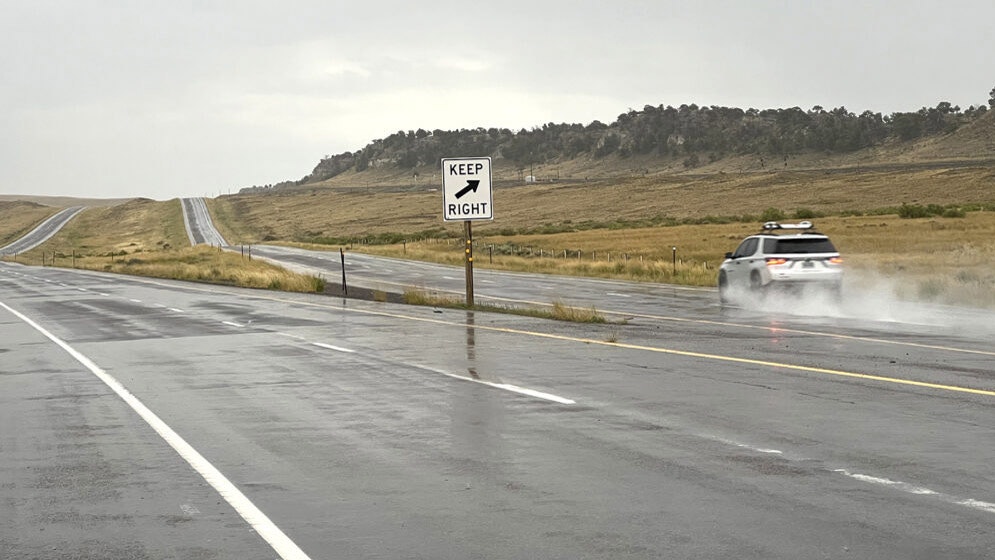
Nowadays, U.S. Highway 30 running between Hanna and Laramie is a back road.
Savvy travelers sometimes us it as an alternative to the busy parallel stretch of Interstate 80, particularly during nasty weather.
But at one time, it was one of Wyoming’s busiest, most congested highways. It even gained the nickname “Blood Alley” because of the high number of fatal crashes there, including a collision that killed one of Elvis Presley’s movie co-stars.
That’s why there’s roughly 19 miles of wide-open four-lane pavement along the route between Rock River and Bosler, even though today it seems strange to hit a seemingly arbitrary section of divided highway in the middle of nowhere.
‘That Whole Chunk Of Road Was Deteriorating’
In the late 1950s, Interstate 80 was a distant dream. The Interstate wouldn’t open until October 1970, and only after much consternation over what the route should be.
Meanwhile, the congested two lanes along “Blood Alley” was piling up casualties.
Most notably, movie actress Judy Tyler and her husband were killed in a collision near Rock River on July 3, 1957. Tyler had just finished filming “Jailhouse Rock,” in which she co-stared with Presley.
Tyler and her husband were driving from Los Angeles to New York when they were killed.
‘Snow Chi Minh Trail’
Tyler’s death, numerous other high casualties and the generally rotten condition of the road prompted Wyoming to take action in 1961, historian John Waggener told Cowboy State Daily.
“That whole chunk of road was deteriorating. And the traffic volume was such that it was really difficult to rebuild it without causing significant problems. So, they built an all-new road parallel to the old road so traffic could continue to run on the old road during construction,” he said.
After the new stretch of U.S. 30 was completed, the old highway was also rebuilt and both were kept open, effectively creating that stretch of divided four-lane that’s still open, he said. The four-lane was never extended farther because plans were underway to build 1-80.
Waggener probably knows the history of Wyoming’s highways in that region better than anybody. He’s an archivist and historian at the University of Wyoming’s American Heritage Center. And he wrote the 1973 book “Snow Chi Minh Trail: The History of Interstate 80 Between Laramie and Walcott Junction.”
The book’s title is based upon the “Snow Chi Minh Trail” nickname for that stretch of I-80, which can be notoriously bad during the winter.
False Rumors
Over the years, some rumors have sprung up around the middle-of-nowhere four-lane, Waggener said.
There are two in particular Waggener points out. The first is that it was the initial section of I-80 or a section of I-80 built before it was ultimately decided to route the interstate through the Elk Mountain area. The second is that the state of Wyoming always wanted I-80 to take the old U.S. 30 route, and started building a section of interstate there to force the Federal Highway Department’s hand.
Neither are true. And the proof of that is in the construction of the four-lane section itself, he said. It simply isn’t up to federal interstate highway standards.
Too Narrow, Not Enough Visibility
For starters, it’s too narrow.
“When you drive it, you’ll notice the shoulders, on both the inside and adjacent to the passing lane, aren’t as wide as the shoulders on the interstate highways. And the overall width of the road just isn’t as wide as an interstate,” he said.
Moreover, there are a couple of hill crests that could never pass interstate highway standards for forward visibility coming over the hills.
“There are two hills in particular that don’t offer drivers the minimum view forward in order to meet interstate construction standards,” he said. “One in particular: If you’re are eastbound, shortly after you leave Rock River, you go up a hill, and you can’t see 25 feet in front of you.”
‘Source Of Contention’
The story about wishes for the routing of I-80 is at least partially true, Waggener said.
Many Wyomingites wanted the Interstate to take the U.S. 30 route, especially folks in Hanna, Medicine Bow and Rock River. Moving the main highway route south would mean a lot less traffic and business for them.
“That was a big source of contention in Rock River and Medicine Bow, and to a lesser degree, Hanna,” he said.
Hanna had already lost out to an extent in the 1950s, when Highway 30 was moved south of the town.
“U.S. Highway 30 used to go right through Hanna. If you go straight through town, you’ll see the old east-west highway. But in the very early 1950s, the highway was moved to its present location,” he said.
Nevertheless, there was, and still is, a feeling there that the feds played dirty pool by using Elk Mountain as the main marker for routing I-80 where it ended up going.
According to standards, interstates should be built in a manner that adds direct service to the most people, while taking it away from the fewest. And pitting Hanna against Elk Mountain wasn’t fair in that regard, Waggener said.
Federal government officials “were cheating. Elk Mountain is farther away from I-80 than Hanna is from Highway 30. That’s the sort of game-playing the feds were doing in their report. Part of bypass policy is determining how many people are getting bypassed verses how many are served by the new road,” he said.
A Better, Quieter Drive
Regardless of any wrangling during the decision-making process, Highway 30 “really started quieting down” once I-80 opened, he said.
But many drivers appreciate the old highway, and the four-lane section in particular, because they perceive it to be a safer drive, particularly during winter.
And that’s not just a perception. Conditions frequently are much better along Highway 30 than along the parallel stretch of 1-80, Waggener said.
“The closer you get to the mountains there (adjacent to I-80), two things occur,” he said. “The wind velocity gets higher, and you’re closer to the heavier deposits of snow. So, that’s going to create more blowing snow.”
Mark Heinz can be reached at mark@cowboystatedaily.com.