JACKSON — The telescope Rachel Fischer puts together beneath a dark night sky on the edge of Grand Teton National Park looks like a giant black cannon.
But looks are deceiving. This “cannon” isn’t going to shoot anything out into the sky. Instead, it’s going to take in all the light that its huge lens can possibly gather. It’s powerful enough to capture light that’s trillions upon trillions of years old.
The mobile telescope is all part of the private stargazing parties that Wyoming Stargazing has been offering in Jackson Hole since a little before the total solar eclipse that passed over the Cowboy State at nearly 100% total in 2017.
Since then, an increasing number of students, corporations and tourists are looking for just this kind of out-of-the-world experience, which can only be had under a vast night sky unpolluted by modern lights.
Fischer is among a half-dozen highly trained astrophysicists Wyoming Stargazing has hired to lead star parties for tourists in Jackson. The nonprofit will even pick up guests curbside from their hotels, and return them again once the party is over.
“We’re seeing rampant growth,” Wyoming Stargazing Executive Director Sam Singer said. “And it’s not just in Jackson. If you look at the trends with astro-tourism, it’s like all over the western United States, and it’s in places like New Zealand, Tanzania and Chile. There’s just a huge amount of growing interest from people traveling to remote destinations to enjoy the night sky in lots of different ways.”
Some offer cocktails to sip and savor alongside their star tours. Others offer a sightseeing tour of the largest animals by day and the brightest stars by night.
“There’s a couple other small organizations (in Jackson Hole) that do in-house stargazing programs at specific hotels,” Springer said. “We’re the only outfit that actually picks people up from anywhere and goes to private residences. We do corporate events, we do weddings, and it’s a ton of fun.”

How Far Is One Light Year
Stargazing is not just fun, though. It’s fun in a thought-provoking way, especially the way that Wyoming Stargazing goes about it.
Fischer first gives her night sky tourists a quick, fun lesson in astrophysics.
Distances in space are so vast that astronomers do not measure them in miles, she explained. Instead, they use the light year.
“Light is the fastest thing we know, but it’s not instantaneous,” she told a small group of tourists joining her for a recent grand tour of the night sky on the fringes of Grand Teton National Park. “A light year is the distance that light can travel in one Earth year.”
Having set the stage with that basic information, she then asks her guests the trillion-dollar question: Just how many actual miles does light travel in a single year?
No one comes even close to the right answer.
“It’s 6 trillion,” Fischer finally said. “In the time it takes Earth to obit around the sun one time, light will have traveled 6 trillion miles. But if I said something is 90 trillion miles away, you wouldn’t understand that. So that’s why we use light years instead to help us get a grasp of these massive distances.”
Five light years — a relatively short distance astronomically speaking — is 30 trillion miles away from Earth.
Proxima Centauri, a red dwarf star in science fiction stories that often mention the Alpha Centauri system, is 4.22 light years from Earth.
A Night In The Life Of A Former North Star
One of the brightest stars in the night sky is Vega, which is part of the constellation Lyra, and it’s one of the first stops on Fischer’s tour of the night sky.
As stars go, it’s fairly young at 450 million years old.
Vega is a very bright star and used to be our North Star about 12,000 years ago. But the Earth’s axis wobbles, and our perception of which star is always pointing north changes with that cycle.
That means Vega will regain its status as our North Star in another 12,000 years or so.
Vega was the subject of the first spectrographic image made in 1872, but it rose to prominence more recently thanks to Carl Sagan’s novel “Contact,” later adapted into the 1997 Hollywood movie of the same name starring Jodie Foster.
In the movie, astronomers discover a signal that appears to emanate from Vega.
“Vega is one of the closest stars we’ll see tonight,” Fischer said. “It’s 25 light years from Earth.”
That makes it 150 trillion miles away.
“The light you’re seeing in the telescope has taken 25 years to travel from the inside of Vega to us tonight,” Fischer said. “So, if you can think back on what you were doing then, that’s exactly what Vega looks like right now. You’d have to wait another 25 years for that light to travel here to know what Vega actually looks like right now.”
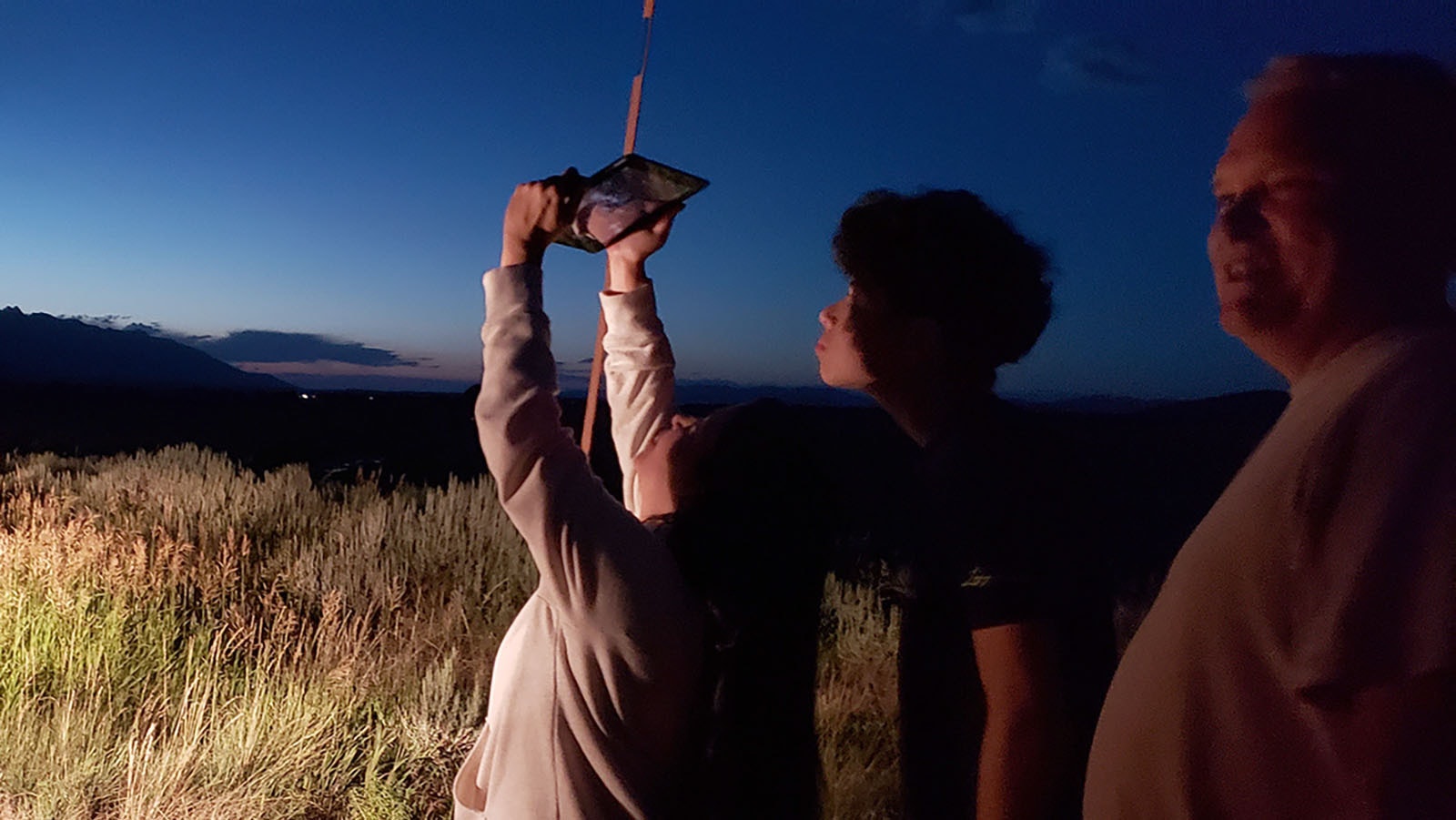
A tour group from Texas tries out an iPad equipped with an app that will highlight anything interesting in the piece of sky its being pointed at. (Renée Jean, Cowboy State Daily) 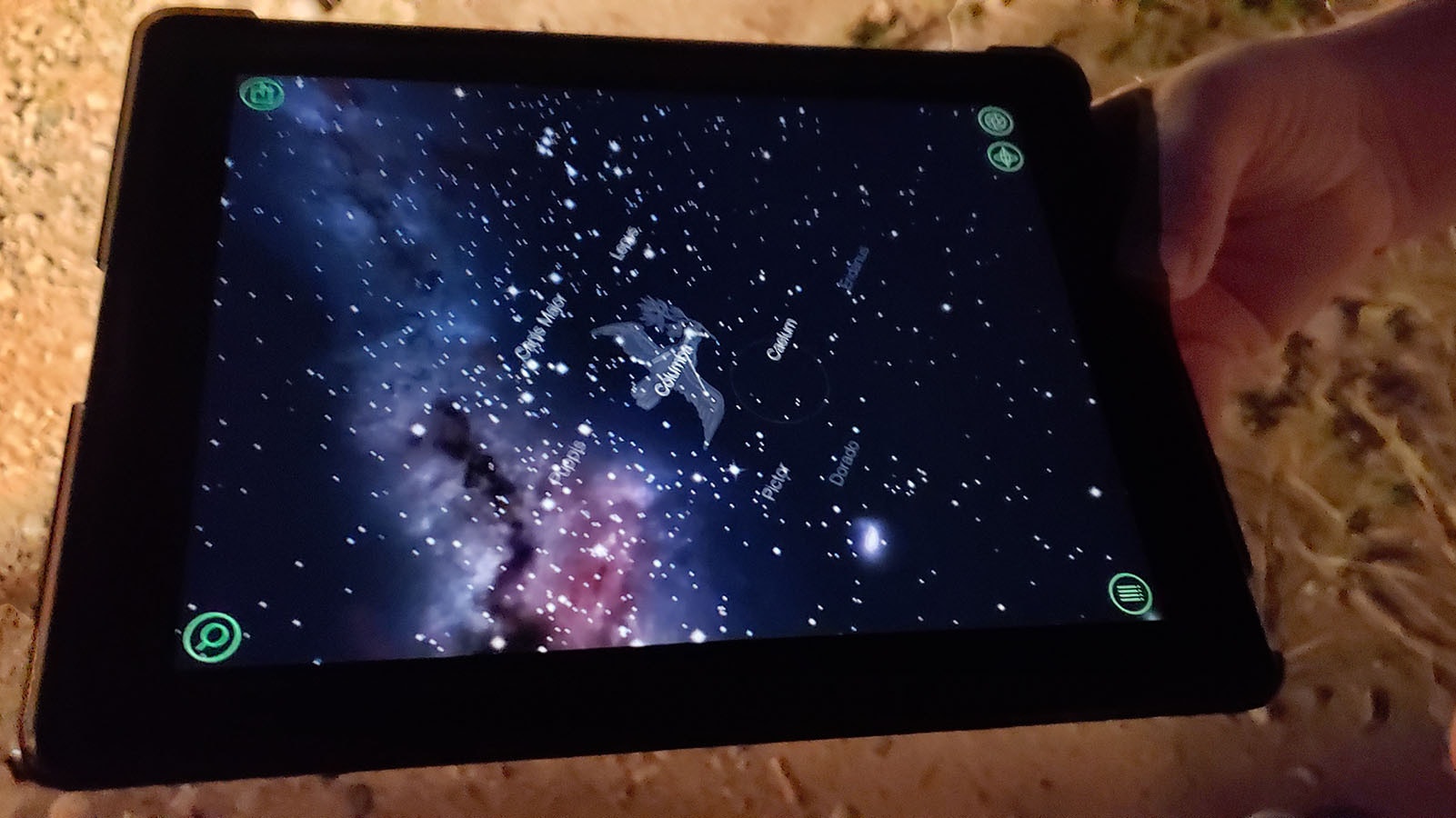
An iPad with an app that shows interesting things in whatever piece of sky its being pointed at. In this case since it's pointing at the ground and showing the starscape over China. (Renée Jean, Cowboy State Daily) 
Rachel Fischer is an astrophysicist with Wyoming Stargazing. (Renée Jean, Cowboy State Daily) 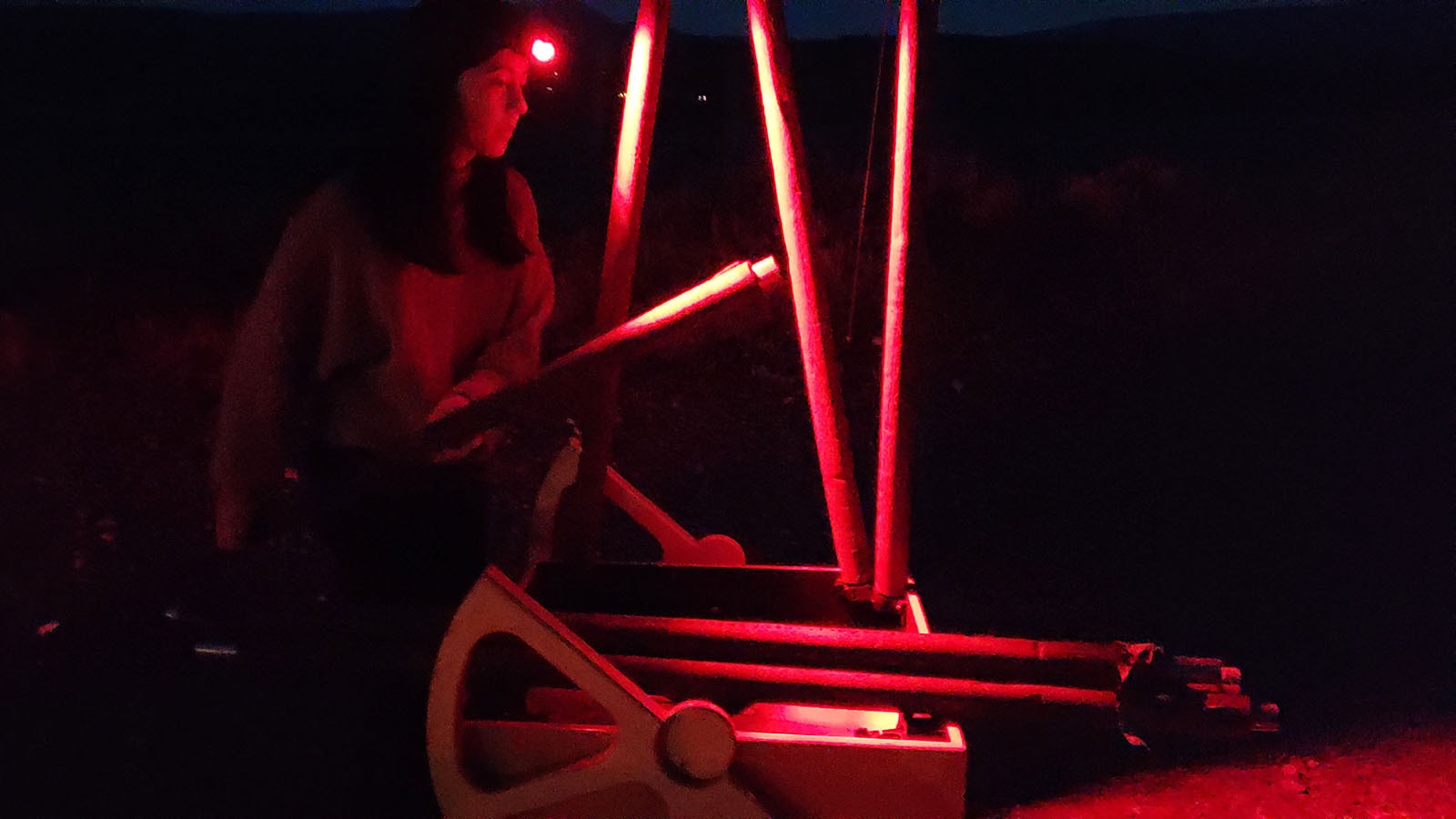
Rachel Fischer puts together a mobile telescope on the fringe of Grand Teton National Park using only a red light. Red lights don't cause one's eyes to contract, helping to preserve better night sight. (Renée Jean, Cowboy State Daily) 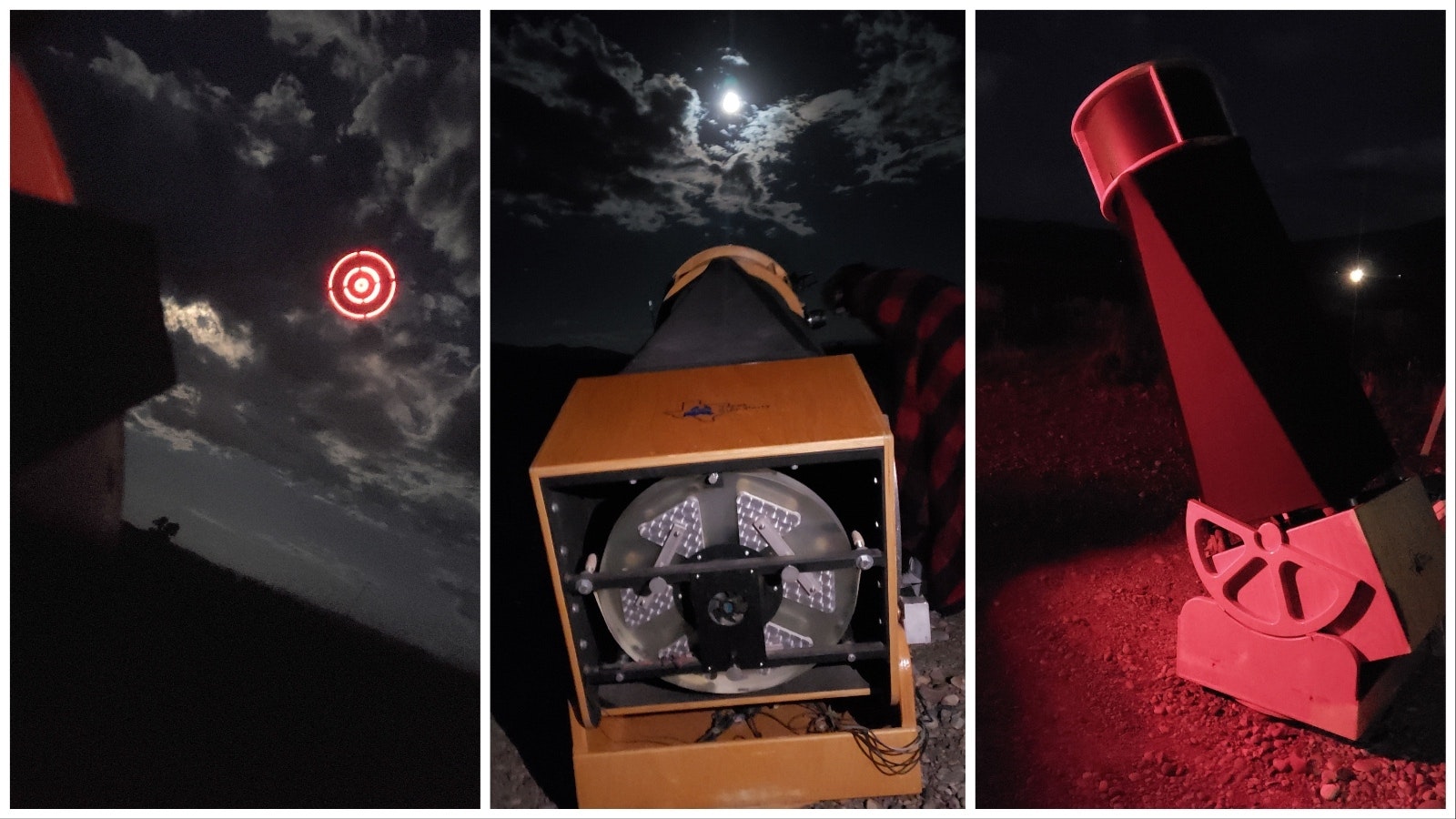
A bull's-eye projected onto a smaller lens helps the telescope operator aim it more easily; The completed telescope looks a bit like a strange cannon pointed at the sky. It swivels 360 degrees around and moves up and down vertically as well. It can be pointed at any part of the night sky with ease; Wyoming Stargazing's mobile telescope can be pointed to sites that are very low on the horizon. It also swivels all the way around. (Renée Jean, Cowboy State Daily)
An Accidental Career
Fischer became an astrophysicist somewhat by accident. She was in her junior year of high school and just needed one more credit to finish out her semester.
She wasn’t very interested in the at-school options, so she decided on an online astronomy class.
“It seemed like the least painful one out of all of them,” she said. “So, I signed up for the class, and I was in the library in headphones working on a computer every day during my last period.”
The class didn’t turn out to be as easy as she had thought.
“I still fell in love with the course, even though (online) was the most boring way all that information could have been given to me,” she said. “I feel like I should have hated that class, and it should have turned me off from astronomy.”
But it didn’t. It sucked her in like a black hole.
Before her parents knew it, Fischer was changing her ideas on what her eventual career would be.
“It was amazing for me,” she said. “It totally changed my life.”
Physics and math weren’t subjects that came easy for her, though, which made the degree an exhausting five years. Halfway through, she even changed her major to ecology for a semester.
And then she came right back to the stars.
Even so, after graduating, she felt burned out, but the job with Wyoming Stargazing has completely changed her outlook. Burn-out melted away.
“I just love to be on top of astronomy and the news,” Fisher said. “Guests will ask about it on programs, and I like to bring it up as well.”
Glitter Paint In The Sky
The enthusiasm Fischer brings to her star parties is all part of the fun, both for her and her guests.
But like most of Wyoming Stargazing’s guides, she has her favorite sights, and many of her choices are different from the others.
That diversity makes each Wyoming Stargazing star party a different experience. The guides change up their tours based on what’s happening in the world of astronomy at the time, as well as the seasons of the year.
One of Fischer’s favorite standbys is the globular cluster called the Hercules. A globular cluster is a sphere of stars bound tightly to each other by gravity. The concentration of these stars grows toward the center, which may contain tens of thousands to many millions of stars.
“Visually, (the Hercules globular cluster) is just amazing,” Fischer told Cowboy State Daily. “I usually ask guests after they look at it, you know, I say, ‘If I’ve never seen this object before, if I’ve never looked at it through a telescope, how would you describe it to me? What did you see?’
“And I get these great answers. ‘Oh, it looks like paint splatter.’ ‘It looks like somebody threw glitter on the sky’ or ‘it looks like a snow globe.’ It’s just a beautiful star cluster to look at, it’s amazing.”
But it’s not just the pretty lights that fascinates Fischer and ultimately her guests.
“It’s actually thinking about what you’re looking at as well,” she said. “It’s starlight from hundreds of thousands of stars, so far away from us.”
Where Vega is 25 light years away, the Hercules cluster is 25,000 light years away.
That’s 150,000 trillion miles.
That distance means the stars in the globular cluster may already be dead. They could be ghosts sending out their last tendrils of light into the universe.
“You wouldn’t know about that because of how long it takes that light to get here,” Fischer said. “And it’s a point in the sky that you can never see with your naked eye. You can only see it through a telescope. It really is amazing.”
If You Go
Wyoming Stargazing offers private star parties year-round in both winter and summer.
Programs should be booked at the beginning of a trip so they can be rescheduled if there is bad weather. Programs range from private night photography to stargazing tours.
Wyoming Stargazing also offers a free starry night tour the first Thursday of every month at the Stilson Parking Lot with a large aperture telescope and iPads that can be pointed at the sky without looking through a telescope at all.
If weather is too bad for stargazing, the group offers a movie instead with popcorn, apple cider and hot cocoa.
Call 1-844-WYO-STAR or email at info@wyomingstargazing.org for details.
Renée Jean can be reached at renee@cowboystatedaily.com.