At first, Lisa Schmidt was no fan of grizzlies returning to their natural prairie habitat around her ranch in north central Montana.
She was recently driving truck full of livestock from her ranch near Conrad, Montana to a processing plant some 180 miles away. She stopped to visit with Cowboy State Daily over the phone, and recalled a particularly bad morning several years ago.
“I walked down to the barn, about a quarter-mile from my house, and there were dead sheep scatted everywhere,” she said.
‘Seventh Strike’
The dead sheep had broken shoulders and hips – a telltale sign of having been slain by a grizzly.
The bear had eaten the ewe’s udders “for the milk” and left the rest of the carcasses, she said.
Schmidt was livid. It was far from the first time that particular grizzly had hammered a ranch in her area.
“It took them (Montana Fish, Wildlife and Parks) three days to get that bear. It was its seventh strike, and I really wasn’t happy about that.”
Her husband, who has since passed away, was planning leave that day to go visit a grandchild in another state. But upon seeing the carnage, he offered to stay.
‘You’ll Kill That Grizzly’
Schmidt admonished him to go anyway.
“I told him, ‘If you stay here, you’ll kill that grizzly, and that’s a $50,000 fine. These dead sheep aren’t worth $50,000,’” she said.
Schmidt was so incensed, she wrote a piece for the local paper, which got passed around to other publications in the area.
She said that when her husband stopped for a bite in a South Dakota café on his way back home, some of the patrons were discussing the piece and “trashing” her husband for leaving her alone on the ranch with a grizzly lurking about – not realizing that he was right there.
She said that he later told her that upon getting up to pay for his meal, he turned to the trash-talkers and said, “I left her with a .30-30 and a 12 gauge, and if I was betting, I’d bet on Lisa.”
That silenced the critics right quick, she said. She’s yet to use her firearms on any grizzlies.

Prairie Comeback
Though her sheep and cattle ranch is only 60 miles southeast of Glacier National Park – where grizzlies have long thrived – it’s in an area where Schmidt and her neighbors never dreamed they’d have to deal with the bears.
Grizzlies are actually well-suited to life on the prairie, but have long since been mostly driven into the mountains, so folks these days don’t regard them as a plains species.
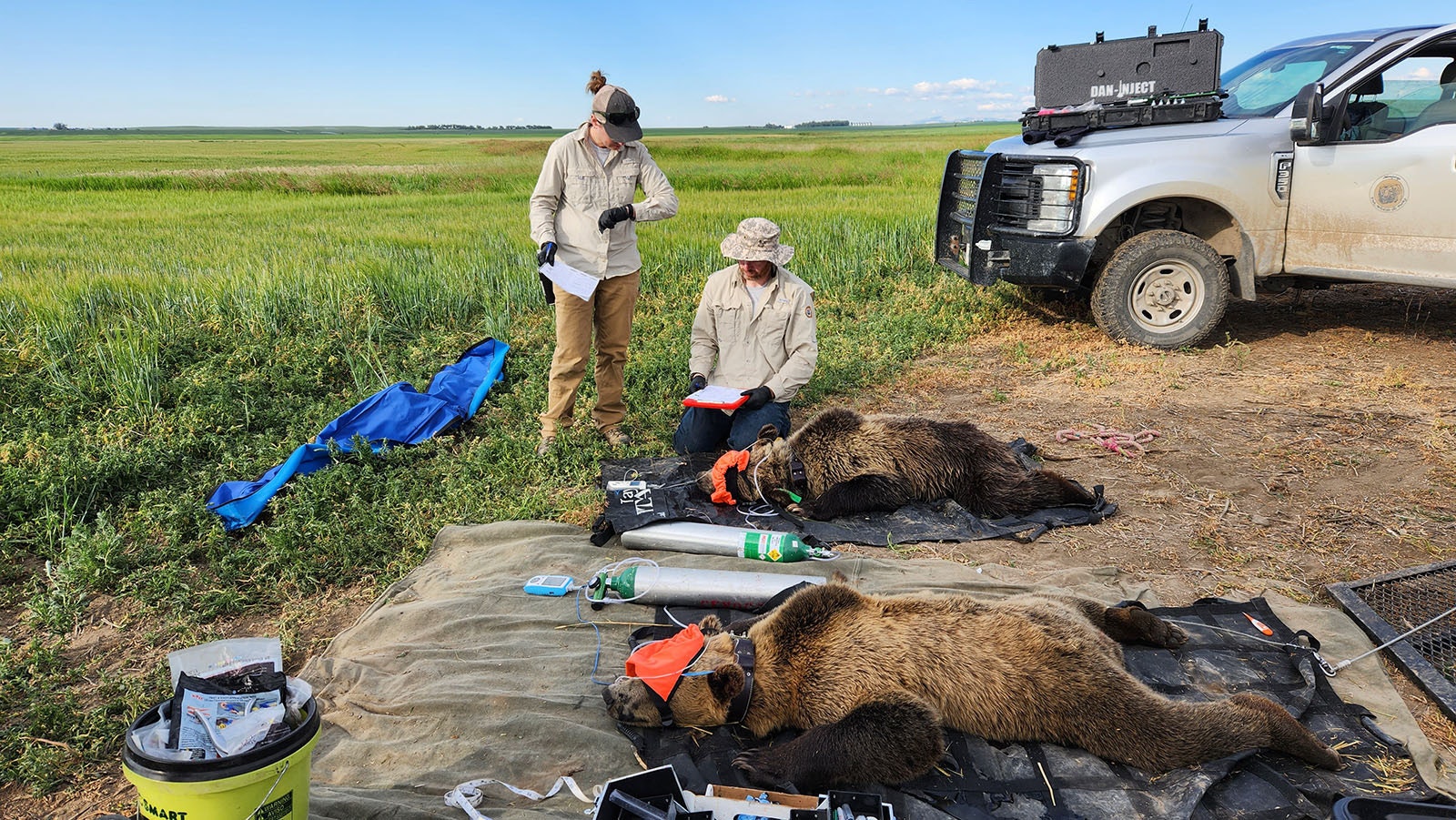
However, the bears have done so well in their core habitats of Glacier park and Northern Continental Divide Ecosystem in Montana, they’ve started pushing outward in all directions. For several years now, they’ve been repopulating high plains habitat around Conrad, Valier and other small Montana prairie towns, FWP biologists recently told Cowboy State Daily.
They’ve since become a fairly common sight around the area, Schmidt said, and they continue to push east, ever farther out into the prairie.
She added that she even once had a grizzly right in her yard, “sniffing around the picnic table,” and that was a bit too much.
Growing Tolerance
Even so, Schmidt said her attitude toward grizzlies has “evolved” from resentment to admiration.
Now, she’d like to see them continue to reclaim their home on the range.
“I really don’t want them on my yard, and I don’t want them killing my livestock,” she said.
But otherwise, she said the thinks it’s possible to live alongside grizzlies.
She noted that a female grizzly denned on her place and had cubs.
“She’s shy and scared of people,” Schmidt said. “When she sees me coming, she goes running over the hill with her cubs.”
Schmidt said she’s come to realize that grizzlies, like people, have different personalities. Most, like the momma bear that took up residence on her place, just want to go about their business and be left alone.
Others, like the one that killed her sheep, cause trouble and must be dealt with accordingly, she said.
And people need to make adjustments, she added, such as keeping garbage secure and discouraging bears from raiding commercial beehives.
“There’s been an evolution of my attitude. I’ve seen that evolution of attitude happen with communities, like Choteau (Montana),” Schmidt said. “If we all keep our garbage collected and keep electric fences round our beehives, electric fence that’s super-hot, then we can live with these bears.”
Favors Delisting
Grizzlies in the Lower 48 had been nearly wiped out by the 1970s. They were placed under special federal endangered species protection in 1975. Their numbers have grown and they’ve expanded their range ever since. There have been several unsuccessful attempts to have the grizzlies delisted and management handed over to game agencies in Wyoming, Montana and Idaho – most recently in 2018.
This year has seen a renewed push to desist grizzles.
Schmidt said she’s all for it. She doesn’t want to see grizzlies driven back off the prairie, but she’d like to be able respond directly if one gets into her livestock again.
Coyotes have taken a far greater toll on her sheep than grizzlies ever have, Schmidt said, but she’s allowed to control coyotes on her place, killing them if she has to.
But with grizzlies still under federal protection, she feels powerless to stop another one from attacking her herds.
“As a rancher I really need to protect my livestock. It’s not just a monetary thing, I feel a moral obligation to take care of my animals,” she said. “When we’re talking about taking bears off of the endangered species list, it’s about that need to protect our livestock.”
Mark Heinz can be reached at mark@cowboystatedaily.com.