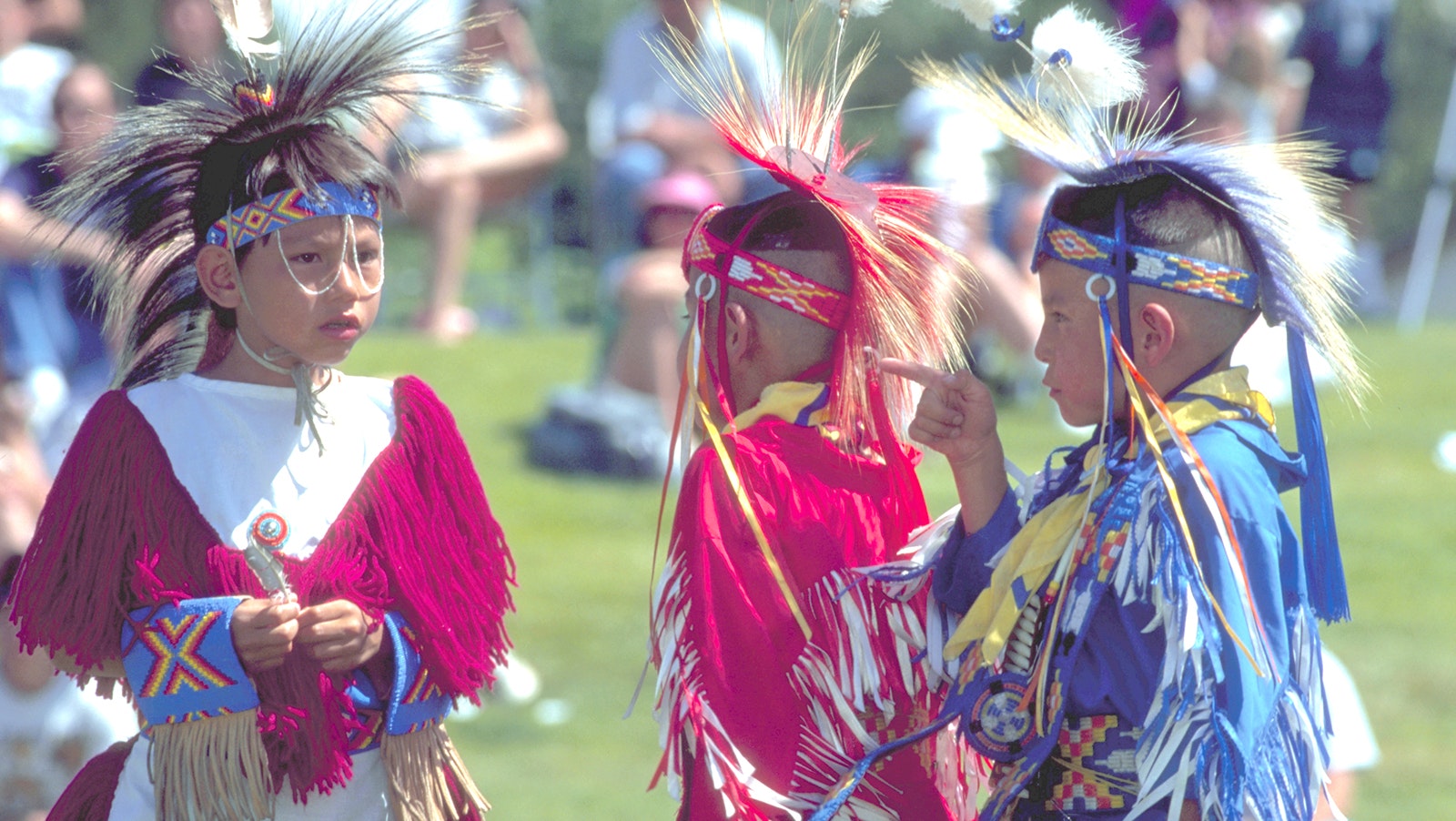
Wyoming lawmakers are contemplating whether allowing Arapaho prayer training in state-funded schools on the Wind River Indian Reservation puts the state at risk of a church-and-state lawsuit.
Northern Arapaho Business Council Member Teresa His Chase is urging state lawmakers to keep native culture in reservation schools by letting them teach religious prayers to students, including at the K-8 school in Arapahoe.
She made her plea last week during a legislative Committee on Tribal Relations meeting in Fort Washakie, where lawmakers were trying to find solutions to low state standardized test scores in three state districts on the reservation.
Sen. Cale Case, R-Lander, floated the idea that the committee should study relevant case law to see if some of the school’s culture training – the prayers and religious teaching – violates the Establishment Clause of the First Amendment and puts the state at risk of being sued.
In Everything We Did, There Was Prayer
“In everything we did, there was prayer included,” His Chase told lawmakers about a culture program at Arapahoe School. “We would first explain to the students that, as Arapaho, we say we’re not worthy to talk to God directly, so we call upon all the beings of creation first.
“We talk to the waters. We talk to the animal life, the plant life; we talk to the winds, we talk to all the planets; all the animals in the water and we ask them to help us talk to God — because as Indian people we live in harmony with mother nature and we still continue to live that way, to this day.”
His Chase said the children who participated in this program showed better academic performance than their peers. She said instructors incorporated math and other state-standard training into the culture program, such as calculating the beads necessary to coat a moccasin or the poles needed to build a tipi.
The children need their tribal language and culture, said His Chase, adding that the state should support that.
“What we need is for you guys to provide support for families, so students will succeed,” she said.
Establishment Clause
Case on Friday asked the committee if its staff, the Legislative Service Office, could compile relevant case law on the Establishment Clause, to learn to what extent the state can sponsor religious teaching.
Case was concerned that the state could be liable to a lawsuit if it doesn’t adhere to the U.S. Constitution.
“Education folks were talking about how they can reach Native students, and I’m so for that,” said Case. But the spirituality teaching might have issues, he added.
“If you had an overtly Christian school … offering Christian-based prayers and offerings to Jesus Christ as part of the curriculum, it would raise eyebrows,” Case said.
Oakley told Case during the meeting that it was a “great point” and could become a committee action item.
‘How Lucky These People Are’
Rep. Sarah Penn, R-Lander, said she had the opposite reaction to His Chase’s speech.
“Religion is their culture,” said Penn. “And (with them) trying to integrate their culture into their studies – I was sitting here thinking how blessed and how lucky they are.”
Penn said she views the Establishment Clause more narrowly, as barring governments from establishing a state religion.
“We need to be very careful how we tread here. That’s something that’s very important to these people,” said Penn.
Both Penn and Case represent the Wind River Indian Reservation. Penn’s reservation-based district, which is about 67% American Indian, is nested within Case’s district, which also encompasses Lander and other parts of Fremont County.
Culture Vs. Religion
Rep. Ken Chestek, D-Laramie, told the committee there have been U.S. Supreme Court cases “teasing out the traditions of Native people which are bound up in spirituality,” and confirming spirituality as inseverable from tribes’ customs.
If the committee undertakes such a study, said Chestek, it should focus on cases specifically addressing Indian law and culture.
Ultimately in response to this issue and other requests from legislators, a Legislative Service Office staffer at the meeting said LSO can investigate how other states incorporate tribal culture into their state K-12 standards, and how to do that without violating the Establishment Clause.
Chestek, who was critical of the Wyoming standardized test's ability to measure tribal children's successes, asked whether Wyoming can adopt a "two worlds" standards set for reservation schools, letting students access the standards of their tribe or of the "Western" world.
Ellis, who is a member of the Navajo Nation, said she wouldn't support that.
"I don't like this notion of two standards, because I don't like setting lower expectations for people," said Ellis.
Clair McFarland can be reached at clair@cowboystatedaily.com.