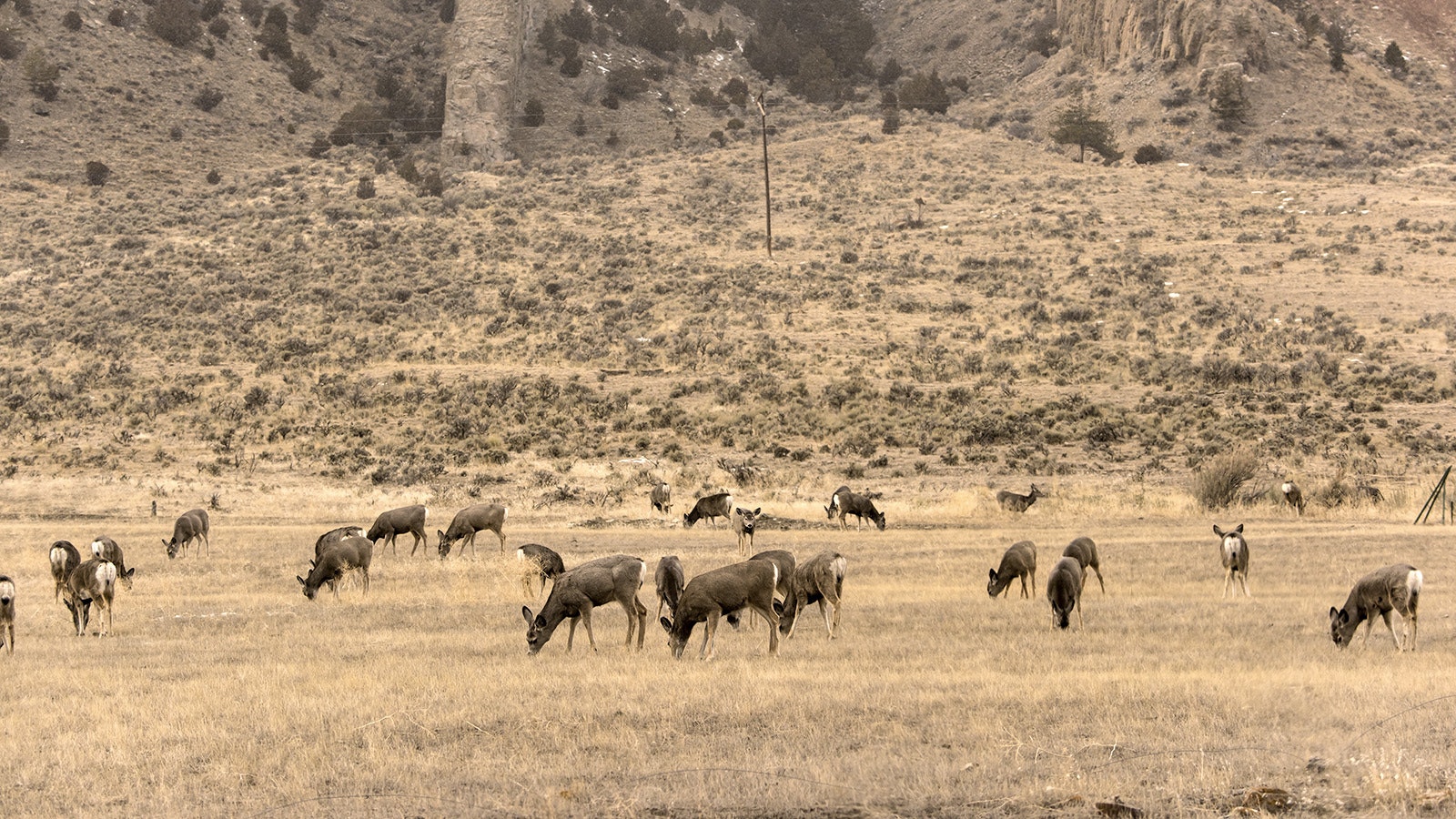
Tens of thousands of Wyoming mule deer could have been spared from starving to death this past winter if they’d been artificially fed, says an outfitter and retired Wyoming Game and Fish Department officer.
“You guys are damn near in a hole you can’t crawl out of” in terms of the mule deer population decline, outfitter Daniel Richins of Utah told Cowboy State Daily.
He leases hunting property in southwest Wyoming and said he’ll probably cut back his business in the Cowboy State by 35 employees this fall because so many mule deer died.
“That’s 35 people who could have made as much in three months as they would make in eight months at a regular job,” he said.
Ron Dean of Etna supervised the Game and Fish’s elk feeding program for 33 years before retiring from the agency. He told Cowboy State Daily he also thinks that Game and Fish should have tried feeding deer this winter.
“As a game management organization, the Wyoming Game and Fish is second to none,” he said. “However, I do believe they let one slip through the cracks last winter.”
Outfitter Says Feeding Works In Utah
The scale of the loss is almost unimaginable, Richins said.
The Wyoming Range Mule Deer Herd is one of the best-known, genetically superior herds in the West, coveted by hunters and outfitters everywhere, he said.
Richins said the herd went into the winter numbering about 30,000 deer. Now, he figures about 5,000 are left. That’s a blow he worries the herd might not recover from.
Meanwhile, he said he’s been feeding deer on the Utah side of his hunting leases for 20 years. And even after a winter as brutal as this past one, he claims that he’s had good results.
“Any deer that got supplemented (with artificial feed) this year had an 85 % chance of surviving. Any did that didn’t get supplemented had about an 85% chance of dying,” he said.
In an essay he wrote about feeding deer and shared with Cowboy State Daily, Dean also argues that feeding deer worked in other states.
“Not only is last year’s fawn crop gone, but the surviving does most likely either aborted or resorbed the fetuses that would have been born this spring,” he wrote. “Two years of reproduction lost. The magnitude of this starvation was unnecessary. While Wyoming was doing nothing, Wildlife management agencies in neighboring states of Idaho and Utah opted to try to save deer by offering supplemental feed.”
Game And Fish Says Feeding Does More Harm Than Good
As this winter dragged on and concern increased over the loss of wildlife, feeding deer was suggested at meetings hosted by the Game and Fish.
However, the agency stood by its stance that feeding does more harm than good.
Deer might not be able to properly digest artificial feed. Or, even in instances when they can, might still suffer and die in the spring because their digestive systems can’t readjust quickly enough to natural forage, officials said.
Hay, which elk can eat and digest, can also kill deer, which frequently can’t properly digest it, Game and Fish officials said.
Game and Fish fed elk in some parts of Wyoming this winter. That was done mostly to keep hungry elk off ranches, where they were destroying fences and raiding ranchers’ haystacks.
Quality, Timing Of Feed Matters
Richins agreed that run-of-the-mill hay can kill deer. He said he feeds deer a combination of “dairy feed-quality” alfalfa and pellets.
“It’s a formulated pellet that’s almost the same as what you’d feed a goat,” he said.
He also agreed that deer having to readjust from artificial feed to natural forage in the spring can be a concern, particularly if supplementary feeding starts too late in the winter.
He said that’s why he starts feeding deer early, usually in November or early December.
“I don’t take it (artificial feed) away from them until they start leaving it on their own in the spring,” he said, to mitigate the risk of a sudden diet change harming or killing the deer.
Richins added that he normally feeds about 700-800 deer, but this winter he fed about 2,500 — many of which might have crossed the state line from Wyoming to get to his feed lots.
Mark Heinz can be reached at mark@cowboystatedaily.com.