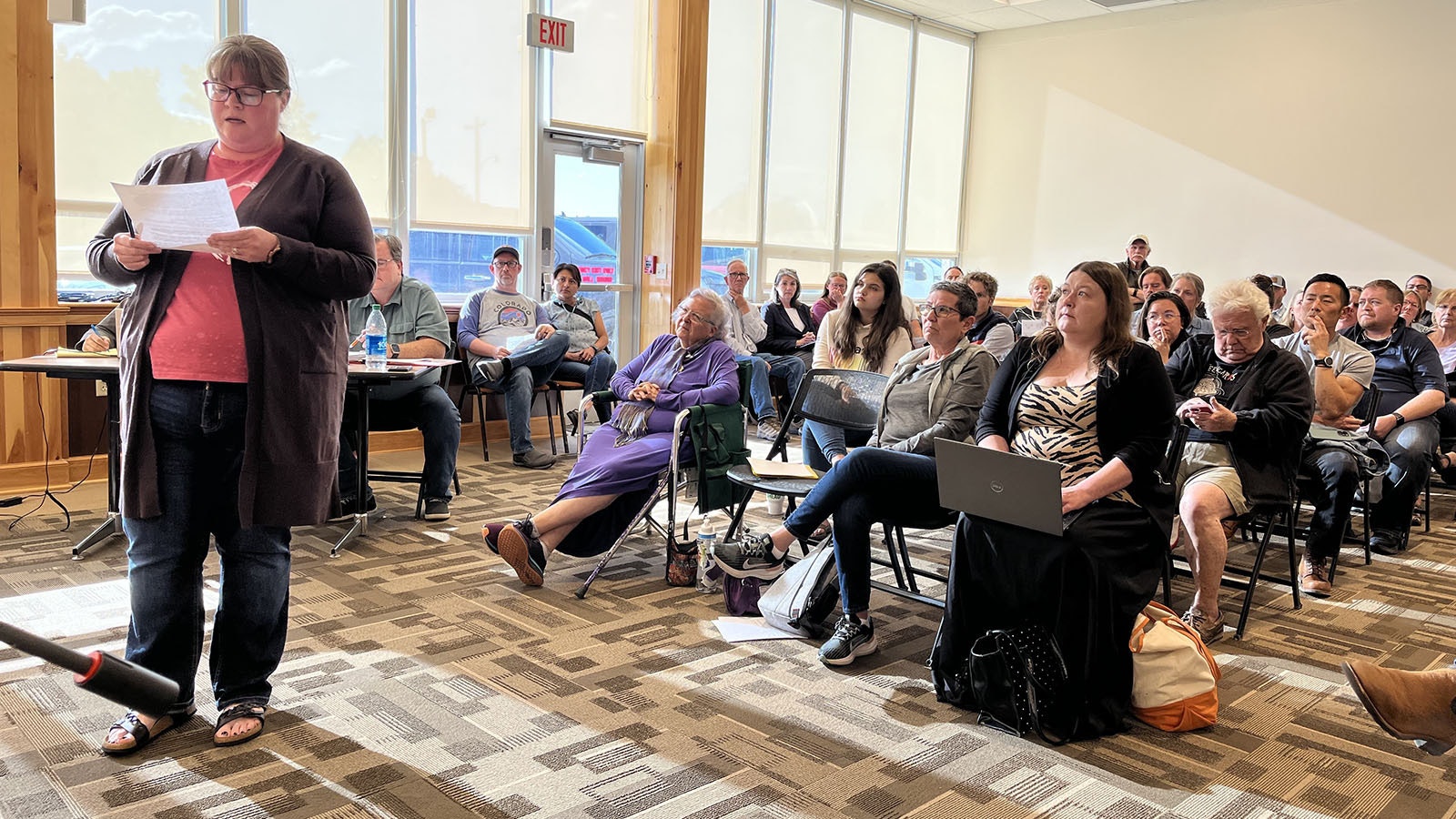
It was a packed room in Lander for four hours Tuesday night as the Fremont County School District No. 1 board met to adopt a new policy for weeding out sexually-graphic books.
Of two new policy drafts up for consideration, the board’s 4-3 majority voted to adopt the draft that critics of sexually graphic books in schools favored most.
The change follows months of controversy over "Let's Talk About It," a book in the Lander Valley High School library that is under a challenge review.
Proponents of keeping books like “Let’s Talk About It” in schools preferred the second policy draft, which failed.
The winning draft adds transparency requirements for staffers who remove books from school libraries so that a librarian or administrator who removes a book must explain the decision publicly, said Scott Jensen, board vice-chairman and main author of the policy draft.
“I want daylight on what’s happening in this process,” said Jensen. “Things shouldn’t happen in the dark.”
First Up, Librarian
A parent or resident following this new policy can complain about a book to the librarian or other staffer in charge of the book.
As a first step in the challenge process, the librarian may be able to remove the book if it’s discovered it doesn’t align with community’s values or the district’s mission, the new policy indicates.
That prospect spawned debate.
Board member Aileen Brew, author of the second draft option, said the challenge should go to an appointed committee instead of climbing up through the librarian, to the superintendent, then to the school board as in Jensen’s challenge policy.
Brew said an appointed committee would represent a more diverse swath of the district population than one librarian.
“Most of the time an individual comes in with a strong opinion — we all have a little intrinsic bias — and oftentimes those bigger questions about what (books) should remain should be something that has a review process, with a review committee to represent a broader perspective,” said Brew.
Now It’s Censorship?
Jensen rebutted. He characterized reaching straight for an appointed committee as hypocritical, saying the school lauds and defends its librarians’ professionalism and expertise when they are choosing books, but strips them of the ability to remove those same books if the acquisition turns out to be a mistake.
Librarians are discarding books all the time for irrelevancy, unpopularity, age and other factors, said Jensen.
“So why only if a parent raises the concerns … do we need to have a review committee to make sure that librarian isn’t censoring (books) on their own notions?” he asked.
“You might have the same book, ‘Let’s Talk About It,’ and a librarian ... comes to determine that book doesn’t meet the standards and criteria they believe fits within the library, and they choose to remove it,” Jensen said. “But because a parent brings it to their attention, now it’s censorship and it needs a committee?”
Brew pushed back, saying librarians may be tempted to cave to aggressive book challengers, and the result would be censorship.
Jensen said that is a risk of the new policy, but at least the librarian would have to account for that choice publicly under the transparency mandate.

Elected Vs. Appointed
Jensen also noted a policy provision letting the school board form a review committee at its discretion.
Brew’s proposed policy, conversely, would have required the district’s Curriculum Coordinating Council to build a review committee made up of the school curriculum director, a parent or community member, an administrator, language arts or reading specialist and library specialist.
An unsatisfied book challenger could appeal the committee’s decision to the school board.
Board member Karen Harms voted in favor of Brew’s policy draft, saying it conforms to existing policy requiring the board to delegate its authority to superintendents or designees.
“We need to honor that we have policies in place to delegate authority,” said Harms.
Jensen countered, calling subcommittees undemocratic.
“I don’t like the mandatory committee review. I think we already have a committee,” he said, gesturing toward the school board with both arms. “We have a democratically-elected committee sitting right here.”
Jensen posited that the school board, which is subject to both open-meeting laws and the scrutiny of campaigning, is bound to be more transparent than an appointed committee.
‘Out Of Context’
Board member Taylor Jacobs presented the results of a survey she dispatched on her own last month.
Of the survey’s respondents, 96.2% did not believe “Let’s Talk About It” is appropriate for the town’s high schoolers, Jacobs said.
Local resident Sarah Reilley called Jacobs’ survey biased and read her own survey results, in which 281 respondents answered “no” to the question: “Do you believe that books in school libraries should be banned for ALL students?”
There were 46 “yes” answers to that same question, Reilley reported.
“This book is fantastic,” said Reilley of “Let’s Talk About It.”
Jacobs’ survey had included the book's quotes about butt plugs, pornography and sexual kinks.
Reilley said these were “inappropriately taken out of context.”
A Spat On The Board
Harms and Jacobs exchanged tense comments.
Harms read from policies requiring board members to “represent all district constituents equally and honestly … refusing to surrender this trust to any special interest or partisan, political group,” to work respectfully with other board members and to delegate authority to the superintendent.
Jacobs said she knew these comments were directed at her and her decision to dispatch her own survey assessing “Let’s Talk About It.”
“I know ... you were directing it to me, because you don’t think I did this appropriately,” said Jacobs, adding that she’s a mom first, a board member second.
“I have the right to be a mom and share this content that I deem obscene, and obscene material is not covered under the Frist Amendment,” she said. “I respect our educators greatly, but they do not hold any authority over a parent, and what they think is best for their children.”
Some attendees applauded Harms; others applauded Jacobs.
Board Chairman Jared Kail also commented on the book, saying its library inclusion is a symptom of educators going “off the rails.”
Harms countered again, saying it’s unfair for board members to keep condemning a book for which the challenge process is still ongoing.
Jacobs challenged the book just before the school year ended under a policy requiring the superintendent to review it.
Jensen also bristled at the implication that he and Jacobs were acting on behalf of special-interest groups. He said he tries to represent all Lander families – including those who don’t show up to board meetings.
The Book, The Bible, The Cellphones
Numerous public commenters approached the microphone to rail against “Let’s Talk About It” or defend it, and to debate the conflicting policy drafts.
Their comments roughly mirrored similar comments in school board meetings throughout the state.
The book’s supporters:
- Implied that the board is transphobic and homophobic for strengthening its challenge policy.
- Said high schoolers can access pornography on their cellphones anyway.
- Said high schoolers are having sex and doing other forbidden things and should have sex literature to keep them safe.
- Said removing the book would be book-banning and censorship.
- Said parents can just opt their children out, but not control other parents' children.
- Said circulating images of sex scenes from the book are taken out of context.
The book’s critics:
- Said exposing children to pornography harms brain development and quality of life.
- Said parents who want to expose their children to sexually graphic materials can buy the book themselves.
- Said a school should focus on academics.
- Said opt-out policies don’t work because no parent knows about every page of every book in the school library.
- Quoted the Bible’s Luke 17:1-2, which says that people would be better off being thrown into the sea with a millstone tied around their necks than to cause “little ones” to stumble.
Clair McFarland can be reached at clair@cowboystatedaily.com.