BOULDER, Colo. — During his opening remarks Friday about the condition of the Colorado River, a Colorado law professor referenced a graphic from The New York Times indicating that most of the water used from the river goes to agriculture, particularly for growing livestock feed.
But after getting pushback from Wyoming rancher Pat O’Toole, University of Colorado law professor Mark Squillace admitted that perhaps using a “graphic from The New York Times” wasn’t the best way to kick off a discussion over so controversial a subject as water rights to the shrinking river.
O’Toole also balked at the suggestion that farmers and ranchers should stop growing alfalfa, as well as earlier remarks from former U.S. Interior Secretary Bruce Babbitt about “retiring” farmland.
“Oh my God, it (alfalfa) is the baseline, it’s at the bottom of the food pyramid,” O’Toole said.
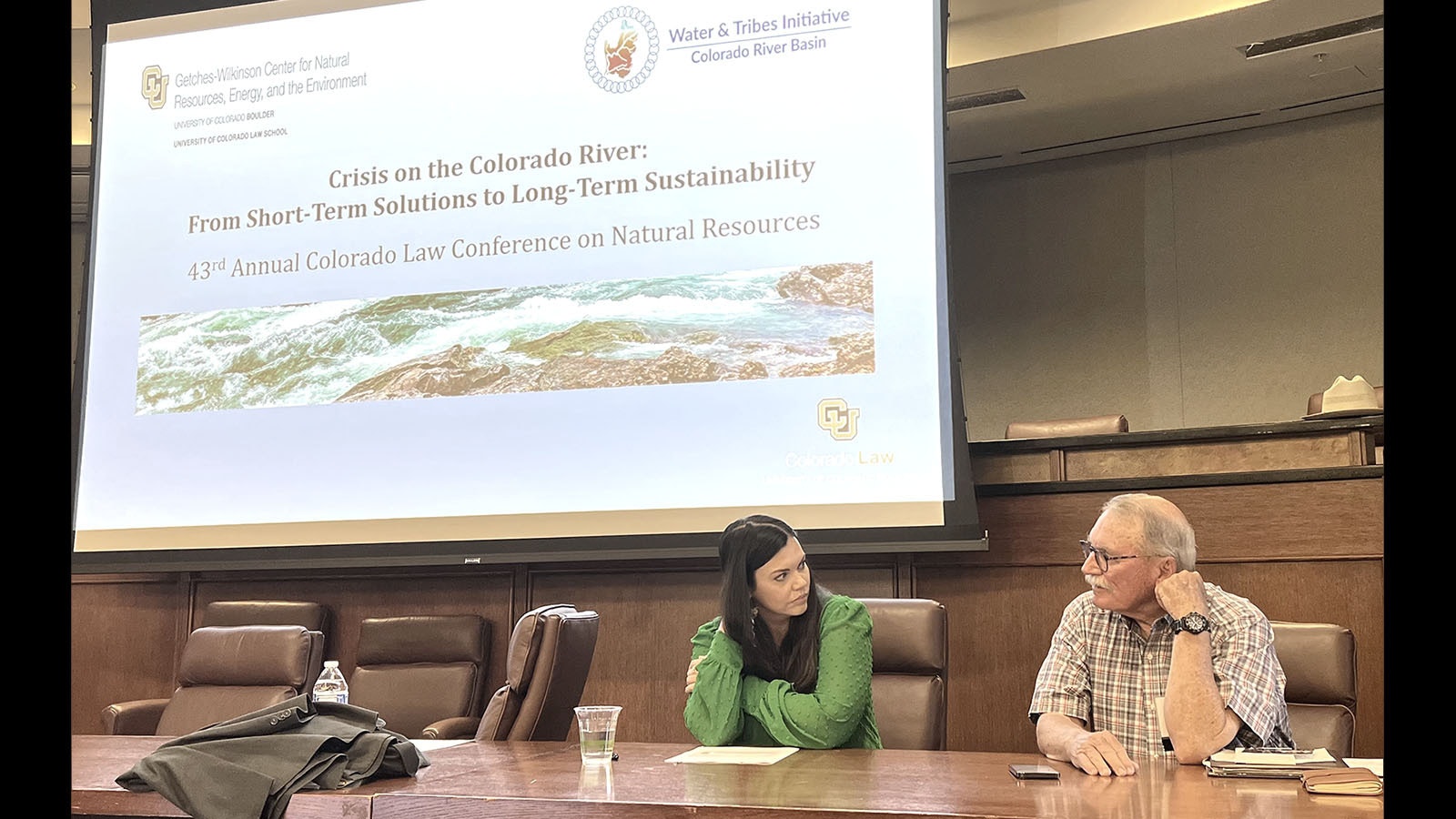
He, Squillace and others hosted a discussion on agricultural water use during the “Crisis on the Colorado River” conference in Boulder, Colorado.

Farmers And Ranchers Embattled, Weary
O’Toole, a former Wyoming state lawmaker, said his grandchildren are the sixth generation of his family to work on their ranch, which straddles the Wyoming-Colorado state line near the headwaters of the Yampa River, which is a tributary to the Colorado River.
He said many people don’t grasp “how scary” the situation is with America’s food supply, because the number of farmers is shrinking. And burdening them further by cutting access to Colorado River water doesn’t help.
“About 99% of famers are families,” said O’Toole, who was speaking on behalf of the Family Farm Alliance. “We’re individual families who are participating in something we think is good — producing food.”
Agriculture also helps to keep the land healthy, he added, which is a benefit to wildlife.
So, merely pointing out that irrigating alfalfa uses a large percentage of river water doesn’t give a fair picture, because as the most effective, profitable livestock feed, it’s the foundation for much of the food supply, including meat and dairy, he said.
O’Toole noted that the U.S. beef market recently had to be supplemented with beef imported from Paraguay, and quipped that “the remaining generation of Nazis in Paraguay get a market for their beef.”
His quip was in reference to the fact that after World War II, many Nazis sought shelter by fleeing to the South American country.

‘Crop Switching’ Should Be Voluntary
During his presentation, Squillace said that water could be saved if farmers switched from alfalfa to less thirsty crops, such as soybeans.
During his talk earlier in the day, Babbitt also suggested that buying out and “retiring” farmland has worked well in the Midwest and might also work in the Colorado River Baain.
It was also suggested that alternative crops, such as beets, could be grown for livestock feed.
O’Toole said alfalfa is profitable, so farmers and ranchers will want to keep growing it.
Speaker Meghan Scott, an attorney who works with farmers near Yuma, Arizona, said farmers are willing to make changes, but only if those changes are practical.
“I’ve never heard of people feeding their animals beet pulp,” she said. “I’m not saying there’s not people who do that, but I’ve never heard of it.”
Squillace stressed that any changes farmers and ranchers make should be voluntary.
“I’m all about this (crop switching) being a voluntary program,” he said.
It All Starts At The Headwaters
With all the attention being paid to the river, people are ignoring problems at the water’s sources, high in the mountains of Wyoming and Colorado, O’Toole said.
During his talk, he showed a slide of a photo he took during a recent horseback ride into the Medicine Bow-Routt National Forest near his family’s property. It showed the forest floor choked with jackstraw piles of dead trees.
“That is failed policy,” he said of the image. “This is our water supply. This is the headwaters of the Colorado River. It’s like that across hundreds of thousands of acres.
O’Toole later told Cowboy State Daily that he thinks all the deadfall in the forest is impeding the flow of water in the mountains toward the river’s watershed. So, the forest floor needs to be cleared of the dead trees and new saplings should be planted in their place.
‘Were In A Fight’
O’Toole said that as the situation on the Colorado River becomes more dire, farmers and ranchers face lawsuits from environmental groups, and other interests trying to take their water.
“We’re in a fight, and we know that,” he told the audience. “I told my kids, if you don’t want to fight, don’t come back (into agriculture).”
He also remarked that he doesn’t consider Babbitt to be a friend of agriculture, because during his tenure as Interior secretary under Bill Clinton, he vowed to “go after” ranchers and loggers.
Mark Heinz can be reached at mark@cowboystatedaily.com.