BOULDER -- Despite robust runoff from record snowfalls this past winter, the Colorado River is still in decline, and a 101-year-old water rights agreement isn’t doing any favors for Upper Basin states, which include Wyoming, a water expert said.
“The Upper Basin in 1922, when they agreed to take on that risk, they agreed to take on drought risk. They didn’t agree to take on a permanently reduced flow,” said Brad Udall, a senior scientist and scholar at Colorado State University.
“The entire risk of (reduced flow from) climate change falls on the Upper Basin, (and) that’s nonsensical,” he added.
Udall was one of the first speakers at the 43rd annual Colorado Law Conference on Natural Resources on Thursday. The conference convened at the University Colorado Campus in Boulder with the theme “Crisis on the Colorado River.”
Udall was referring to the 1922 Colorado River Compact, which obligates the Upper Basin states to provide 75 million acre feet of water every 10 years to the Lower Basin.
The Upper Basin states include Wyoming, Colorado, Utah and New Mexico. The Lower Basin states are Nevada, California and Arizona.
An acre foot is the amount of water it would take to flood an acre of land to the depth of 1 foot.
It Would Take 21 More Years Like This One To Solve Crisis
It’s been a good year so far for the Colorado River Basin, Udall said. Snowpacks averaged 250% of normal across the West, and roughly 170% of normal in most of the Colorado River Basin.
That’s led to some great runoff, Udall said. For example, Lake Powell has been refilling at the rate of about a foot per day.
However, this spring’s bounty won’t be nearly enough to reverse a 24-year trend of depletion along the Colorado, he said.
It would lake “21 more years like this one” to completely refill Lake Powell and Lake Mead, the two largest reservoirs in the Colorado River Basin, he said.
Udall blamed rising temperatures driven by climate change, which he thinks is probably driven by human activity, for the continuing depletion of the river, along with more development and greater demands for water.
Since 2000, nearly half the years have seen an overall loss of water along the Colorado River, he said. And there hasn’t been a “two-year fill period” yet this century.
“We might get lucky next year” and see such back-to-back “fill years” if winter 2023-24 is as snowy as this past winter was, he said.
‘You Guys Pretty Much Screwed Up’
While states and the federal government squabble over the Colorado River, it’s important that the river’s original users, Native American tribes, have a voice, said Nora McDowell of the Fort Mojave Indian Tribe, which has territory in Arizona, Nevada and California.
Since the West’s arid Southwest region has been settled, too much demand has been placed on the river, she said.
“If that river could speak today, what would it say? It would say, ‘You guys pretty much screwed up,’’ she said.
“We have to do a better job” and can’t keep relying on the 1922 compact to manage the Colorado River, McDowell said.
Udall agreed that the compact, which divides the management of the Upper Basin and Lower Basin, is probably outworn. Instead, the entire river basin should be managed as a unified system, and the Upper Basin states can’t continue to bear the burden of shortages in the Lower Basin.
Tri-State Deal Praised
However, he and other speakers praised California, Nevada and Arizona for recently striking a deal to reduce their river water use by 3 million acre feet through 2026.
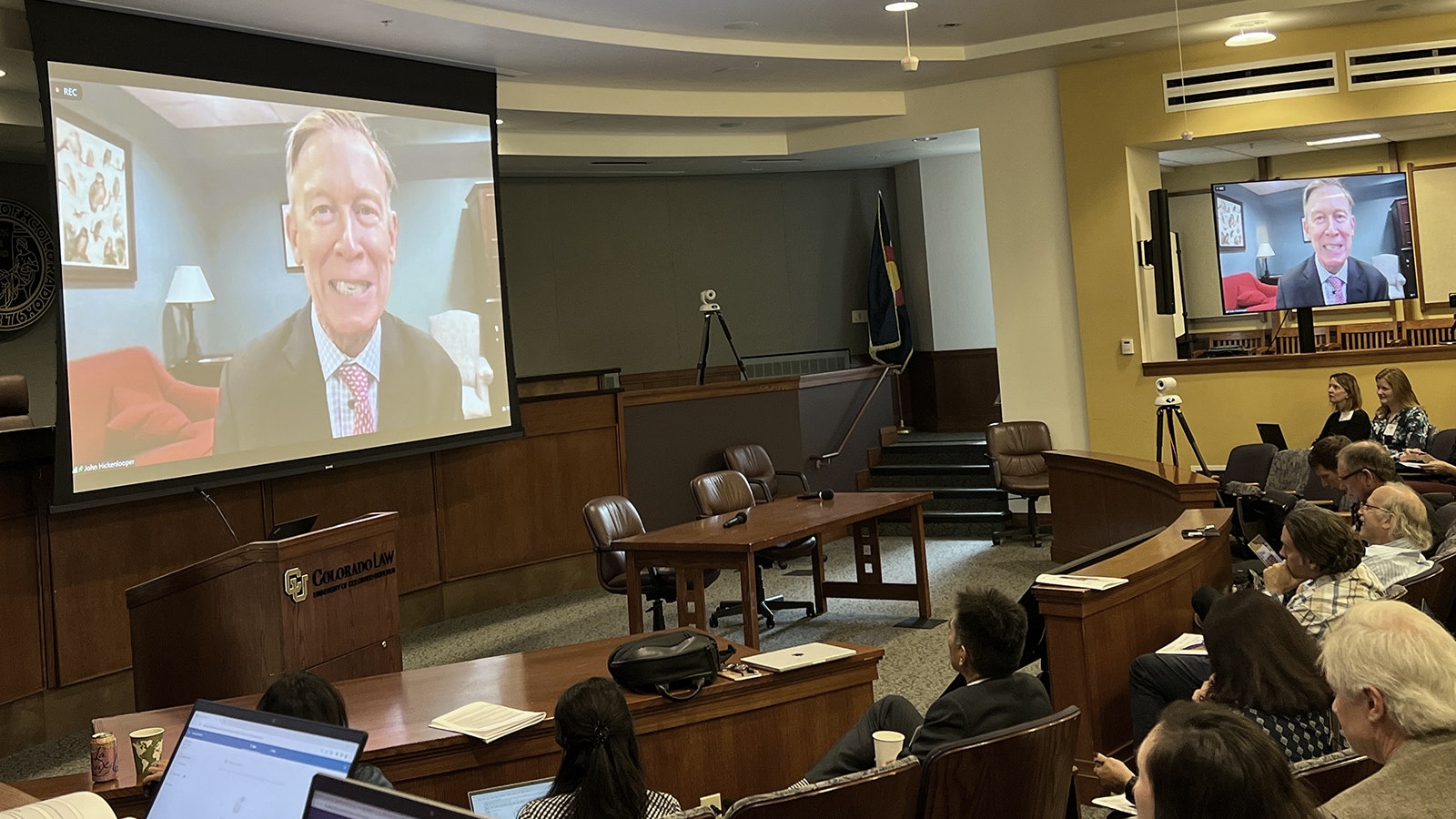
Addressing the conference via Zoom, U.S. Sen. John Hickenlooper, D-Colorado, agreed that it’s best if states can work together rather than dragging things through the courts.
Hickenlooper added that President Biden’s Inflation Reduction Act should include hundreds of millions of dollars for infrastructure improvements across the drought-stricken West, including for the Colorado River Basin.
Mark Heinz can be reached at mark@cowboystatedaily.com.