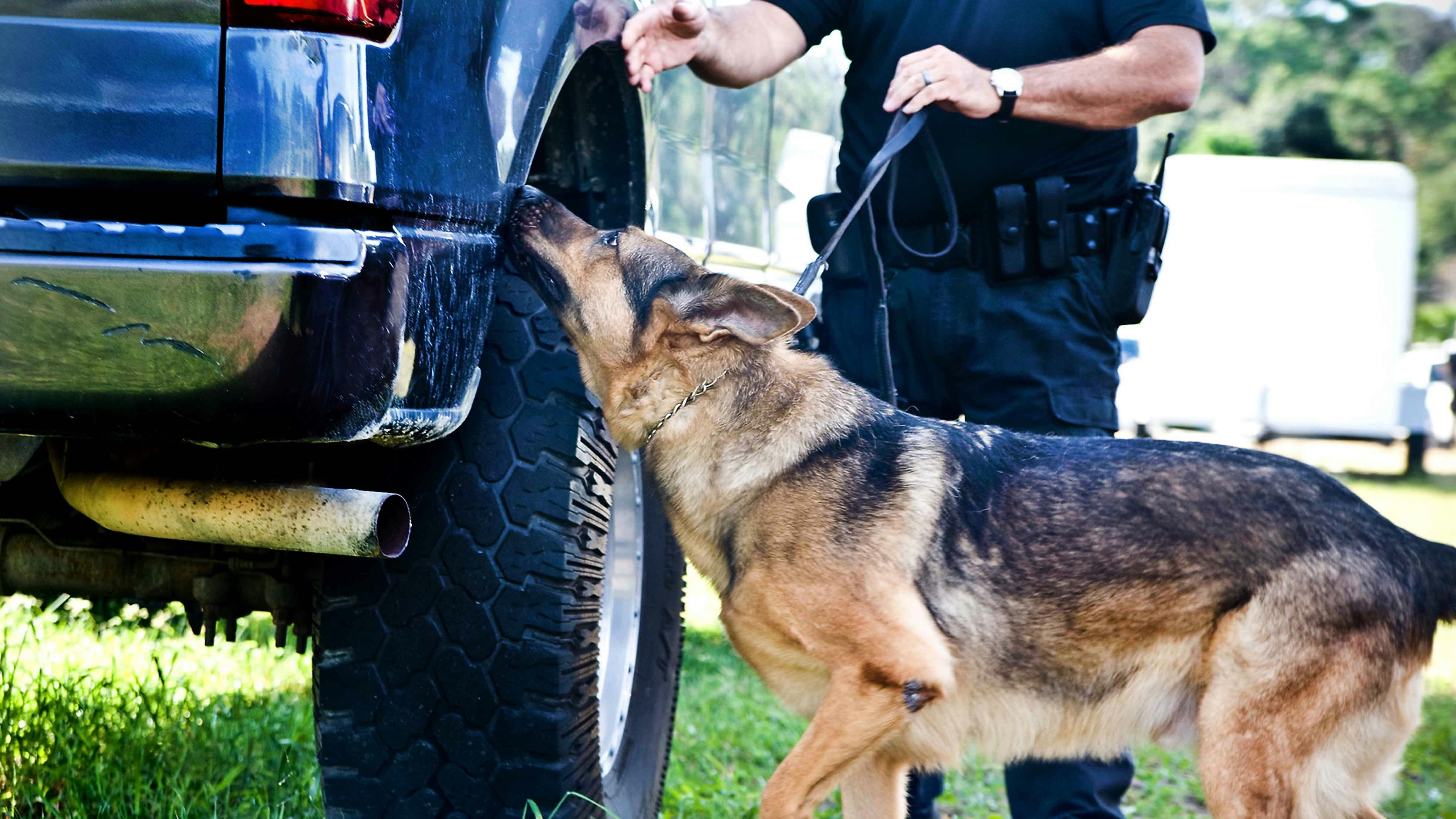
The Wyoming Supreme Court on Wednesday ruled that police drug-detection dogs don’t need probable cause to sniff search the outsides of vehicles.
The decision draws from and clarifies earlier case law, including U.S. Supreme Court decisions holding that a drug dog’s sniff of a vehicle’s exterior isn’t an invasion of privacy because it’s “minimally intrusive” and can reveal only drugs, over which people can’t claim a privacy interest.
People have no “legitimate expectation of privacy in the airspace around a vehicle,” the Wyoming Supreme Court also ruled in 2020.
Proponents of Wednesday’s ruling say it’s one more tool for Wyoming law-enforcement officers to use to protect people from dangerous drugs, while detractors say it’s an erosion of privacy rights for Wyoming residents.
Looking For A Ping
The ruling is “an unfortunate sidestep,” Tyler Lindholm, Wyoming director for Americans For Prosperity, told Cowboy State Daily on Thursday.
Lindholm’s group advocates for individual interests in the criminal justice system. He served prior as a Republican, Libertarian-leaning delegate to the Wyoming Legislature.
“A person has the right to a reasonable amount of privacy,” said Lindholm. “Does (this decision) now indicate that drug dogs could be walked from parking lot to parking lot, looking for a ping?”
Lindholm said he hopes the state Legislature will address the issue to bolster individual privacy rights.
Murky With Marijuana
For example, the two people convicted of drug possession and possession with intent to deliver who took the issue to the state’s high court, challenged drug dogs’ reliability. They argued that drug dogs may alert on hemp, which is legal in Wyoming, and prompt unjust police searches.
If dogs could confuse hemp and marijuana, the appellants argued, then the court should recognize more of a privacy right over marijuana than other drugs.
Ultimately, the court declined to address that hypothetical, saying the convicts didn’t prove whether the dogs on their respective cases could or could not tell the difference between the two substances.
“This highlights the fact that the state of Wyoming needs to take action in a bigger way, and they need to do so quickly,” said Lindholm.
Lindholm supports a law shift toward civil penalties and treatment for marijuana law violations, rather than criminal penalties.
Free Air
State Rep. Art Washut, R-Casper, countered, saying the court’s decision makes perfect sense. Washut is a law-enforcement expert who chairs the House Judiciary Committee.
“I think it was the right decision,” said Washut, adding that federal and state case laws addressing law-enforcement procedures tend to align, so he expected the court to rule the way it did.
“It’s hard to say you have an expectation of privacy in the air surrounding your car or the air surrounding your body, so I think it’s consistent with what we’ve seen in Fourth Amendment case law all along,” he said.
The Wyoming Constitution’s promise of individual privacy is more protective than the Fourth Amendment’s, the high court noted, but not protective enough to bar it from siding with the U.S. Supreme Court on the free-air issue.
‘Always Risky To Comment On Hypotheticals’
Washut was hesitant to comment on the appellants’ hypothetical of dogs who can’t distinguish hemp from marijuana.
Lindholm raised another hypothetical: The prospect of “malcontents” rubbing illegal drugs on their enemies’ vehicle exteriors to prompt a search of whatever — related or unrelated things may be in that vehicle.
“It’s always risky to comment on hypotheticals,” said Washut, adding it’s not a new worry. “It’s always possible for somebody to plant contraband on somebody, I suppose.”
Officers are trained to note “the totality of circumstances” in an investigation to determine whether there is criminal activity, Washut said.
“Only if the officer then finds contraband will there be a prosecution,” he said.
Washut added, however, that other prosecutions from other findings are also possible under the plain view doctrine.
“If they find a sawed-off shotgun in your back seat, that sawed-off shotgun is going to be recoverable, and you might have a spinoff prosecution,” he said.
Legislature’s Next Move
If advocates for looser marijuana laws keep pushing privacy rights based on hypotheticals like hemp triggering drug searches, Washut said the Legislature could go the other direction and simply put more restrictions on hemp.
“There’s not a guarantee, as the Legislature decides to take up the topic, that we’ll always move the needle in the direction the marijuana advocates desire,” he said.
As for the court’s decision not to rule on hemp-prompted searches specifically, the question could come up again in a case more focused on the chemical distinctions between the two, Washut said.
Put It In The Toolbox
Rep. Barry Crago, R-Buffalo, who also works in the civil division of the Johnson County Attorney’s Office, told Cowboy State Daily he’s grateful law enforcement have one more tool with which to protect people from dangerous substances.
Crago emphasized that this case impacts more than mere marijuana possession.
“Wyoming has a very large drug-trafficking problem which includes fentanyl and other harmful drugs, and as a legislator I won’t be inclined to reduce the tools we’ve given law enforcement to fight that problem,” said Crago.
About This Case
Two people convicted for drug possession, Maria Anne Joseph and Jackson Elliott Tarzia, both challenged drug dogs’ authority in their appeals to the state Supreme Court, which ended with Wednesday’s ruling.
Besides arguing that Wyoming’s privacy promise is stronger than the federal right and drug dogs may confuse hemp and marijuana, they also argued that Wyoming is a “freedom-loving state.”
The court called that latter argument generalized and unconvincing.
Mushrooms And Marijuana
Charged in 2021, Joseph pleaded guilty to drug possession with intent to deliver after a Wyoming Highway Patrol trooper changed his mind about letting her off with a warning for crossing the highway centerline in Carbon County.
As Joseph’s story wandered and her behavior struck the trooper as unusual — also, her back seat was loaded with blanket-covered cargo — the trooper decided instead to summon Carbon County Sheriff’s Deputy Casey Lehr and the drug dog Zeus.
Zeus ran around the exterior of the vehicle and alerted, prompting a search and the discovery of 25 pounds of THC wax, 2 pounds of psilocybin mushrooms and 58 pounds of raw marijuana plant.
When the Carbon County District Court wouldn’t let Joseph keep Zeus’s results out of the evidence pool, she pleaded guilty to marijuana possession with intent to deliver.
The court sentenced her to three years’ probation, with the possibility of three-to-five years in prison if she failed probation.
Also That Year
Wyoming Highway Patrol Trooper Brandon Deckert on Aug. 4, 2021, monitored for criminal activity by visiting with people who stopped for fuel at a gas station near Laramie, Wyoming.
He saw a 2021 Yukon Denali pull in for fuel. It seemed like a rental vehicle, which was “of interest” to him, according to the high court’s summary of the events in its opinion.
Deckert chatted with one man who was pumping gas, who told Deckert “we” were looking at real estate.
Jackson Tarzia emerged from the gas station and was “rigid and standoffish” as he came back to the Denali.
When one of the men said the Denali was a rental, Deckert asked to see the rental contract. Tarzia tried to show Deckert the contract on his phone; he was breathing heavily and his hand shook as he held the phone, the opinion recounts.
Deckert noted little inconsistencies in the men’s story about their travels. He called for backup, including the drug dog Yeager.
Yeager alerted on the right rear wheel well and door area.
Deckert searched the vehicle and found 149 vacuum-sealed bags of raw marijuana in duffle bags.
Tarzia, like Joseph, asked the court to suppress Yeager’s findings and the court denied that motion.
He pleaded guilty to one count of marijuana possession. The court sentenced him to two years’ probation, with three-to-five years in prison possible if his probation were revoked.
Clair McFarland can be reached at clair@cowboystatedaily.com.