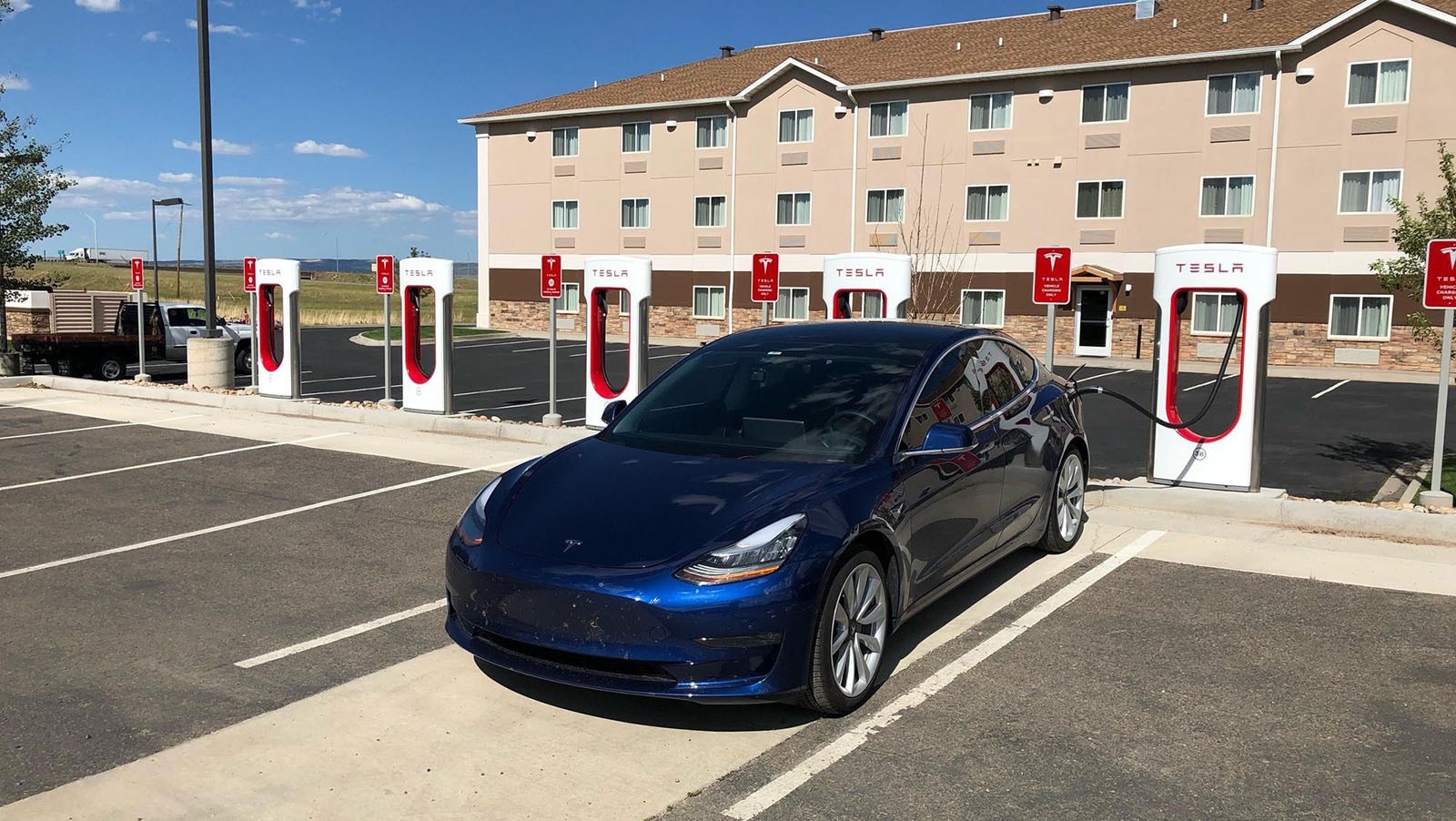
A federally funded program to build electric vehicle charging stations across Wyoming is on hold over concerns the state could be stuck with a hefty bill if unprofitable stations are abandoned.
The National Electric Vehicle Infrastructure (NEVI) Program offered Wyoming $24 million over the next five years to build 17 charging stations along interstate corridors.
The program requires a 20% match from private businesses, which would build and operate the stations. The feds will kick in money to support the stations’ operations for up to five years. The program required no state money.
After five years, the business is on its own.
That’s where the Wyoming Department of Transportation is worried it will run into problems.
Doesn’t Pencil Out
At the Wyoming Legislature’s Joint Transportation Highways Military Affairs meeting last week, Darin Westby, interim WYDOT director, said that research the department has done suggests these stations won’t be profitable for 20 years, let alone in five when federal support money would run out.
“It would take a significant amount of time for it to ever pencil out,” Westby said.
The wording of the legislation that created the NEVI program, Westby explained, suggests that if a station owner were to decide not to continue running a station at the end of the five years of operational support, the owner could ask the station be removed from the property. The state would have to pay for the removal and reimburse the federal government for any federal money used to construct and support it.
“The last thing we want to do is to take more money off of the roads and pay that back to the federal government,” Westby said.
The department was ready to release a request for proposals (RFP) to find interested contractors to build the EV charging stations. Once the department realized it could be on the hook for the money, WYDOT reversed course and put the brakes on the program.
“We pulled back the reins on the NEVI program. We had the RFP sitting on the shelf. It was ready to go out the door. At the last moment, we pulled back and said, ‘Let’s pause,’” Westby said.
Needs New Pencils
Patrick Lawson, owner of Wild West EV, told Cowboy State Daily he’s disappointed by the decision.
Depending on what was in the RFPs, he was planning on pursuing the funding.
He said the department’s analysis of how long it would be before the stations are profitable are using old data.
“I don’t believe they’d be unprofitable after five years,” Lawson said.
He said that the department could just stipulate in the RFPs that the state wouldn’t be held responsible for any costs should the station be abandoned.
Lawson said Wild West EV’s station usage increased 50% every year for the past six years. Likewise, electric vehicle (EV) sales are increasing steadily every year.
“The best selling car in the world right now is the Tesla Model Y,” he said.
The NEVI plan was developed a couple years ago, when EV sales and usage were considerably lower. Based on those figures, Lawson said, the department would estimate profitability two decades out.
With the current rate of EV adoption, he said anyone building a station will see profitability at least within five years.
“I don’t think any of them are going to be abandoned unless they’re just poorly managed,” Lawson said.
Lawson said there are other federal discretionary programs, as well as other federally supported state programs, he’s still going to pursue to build more stations.
Rough Road
The department has been on a bumpy road throughout the process to get the funding through the program.
The program requirements were set up in Washington, D.C., and they appeared to have little consideration for how charging stations would work in a rural territory.
The program required stations to be located within 50 miles of each other and within one mile of an interstate exit.
In Wyoming, where towns are greater than 50 miles apart, with little infrastructure in between, the department requested exemptions for the requirements. Most of them were denied.
Then-WYDOT director Luke Reiner said at the time that the department was trying to get some guidance from the Federal Highway Administration on why the exemptions were refused, but the administration was unresponsive.
Make It Make Sense
Sen. Brian Boner, R-Douglas, co-chair of the committee, said Gov. Mark Gordon had at one point gone to Washington, D.C., to have discussions with senior members of the U.S. Department of Transportation in hopes of getting more cooperation with Wyoming’s needs.
Boner asked Westby what’s the process by which WYDOT could get the waivers it needs for the 50-mile rule to something more accommodating of Wyoming’s rural characteristics.
“I think the age-old saying is that if it makes sense, it’s not government,” Westby replied.
Westby said the federal government flexed on the requirements only so much for the placement of the seven stations in the first phase of the buildout. That was as far as the negotiations got them.
It was the concern about being on the hook for abandoned stations that paused Wyoming’s participation in the program indefinitely.
“Right now, as NEVI goes, from the state of Wyoming perspective, we are not going to release the RFPs,” Westby said.
Contact Kevin Killough at Kevin@CowboyStateDaily.com