Since six trained hunting retrievers died from apparent algae poisoning at a popular training ground near Salt Lake City earlier this month, there has been more than heart-wrenching grief for many in the wake of the tragedy.
“It’s a dog owner’s worst nightmare. I can’t imagine what (Josh Conrad, the dogs’ trainer) is going through,” Jimmy Lynn told Cowboy State Daily. “These dogs are priceless. They are highly trained athletes. Only someone who is in the sport know what they’re worth.”
A Utah resident, Lynn frequently hunts in Wyoming. Last fall, he was on a deer hunt in the remote Hoback Peak region in northwest Wyoming. Unknown persons, who Lynn described as “dirtbags,” stole a trophy-sized mule deer head from his campsite.
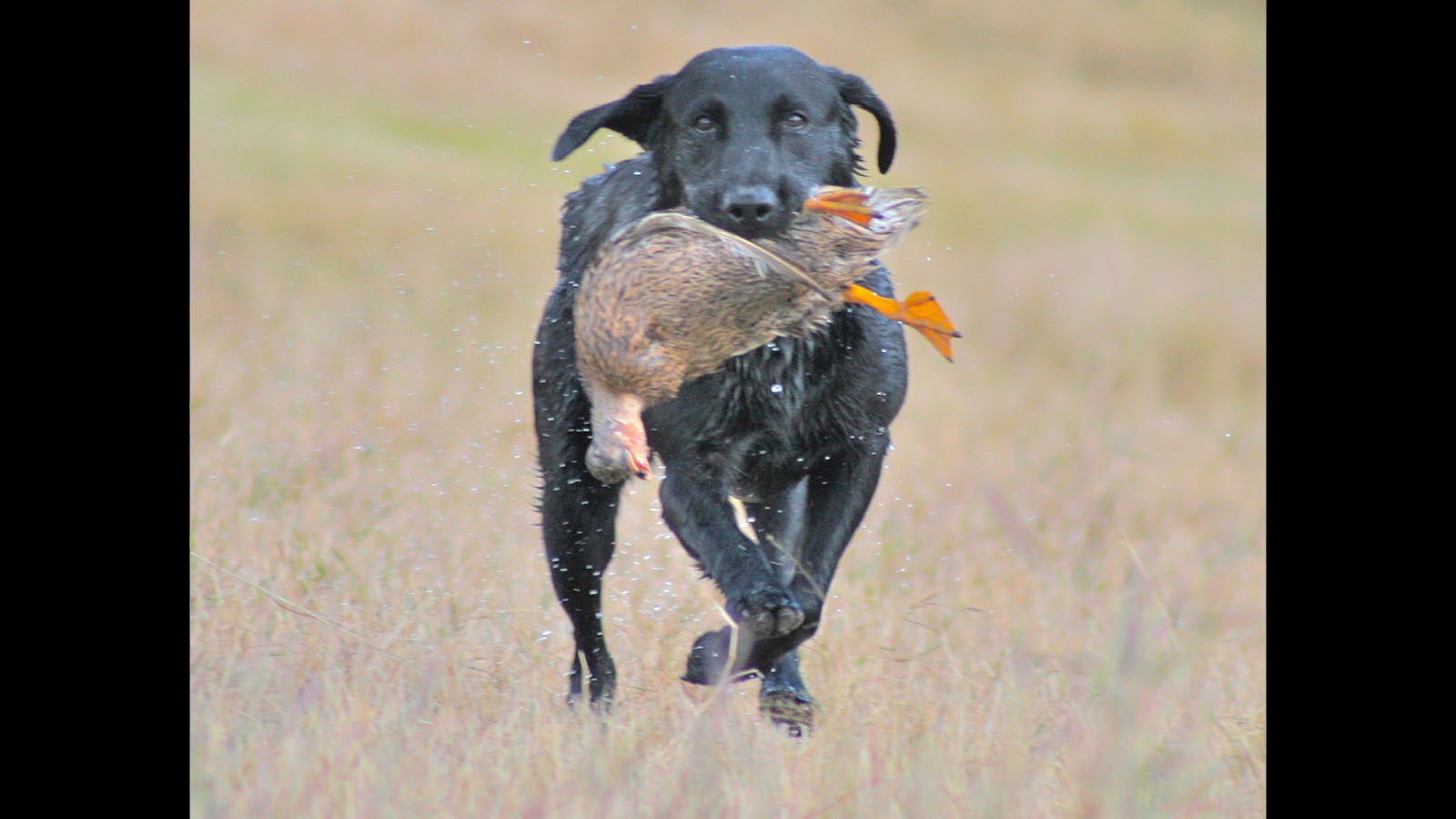
When he’s in the low country, Lynn likes to hunt waterfowl with his highly trained retriever Baily, who was safe and sound on Tuesday.
Field dog trainer Marcy Wright of Wellington, Colorado, said the connections that the dogs have with their owners and trainers are tremendously strong, so to lose six dogs at once is completely devastating.
“We spend every minute of every day with the dogs,” she told Cowboy State Daily. “It would sink me if that happened to me. We love these dogs like they’re family.”
Wright helps host competitive field dog trials in the Wellington area, which draw participants from Wyoming.
The culture that’s built up around field dog trials is tightknit, said Wright, so the loss of the dogs in Utah sent reverberations of shock and sadness across the West.
Blue-Green Algae Suspected
It’s suspected that the dogs were fatally poisoned after eating dried cynobacteria, commonly called blue-green algae, according to reports.
In a statement to field trial dog trainers and owners, Conrad said that on May 17, he let 16 dogs out to “air” (relax and romp) when he noticed several of them gobbling what he thought were goose droppings, so he rounded the dogs back up.
Later, numerous dogs started to fall ill, and six of them — ages 6 months to 8 years — eventually died, Conrad said.
It is suspected that what the dogs had eaten was actually dried blue-green algae, he said.
Specialized Sport, Huge Investment
Field dog trials are highly competitive events that demand a seemingly near-psychic connection between trainers and their dogs.
They are based off waterfowl and upland bird hunting scenarios.
In some events, a quarry, either a dummy or an actual bird, is hidden while the dog is kept at a distance with no way of knowing where the quarry is. The trainer must guide the dog to the quarry using commands such as whistles and hand signals.
Bringing a dog up to big-league competitive level requires a huge investment of time, money and heart, Lynn said.
“Well, you gotta figure you buy a puppy with a stacked pedigree for three to five grand ($3,000-$5,000) to start,” he said “You either train it yourself or pay a pro to train it for $900-$1,000 a month.
“You go run these AKC (American Kennel Club) events, and if your dog does well and wins, they get titles behind their name, which shows they are highly trainable and good for breeding.”
Bloodlines are prized, Lynn said. Even a “straw of sperm” from a male field trial dog with a winning bloodline can go for thousands of dollars.
Wright said that training and running dogs in field trials is enthralling.
“It’s very, very difficult to win a field trial,” she said. “It’s almost like playing the perfect round of golf, running a perfect trail with your dog — there’s just no other feeling like it.”
A Toxin To Avoid
Blue-green algae blooms have caused concern in Wyoming. They toxins they produce can cause illness in humans and are frequently fatal to dogs.
As recently as last summer, the Wyoming Department of Environmental Quality issued warnings about blue-green algae, particularly in warm, stagnant water.
Warnings were also issued in 2019.
Mark Heinz can be reached at Mark@CowboyStateDaily.com