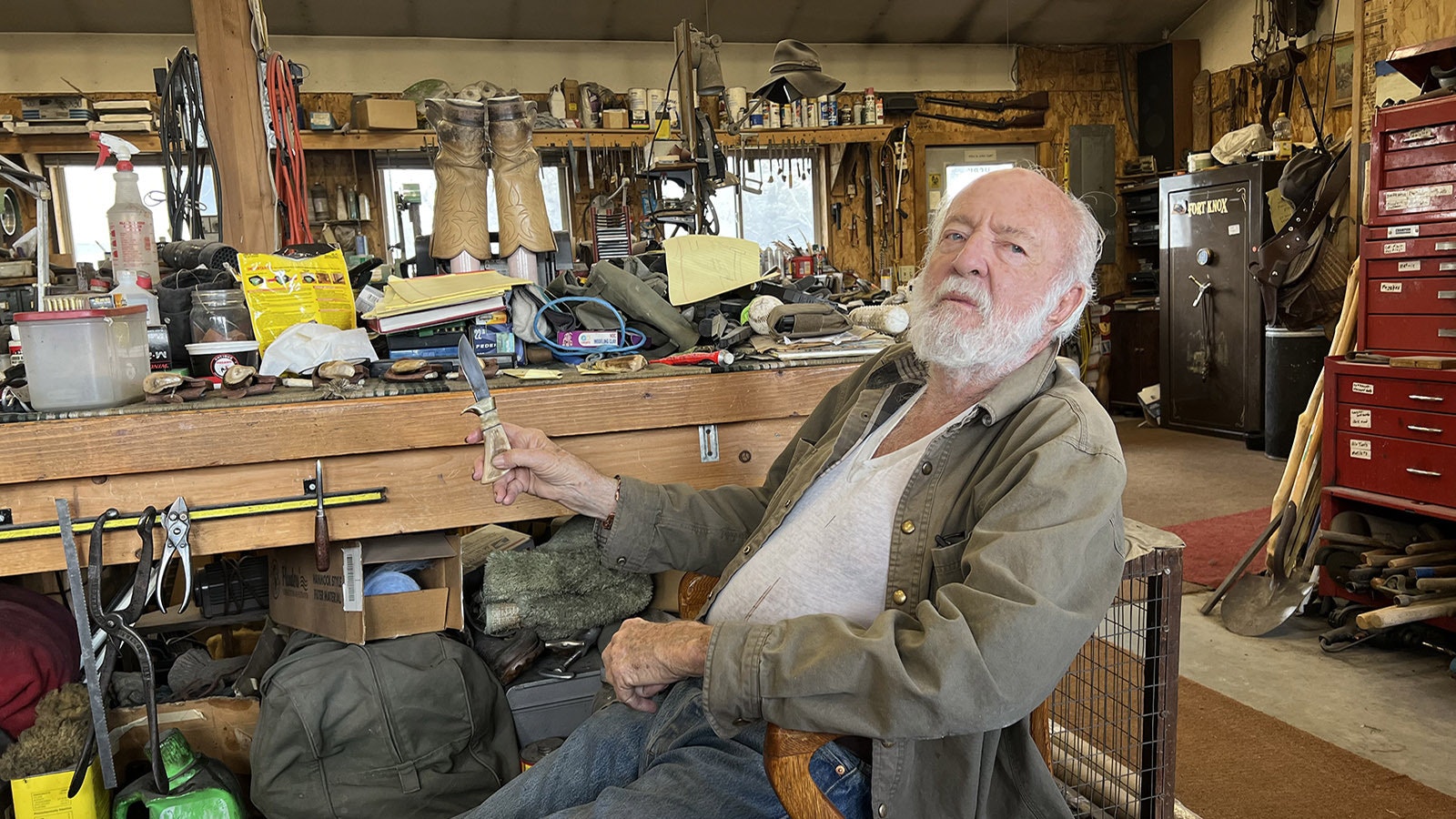
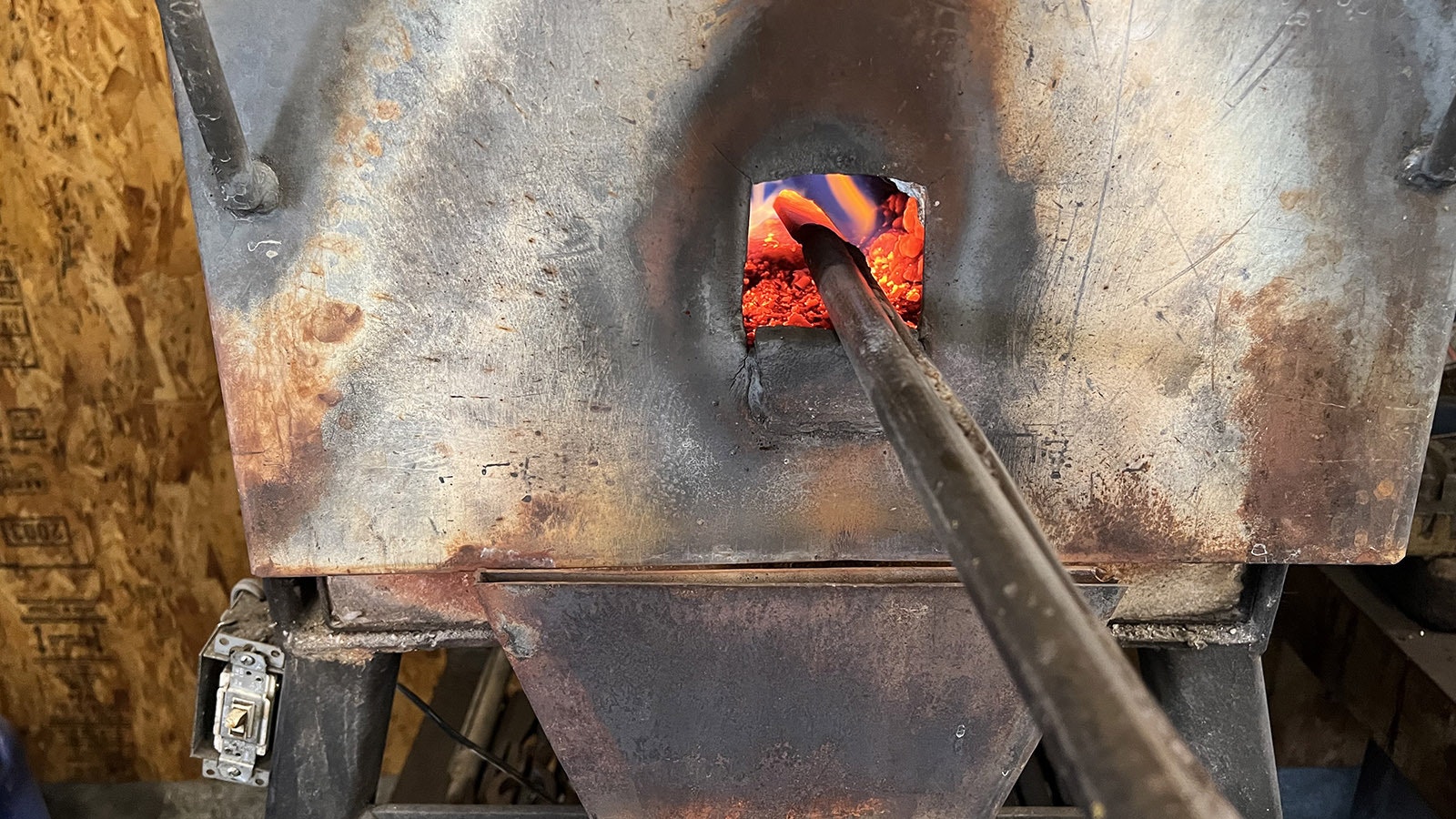
In Ed Fowler’s workshop just outside of Riverton, Wyoming, the unmistakable and enrapturing smell of searing steel permeates the air as a rod with the basic blank shape of a knife on the end rests in a forge, slowly heating up to a malleable red-hot.
Fowler’s close friend and apprentice, Chris Amos, reckons it’s the carbonizing effect that produces that and other “primal” smells, such as meat searing on a grill.
“It’s a smell that tell us, ‘This is a good thing,’” he said.
The white-bearded Fowler watched from a chair near the end of a long, cluttered workbench.
For him, his lifelong relationship with steel and heat started long ago with a bedtime story.
“When I was about 10, my mother told me the story of a legendary sword that wouldn’t cut an honest man and couldn’t be broken,” he told Cowboy State Daily. “Ever since then, I was seeking my ‘Excalibur.’”

‘In Wyoming, I’ve Been Free’
Fowler fashioned his first knife out of wood when he was just a boy. He still has it.
As he grew into adulthood, he set his blade-forging dreams aside for a while as full-time work beckoned. By the early 1970s, he was working as a police officer in Fort Collins, Colorado.
When his father fell gravely ill, Fowler moved to Riverton to help. He took care of the property and raised sheep there.
And starting in the 1980s, he slowly built up his workshop adjacent to the main house. There, he took up forging knives from steel — the quest for his “Excalibur” had begun anew.
Although rough circumstances brought him to the Cowboy State, he’s grateful to have found a home here.
“In Wyoming, I’ve been free,” he said. “The most important aspect of this state is the freedom.”
That freedom has included honing his knife-making skills as he’s seen fit. What started off as a boyhood dream turned into a hobby, and eventually a craft.
Now, the knives that he and Amos forge and craft from raw steel are custom-made for buyers all over the world. They sell for $2,000 or more each.
They’re preparing to take 14 of their prime creations to the Blade Show, set for June 2-4 in Atlanta, Georgia. https://bladeshow.com/home/
It’s the largest, most prestigious knife show in the world, Fowler said.
‘American-Made’ Steel Is The Best
When he started making knives, Fowler used whatever raw steel he could find.
He had to melt down ball bearings for many of his earlier creations. However, those bearings came from all over, and the quality of the steel could be sketchy at times.
Then he made a friend, Rex Walter of Pennsylvania, who gave Fowler a direct line to some of that state’s legendry steel.
There’s nothing else like it, he said, as he hefted up a block of Pennsylvania steel.
“This is American-made,” he said. “It’s supreme.”
Mastering The Craft
As the years passed, Fowler learned all he could about the art of forging blades from steel through trial and error and consulting experts.
He also read voraciously — about metallurgy, knife-making and whatever else that interests him.
“My former housekeeper told me that if I bought one more book, she was going to quit,” he said.
As they mastered their craft, Fowler and Amos have passed their knowledge to others. They offer knife-forging classes and have had students from as far away as Japan and Germany, Amos said.
‘Happy Steel’
Forging knives requires deep knowledge of the physics and chemistry of good steel.
It’s all about just the right temperatures, using water to “quench” the steel at the right intervals, and the “grain” of the metal, Fowler said.
“Think of the rings on a tree. The tighter the rings, the stronger the tree is,” he said.
Or, think of concrete, Amos said.
“What goes into a foundation versus what’s used for sidewalks,” he said.
Ideally, a knife blade should be hardest at the edge, and gradually soften toward the spine, Fowler said.
Amos said the proper heating process can gradually separate the elements of steel — the iron, magnesium and other components. The trick is to shape the steel at just the right time so the components will meld back together in such a manner that “it’s happy in that shape,” he said.
“Happy steel” is a phrase Amos said he learned from Fowler.
“Happy steel is strong steel,” Fowler said.
Stress Test
The hallmark of a good blade is a degree of flexibility, Fowler said. He and Amos test their steel formulas by putting sample blades into a vice and bending them back and forth to see how much they can take before the metal starts to fail.
The quality of the steel can be judged not only by how many bends it can withstand, but the nature of the failure when it finally happens, Fowler said.
“Good steel won’t crack. It will tear, like cloth,” he said.
No Point In Swords
Despite Fowler’s craft being inspired by King Arthur’s legendary sword Excalibur, he and Amos said they’ve never made swords, and don’t plan to.
That’s because the deepest pride they take in their work is knowing a blade will actually be used. They make knives for utility, not just for show.
“‘Art knives’ are sort of taking over the market,” Fowler said. “I feel that the greatest art you can put into a knife is function and safety,” he said.
That includes good hand guards to keep a user’s fingers from slipping onto the blade, he said. The proper shaping of handles is also vital. He and Amos fashion handles mostly from sheep horns but will occasionally use other material such as elk antlers.
Given the hours and care they pour into each creation, they want to know their knives will be used and fully appreciated.
So, they’re not interested in making swords, which would just end up hanging on walls as conversation pieces.
“Putting all the effort into something that would never actually be used, what’s the point?” Amos said.

Couldn’t Have Done It Alone
Fowler said he never could have brought his craft to its pinnacle without Amos. About five years ago, Fowler started having serious heath problems, including cancer and blood clots.
And Amos was there for him, not only to learn everything he could about knife forging, but to help Fowler win his health battles.
Last year, the road out of his property was completely flooded, Fowler said.
“Chris used a canoe to get me to chemotherapy,” he said.
Fowler has recovered, but he still relies on Amos to carry out some of the more difficult physical tasks around the workshop.
“If it wasn’t for Chris, this (trip to the Blade Show) would never have happened,” he said.
‘Starry Night’ Fulfills The Quest
Fowler’s long quest for the perfect blade ended recently. He created a knife with unique patterns in the blade, resembling the patterns in the famous Van Gough painting “Starry Night.”
To the layman’s eye, they might seem interesting. But Fowler explained that expert metallurgists will recognize them as indicators of superb tempering and grain in the steel.
He calls the knife “Starry Night” and said it represents everything he’s aspired to.
“This is my Excalibur,” he said as he held “Starry Night.” “This is the culmination of my life’s work.”
Now that the quest has been fulfilled, what’s next?
Fowler said he’s content watching Amos continue to grow in the craft of knifemaking.
That will leave Fowler more time for his other great passion.
“I think I’ll read,” he said.
Mark Heinz can be reached at Mark@CowboyStateDaily.com