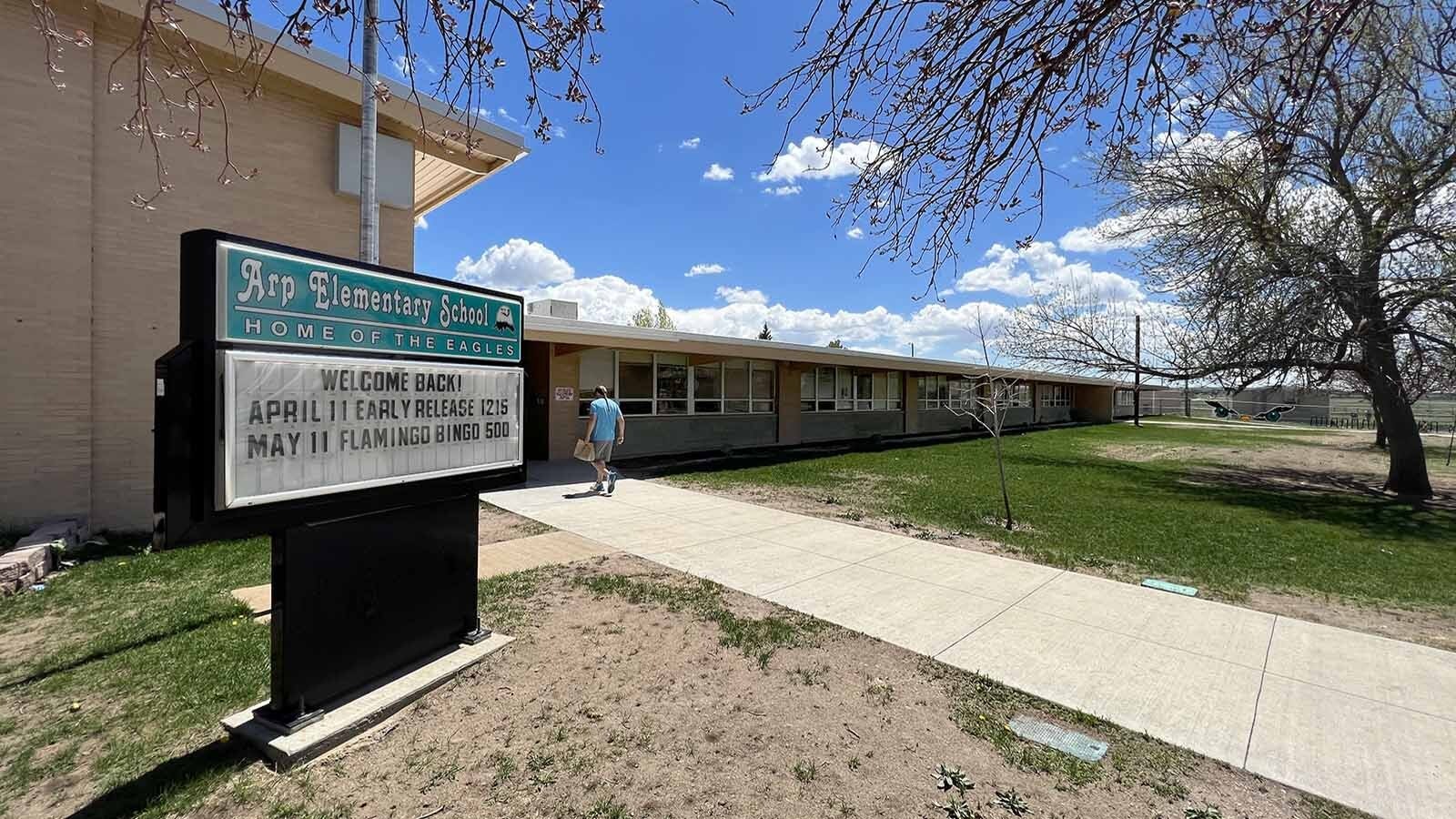
To say the students of Arp Elementary School in South Cheyenne deserve better is likely an understatement.
The infrastructure of the 62-year-old school facility is run down and falling apart, including recent problems with mice, bugs, sewage and holes and leaks in the walls.
“We’ve done the best we can for a building that’s pushing over 60 years old now,” Arp Principal Steven Loyd said.
The optics aren’t great.
Nearly 70% of the students at Arp are enrolled in the free or reduced school lunch program.
“Our families and our community is really resilient around here,” Loyd said. “There’s a lot of history (in the building) so that’s hard, but at some point, everybody realizes that has to make way for progress.”
State Rep. Tamara Trujillo, R-Cheyenne, who represents a portion of South Cheyenne, took a sharper tone on the condition of the school in a low-income area when speaking to Cowboy State Daily on Friday afternoon.
Trujillo said she grew up being told her working class South Cheyenne community was on the wrong side of the railroad tracks, but now she feels like her part of town is being treated like it's on the wrong side of the state.
“It’s classism at its best,” she said.
Bursting At The Seams
Arp also is crowded at 165% of its designed capacity.
The school has become so overcrowded that the school district has set up five modular buildings in addition to its main building to hold its 330 students and 50 staff members, but even some of the modular buildings are coming to the end of their life, Loyd said.
The practice of using modulars isn’t totally unusual for Wyoming schools, but since only one of the ones at Arp has restrooms, students have to walk outside and back over to the main building if they want to use the facilities. In addition, there are two classrooms per modular.
“How are you supposed to learn in that kind of space?” Trujillo questioned. “It’s like hitting a brick wall.”
Even with the modular buildings, the school is so overcrowded that every space it has is being used for educating kids, including maintenance closets.
“When you’re putting things in janitor’s closets to teach our kids, I don’t know what we expect those kids to grow up to be,” Trujillo said.
The gym, which doesn’t have enough space to host basketball games or school assemblies, also serves as a cafeteria.
The strain on teachers is real as well. The school lacks adequate infrastructure to incorporate modern technology. In the teacher’s lounge, only two microwaves can be run at a time.
In short, Loyd said, the school has outgrown its space and usability.
“I tried telling somebody that if you had a party at your house for 180 days for 400 people, how would your house feel?” Loyd said. “That’s kind of how we feel here.”

Short-Term Solution
Next year, Arp will move to the now-empty Eastridge Facility in Central Cheyenne, former home of Carey Junior High School.
Although that building was originally built before Arp, the portion of Eastridge that Arp students will occupy is much newer and offers adequate space for what the school needs. It’s been used as a makeshift facility for other schools in the past.
“It’s a much larger facility than Arp and we will fill it up just fine,” Loyd said. “We’re pretty excited.”
But State Rep. Landon Brown, R-Cheyenne, and Trujillo don’t find this to be an ideal solution.
“This is not the situation they wanted,” Brown said. “They did not want to have to bus kids back and forth across the city. But when they started having sewer backups and rodents and everything come into the school, it became a health and safety concern.”
Some of the students have had a difficult time understanding the value of moving to a new building, developing a relationship with for many kids, the only school they’ve ever known, Lloyd said.
“A lot of kids are upset,” he said. “They love our building, they love the staff here, but I don’t know if they see the progress. It’s your home.”
Future School
One of the outstanding questions for Arp school officials is when a new school will be built or the existing one significantly upgraded. Although Loyd is optimistic this could happen as soon as the state School Facilities Commission (SFC) meeting June 6-8, Brown said that’s extremely unlikely.
“The truth of the matter is, it’s taking a lot of back work to try to get anybody to approve this school and things that are going on here,” Brown said.
Although there is a higher chance the SFC could approve demolishing Arp at its June meeting, Brown said all of these decisions may not come until the commission meets in the fall.
Even after being chosen for a construction project, a school district must prove to the SFC that where and how it plans to build a new Arp Elementary is the most cost-effective approach.
During the 2023 legislative session, lawmakers passed a blanket $100 million spending package for school facilities around the state. There was no separate vote on the schools funding package within the budget.
Trujillo, a member of the staunchly conservative Wyoming Freedom Caucus, voted against it. Her House District 44 contains Cheyenne South High School, which Arp feeds into.
Although she supports funding all Wyoming schools, Trujillo said she voted against the budget because she doesn’t agree with the way the state has been spending its money.
“Wyoming has done a very poor job of taking care of schools in my district,” she said. “Why should I vote ‘yes’ when they don’t take care of my district?”
But Brown said votes like these cast by Trujillo and other Republican Cheyenne legislators like Reps. Clarence Styvar, Ben Hornok and Daniel Singh have not helped the situation.
Overhanging Lawsuit
In contrast to past practice, Brown said lawmakers were advised by legal counsel to not delineate specific schools that would receive funding within the package due to an ongoing lawsuit between the state of Wyoming and the Wyoming Education Association and a possible perception of preferential treatment that could be leveraged in the lawsuit.
“It’s real frustrating,” said Tim Bolin, chairman of the Laramie School District 1 Board of Trustees.
Brown said the lawsuit has both nothing and everything to do with the ongoing situation at Arp.
The WEA, a collective of about 6,000 advocates for Wyoming’s elementary and secondary schools, is accusing the Legislature of neglecting its duty to provide enough money for schools amid record-high inflation. The association is asking the court to compel the Wyoming Legislature to give the state’s K-12 schools more money for competitive hiring, better equipment, more school counselors and other reported needs.
The Select Committee on School Facilities that Brown chairs had originally proposed in late 2022 for $80 million to be delineated to the construction of three schools in Laramie School District #1, a plan Gov. Mark Gordon supported in his supplemental budget proposal.
Now, Brown says the money is much less guaranteed to go to Arp and the other Laramie schools, as the SFC will rely on a statistical scoring system known as the Facility Condition Index and another index calculating school capacity to determine what schools will receive school construction funding.
The Facility Condition Index, which will be updated for the first time in five years, will likely be the largest factor as to whether Arp receives funding. It won’t be released until the June Facilities Commission meeting.
“There is some concern that the south side kind of gets shortchanged in this, but I truly don’t think that’s going to happen,” Loyd said. “Our kids deserve to have the high-quality educational facilities so they can learn at the highest level possible.”
Competition For State Money
There are other school districts that also want money for their construction projects.
Bolin said in the past, politics has played a part in school funding choices, as there were instances where schools with lower needs received money over facilities in Laramie School District 1.
This round, Sweetwater County School District #1 wants money for a new high school in Rock Springs, the Campbell County School District wants money for a new bus barn and Teton County School District #1 will be requesting funds for its Bronc Achievement Center.
Brown said this puts a certain perception, which he doesn’t agree with, into the significance of the lawsuit.
“What this does is put credence on the lawsuit, that if you have this many critical needs across the state, there’s higher credence in the understanding that we, as the Legislature and a state, have not done enough to take care of the schools,” he said.
Loyd is confident Arp will be chosen and is grateful to the Legislature for passing the school construction package. He’s having the students send thank you cards to legislators.
“They feel like the state really cares about them,” he said. “There is a light at the end of this tunnel.”
Other elementary schools in the South Triad of Laramie 1 also are in poor condition, with four receiving a worse score than Arp at the time of the last Index reading in 2018.
The district hopes to demolish six elementary schools in the South Triad and replace them with three new facilities, a project Brown said is at least 10 years behind. The average date of construction for schools in Laramie 1 is 1956, and according to the Index, four of the top-10 highest needs schools in the state are in the district.
Brown said as bad as the situation with Arp may seem, he still has faith in the quality of Wyoming’s education system. He’s heard stories from school districts on the East Coast that are still using buildings more than 100 years old.
“Wyoming should be commended for our schools. We’ve actually been pretty blessed,” he said. “Although Wyoming certainly has areas to improve, I certainly don’t want people to look at this and go, ‘Wow, Wyoming has not done its job at all to take care of students.’ I do not believe that for a second.”
Contact Leo Wolfson at Leo@CowboyStateDaily.com