STORY — A packed house and tons of questions confronted new Wagon Box Inn owner Paul McNiel after he proposed setting up a decentralized autonomous organization — otherwise known as a DAO — to help finish fixing up the historical property in Story, which lies in the Bighorn Mountains.
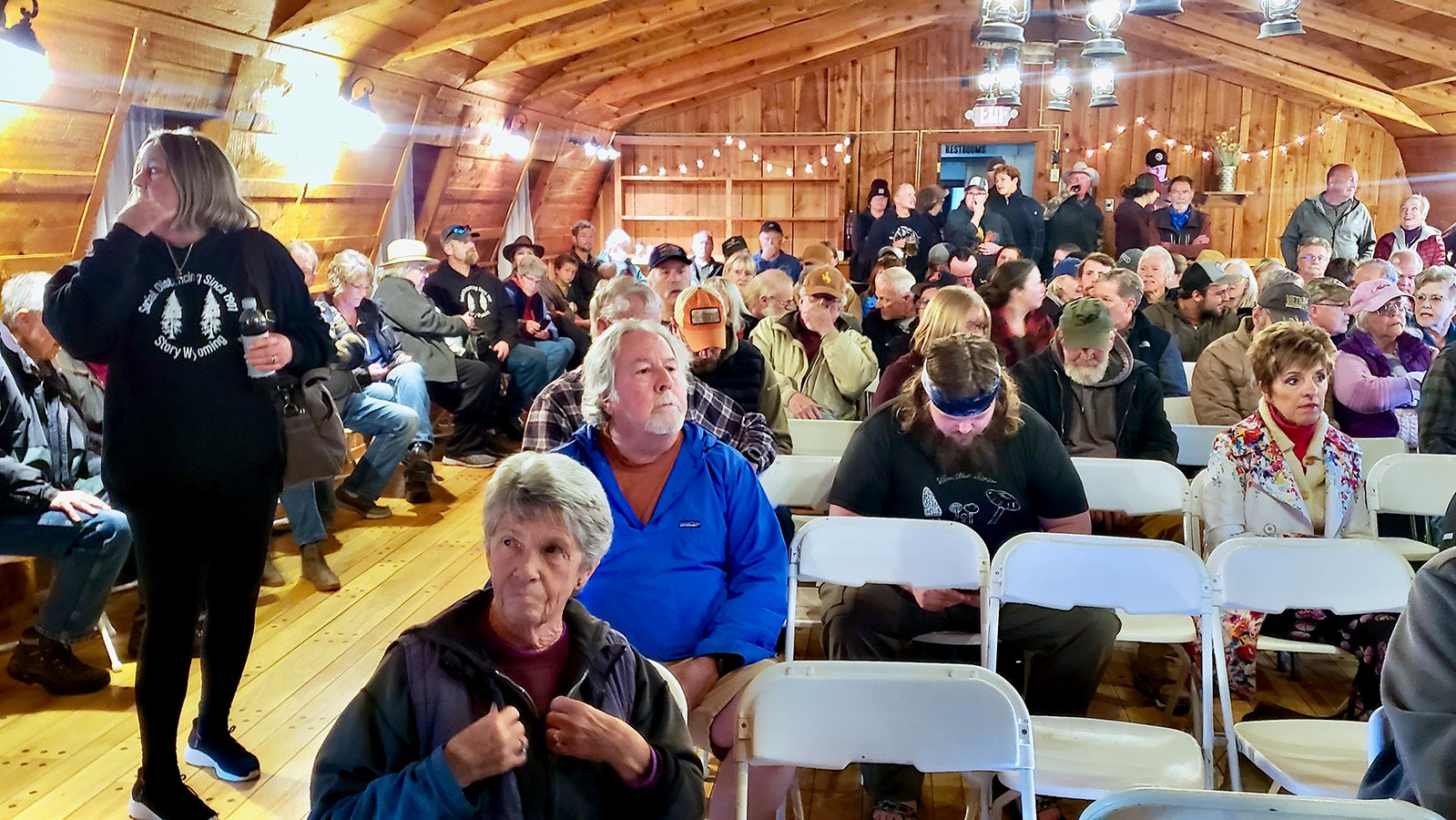
It’s become a multi-million dollar project, McNiel told the crowd of 100-150 people that gathered in an upstairs meeting room of the historic inn to hear McNiel talk about his vision for the Wagon Box Inn.
People in the crowd ranged from mildly curious to vehemently opposed, and everything in between. They wanted to know about McNiel’s quotes about militias in a Vanity Fair story, as well as the whole “apocalyptic retreat” concept mentioned in his online DAO.
Others just wanted to know what the heck a DAO is and questioned why anyone would want a group of 150 people to try and price a hamburger or a coke.
Perhaps the most common question of all was whether the DAO, which the online proposal suggests could have as many as 300 members, would change the fundamental character of Story.

Same As Before, But Fixed
In McNiel’s vision, none of the charming things that drew him to Story in the first place will ever change.
He liked the community from the first after buying a few things at yard sales. People were genuine. They were nice. They were helpful. That stuck with him and is what convinced him to buy the Wagon Box Inn in the first place.
As he sees it, the campground has long been open to guests from afar as part of its business model.
A digital time-share organized under a DAO does not really change that concept — except that perhaps it would be the same members returning year-in, year-out.
“A lot of times when people come off the highway, all they want to do is take,” McNiel said. “They want to take in the beauty. They want to take your trout. They want to take whatever and then they go back (home).
“If you have people that have committed to being a part of this, they will invest. They’re going to run into people, they’re going to be meeting people at the restaurant and the community. So people, over time, are committed. Instead of just being takers, they’re gonna want to give back to the community.”
Preferred access for DAO members doesn’t necessarily mean there won’t be room for the public to come to the campground. McNiel is, after all, trying to make enough money to continue fixing the place up.
While members of the community are worried about too many people showing up, McNiel has the opposite concern. He fears people will not show up at all. That’s actually not so uncommon with time shares in general. People never get around to using their time slot.
That’s one of the reasons why McNiel is thinking about a stipulation that people buying in should expect to spend at least two weeks a year at the campground.
How is that really any different than now? McNiel asked the crowd. There’s a billboard advertising come one, come all to complete strangers. Maybe this year 500 new people come and next year 500 more new people. His idea is that instead the same 150 to 300 people would come, year-in, year-out to talk about life and literature for a little while.
“I think for the most part, this is going to look pretty much like it has looked before, except better — cleaner, with better food,” he said. “Septic not running into the creek.”
McNiel isn’t planning on more RV lots for the campground or hosting dramatically more people in a given summer. He’s aware the septic system needs to be fixed, and he’s committed to doing that. He’s also aware that the septic system will likely be a limiting factor for how many people can stay at the campground at any one time.
Running Restaurants Is Hard
The restaurant business is harder than McNiel realized.
“I didn’t know what I was doing, and it’s very expensive,” he told the crowd. “My payment with taxes and insurance, my payment on this whole project is pushing twenty grand a month. That’s a lot of money.”
That has had McNiel selling things “left and right” to make the monthly payment.
“On top of that, I’ve got payroll and stuff and, surprise, you know, a couple of beers and burgers don’t exactly make that kind of money,” he said.
That is really where the idea for the DAO began forming.
“I thought I’d take on some investors and talk to some friends,” he said. “And I’ve always thought about community building and getting my friends together for conversations and discussions and whatever.”
As he was considering that, he was also reading the book, “The Networked State: How to Start a New Country,” by American entrepreneur and investor Balaji Srinivasan.
“He had this idea that over time, the existing government starts to fall apart and crumble,” McNiel said.
If and when that happens, online communities like those on Facebook and Twitter could coalesce, come together as a kind of digital state. The idea fascinated McNiel.
He has a friend who helps organize Consensus, a large cryptocurrency conference in Texas where Srinivasan was to be a panelist. The friend suggested McNiel could be on the same panel, if he was serious about starting a DAO to fund the Wagon Box Inn.
To show that, he’d need to write a white paper. And he only had a few weeks to get that done. So a white paper was written — in haste — and edited by some friends who are knowledgeable about the crypto community and the topics that interest them.
Apocalyptic Retreats And Wagon Box Countries
The acronym “DAO” is confusing in and of itself, McNiel acknowledged to the crowd. And words like Etherium Blockchain — which in plain English is really just a digital record book — don’t help.
But it was the addition of things like “apocalyptic retreat” and somehow becoming its own country that really struck many Story locals as “bizarre,” in the words of one resident who brought a printout of McNiel’s white paper to read out loud during the event.
“I don’t want to misquote you,” the woman said.
McNiel said those words were added on the advice of some friends who were trying to help him score a spot on the panel about DAOs in Austin.
In the midst of McNiel’s explanation, there was some back-and-forth among the crowd about how likely an apocalypse is and whether it’s wise to prepare for one or flat-out crazy.
Finally, rising above the momentary din was a question that drew everyone’s attention.
“How many people might be here during a non-apocalyptic time?”
Amidst laughter from the audience, McNiel said he really believes the number of visitors will remain about the same as before.
“My idea of the whole project is basically that it would be no different in terms of infrastructure than what it’s already designed for,” he said. “Except, over time, instead of having random people coming off the highway, it would more and more be people who are committed to this kind of, you know, involvement in membership.”
As far as being its own country, McNiel poked fun at himself for that and suggested it was more a thought experiment than anything else.
“I think the Wagon Box might be a long way out from becoming a sovereign country,” he said. “That’s a joke. But yeah, I don’t know even what it would look like for the Wagon Box to be a country. But I’d love to talk about it. I’d love to discuss what that would look like.”
McNiel has trailer parks in Alaska and properties in North Carolina, he added. Working them into the DAO could create an “Archipelago of interesting properties.”
“That’s a cool idea,” he said.

The Vanity Fair Article
McNiel is among people quoted in a Vanity Fair article that looks inside the “dissident fringe” where the “new right meets the far left” and everyone’s expecting an “apocalypse.”
The premise of the article is that the American West is attractive to a diverse group of people who believe society has gone haywire. They’re moving to the West to escape that.
In the article, two particularly flashy quotes caught the Story community’s eye.
One suggested that Story would not have any blue-collar workers in 10 years.
McNiel acknowledged saying that, but not because that’s the way he hopes it will be.
“Like, in 10 years, my grandpa is probably going to die,” he said. “I don’t want my granddad to die, but if somebody asked me, ‘Do you see what’s going on with your granddad,’ I would say, ‘Yeah, in 10 years my grandpa, my granddad’s probably going to die.’”
The other quote was a little bit out of context, McNiel suggested.
“The reporter was asking me about the rise of militias, and I was just pointing out that there’s a lot of people who just want to join a militia that aren’t serious,” he said. “They just kind of want a hunting club, or whatever. So, I said look, if you’re not — you know a militia, if they’re going to war with the federal government, right — and so if you’re not willing to shoot a federal agent, then you’re not serious about being a part of a militia.”
That wasn’t meant to suggest approval of shooting anyone or going to war with the United States, McNiel said, adding that he doesn’t even own a handgun and considers himself a pacifist.
“They’ve gotta sell magazines, you know?” McNiel said.
Some Story Minds Were Changed
Among people who stayed to chat with McNiel after the event was one Justin Ricchio.
He told Cowboy State Daily he came to the meeting in part because he was curious, but also because he wanted to rise above rumors by hearing McNiel’s answers for himself.
“I like him a lot more now than I did after seeing this presentation,” he said. “I think he’s a lot more personable than I initially thought he was.”
Among Ricchio’s chief concerns had been that the cost of tokens, which he’d heard would be around $100,000, would bring an elite crowd that would expect Story to change, so it would measure up to their expectations.
He was relieved to hear that tokens would just be between $15,000 to $25,000, which to his mind is not so extreme for owning a piece of a multi-million dollar property. McNiel suggested the exact amount would depend on how large the actual group of co-investors in his idea for digital time-share writer’s retreat ends up being.
“(People) thought we were just going to you know, try to turn into Teton County, or you know, the old joke about Dubois,” Ricchio said. “That it’s where all the millionaires live who got kicked out of Jackson by the billionaires.”
Ricchio was also impressed by McNiel’s willingness to consider a community advisory board for the DAO.
“He’s probably more open to that than I would be if it was my deal,” he said. “Because I’m sitting here going, ‘Guys’ it’s mine.’ My answer to a lot of those questions would have been, ‘You know what, Why don’t you go ahead and buy it from me, and you can do what you want. The cost is $5 million and it’ll be yours. You can do what you want. Make it perfect.’”
Renee Jean can be reached at: Renee@CowboyStateDaily.com