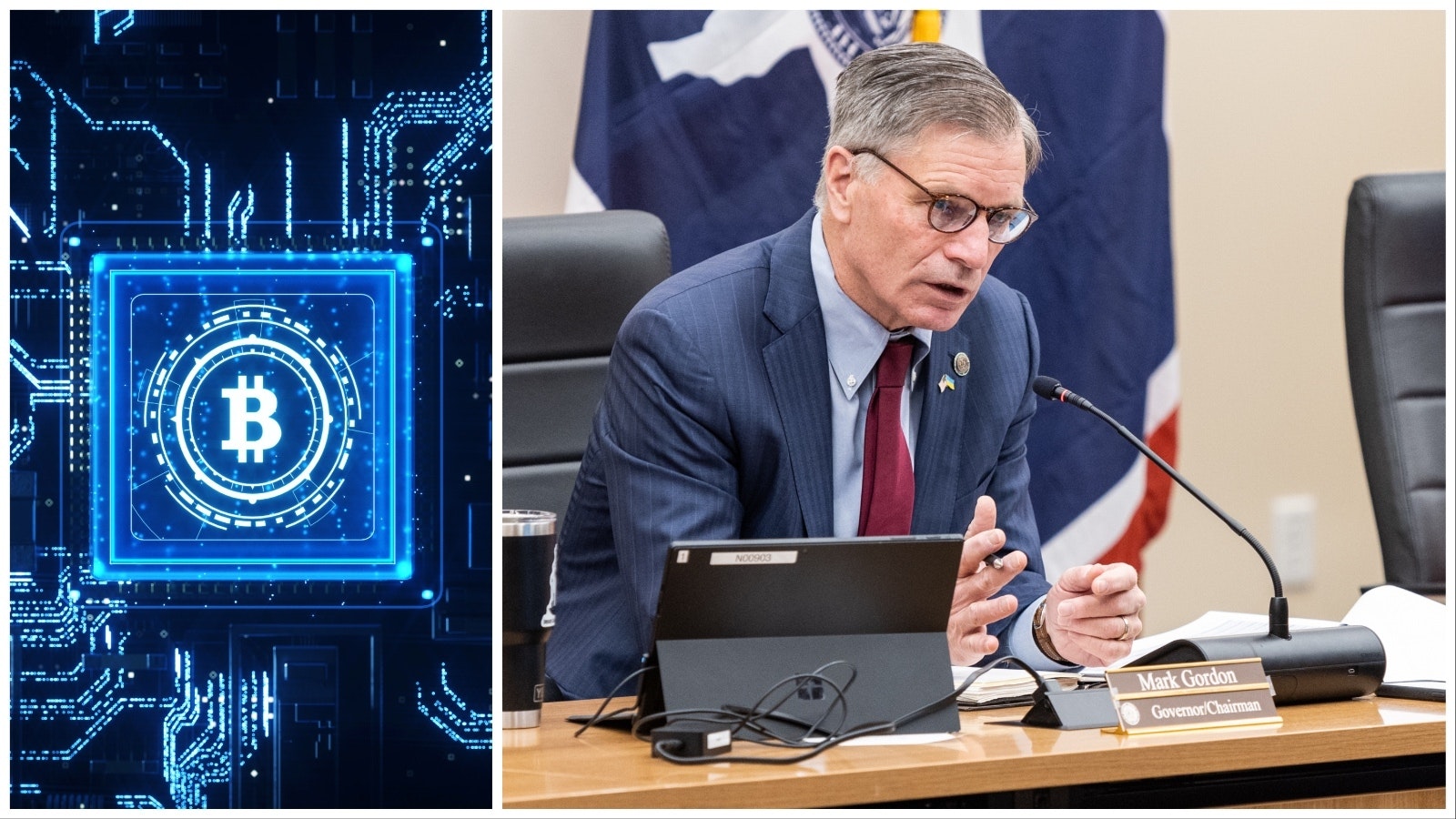
There are some mighty big question marks hanging over Wyoming’s stable token, but perhaps the biggest of them all, as the Wyoming Stable Token Commission met for its first time Monday, is the federal landscape.
Wyoming is running something of a gauntlet already with its digital banks, called Special Purpose Depository Institutions, SPDI or speedy banks for short, after the SEC rejected not only Custodia Bank’s request for a master account, but seemingly the state’s charter itself in an 80-page manifesto that Wyoming critics have said appears to ignore state rights.
Although carefully avoiding a position on Custodia’s individual case, Wyoming has joined the digital bank’s lawsuit over the handling of its master account to defend the state’s SPDI legislation.
The Custodia Bank suit is one in a flurry of federal actions that appear designed to wall off American banks from any exposure to digital banking and cryptocurrencies — more than a decade after such institutions have been operational.
Those actions have pulled the rug from under heavy hitters like Binance and Coinbase, and are driving technological innovations in the financial sector overseas.
The overall landscape makes it “quite clear that our federal friends may not look as favorably on this as we would like,” Gov. Mark Gordon said during the Wyoming Stable Token Commission meeting.
That made finding a legal path forward for what will be a first in the nation — a state with its own stable token — a main topic of discussion during the meeting Monday afternoon, which attracted a number of Wyoming’s digital asset companies to the Capitol in Cheyenne.
Threading The Needle
Senior Assistant Attorney General Devin Kenney, representing Attorney General Bridget Hill’s office, suggested Gordon request an official opinion from federal agencies on the legality of Wyoming’s stable token.
“If they actually provide something, it doesn’t necessarily mean, even if they determined ‘no,’ that wouldn’t necessarily be our ultimate advice,” he said.
The federal opinion would be just one of several things the Attorney General’s office would consider in weighing the legality of Wyoming’s stable token.
The legislation creating the stable token requires that determination prior to issuing any stable tokens. If it’s legally impossible, a report on why that is so is required by Nov. 1, teeing it up for possible corrective action when the Legislature next meets in 2024.
Given that Wyoming is already fighting one legal battle over its SPDI law, Gordon agreed asking federal agencies for guidance would be a vital step.
“I don’t want them to be Lucy to our Charlie Brown on this,” he said, adding that unfavorable counsel could still help Wyoming find a way to legally achieve its aims.
“We want to make sure we meet the letter of the law, but we also want to get this done,” Gordon said. “And so, to whatever degree there’s a challenge on that, I hope we can work through that before we have a finding that this is not possible.”
The questions about legality have an indirect bearing on another issue — the background checks required by Wyoming’s stable token bill.
“That language has to be submitted to the FBI for their approval as to whether they are willing to conduct those background checks,” said Betsy Anderson of the governor's office.
That approval could take several months, she added, and the FBI has “turned down certain statutory language for background checks in the past.”
“This language is not part of our standard background statues and is slightly different,” she said. “So, it’s kind of uncertain as to what the result will be from the FBI’s response to that request.”
Multibillion-Dollar Payday For Success
Wyoming has a very large payday on the horizon if it can thread the needle on its own stable token, representatives of American CryptoFed DAO told the commission during public comments.
CEO Scott Moeller said he was tapped to work with the Merchants Advisory Group, which represents about 60% of America’s largest retailers, because of his background with Mshift, which he founded in 1999 as a mobile banking company.
“When you’re logging in to your bank on your phone and you think you’re talking to your bank, many times you’re talking to Mshift’s servers,” he said. “Which are then securely talking to the bank on your behalf.”
Mshift has served not just the five largest banks in the United States, but institutions down to the tiniest banks and credit unions, Moeller added.
“So, our history is millions upon millions of secure financial transactions, managing that even before blockchain existed,” he said.
In 2009, the Merchants Advisory Group invited Mshift to become a member of its industry work group, which was put together by the Boston-Atlanta Federal Reserve offices. Also selected were PayPal and Apple.
“We were selected as a technology provider because we were one of the first to come up with mobile deposits,” Moeller said. “So, for years, we’ve been talking to the merchants about lowering the cost of payments. That’s their whole purpose, and that’s how we know these guys.”
The Merchant Advisory Group has long been seeking a way to reduce the burden of credit card transaction fees, American CryptoFed CFO Xiaomeng Zhou told the commission. The fees are too high and the speeds too slow.
Moeller and the Merchant Advisory Group believe that Wyoming’s stable token could be the solution they’ve been seeking. And it would mean a huge payday for the Cowboy State.
“In 2018, (MAG) had $4.8 trillion worth of transactions,” Moeller said. “So, over 60% of credit cards and debit card spending in the United States went through these retailers.”
Meanwhile, the overall stable token market today is roughly $100 billion — chump change compared to the overall volume of digital transactions.
“So, when we are envisioning the use case for the Wyoming stable token, it’s for that far greater reservoir of retail transactions in the U.S.,” Moeller said.
How Wyoming’s Stable Token Works
Wyoming’s stable token would not be its own currency. That would run afoul of federal regulations.
Instead, it’s the digital representation of a single U.S. dollar, held in trust by the state and invested in short-term treasury bills.
Lawmakers, in creating the bill, hope that backing the coin this way will avoid the volatility that has caused other stable coins to fail.
Terra Luna, for example, had promised that its mathematical algorithm would keep its coin stable. But when its math failed, there were no real assets backing the coin and it collapsed.
Short-term treasuries are one of the lowest risk investment vehicles around. They do not make a lot of interest, but there is some, and on trillions of dollars worth of transactions, it would be a significant amount.
The stable token bill spells out that earnings from the treasuries would accumulate in the account until the fund reaches 102% of deposits, providing an additional buffer and liquidity for withdrawals. After that level is achieved, earnings would go toward administration of the account to pay for the commission’s operation as well as repay the General Fund for the $500,000 it allocated to initial startup costs.
After that, earnings head to the Common School Permanent Fund Reserve Account, the School Foundation Program Account and the permanent Wyoming Mineral Trust Fund Reserve Account.
The bill also stipulates what would happen in the highly unlikely event that rates for T-bills are negative, or if someone tried to suddenly redeem a large amount of stable tokens before there’s enough liquidity to make such a payment.
In that latter case, the person would have to wait or take a discount — similar to what happens if someone wants to cash a CD prior to its maturity date.
Those caveats ensure that Wyoming is never on the hook for more than what’s in the actual stable token account.
Technical Expertise Needed
But creating a stable token that never drops below $1 in value is a big challenge, certified public accountant David Pope told the commission.
“In a rising interest rate environment, the treasuries that I buy today are worth less tomorrow,” he said. “So, we, in my mind, that’s a risk that we will have to overcome on the investing side.”
He believes the state will need to initially over-buy treasuries to hedge against that.
“And I also know that the legislation de-risks the general fund completely,” he said. “However, in any situation where a token is redeemed for less than $1, that’s the death of the token at that point. So that’s why I think that is one of the major items that we have to look at.”
In this case, Wyoming won’t be seeking to leverage deposits in high-yield markets to turn a profit, so Wyoming Treasurer Curt Meier believes the task is not impossible, for all that it may be difficult.
“If you don’t grow too fast, and you always have enough running through and coming back, you know that in that time cycle where you basically — unless you have a run on every single cent that you have out there — you know you can pretty much manage that type of thing,” he said. “It’s unfortunate that our banks weren’t doing it that way. They got a little bit over their skis and got greedy, I think, in certain circumstances.”
Meier added that there are risk programs like Aladdin which will track everything, as well as stress test hypothetical trades, so outcomes are known ahead of time.
Gordon agreed that holding the value of the Wyoming stable token at $1 will be a key issue.
The commission, in addition to the governor, treasurer and auditor, is to include four subject matter experts.
Gordon suggested that at least one of the four subject matter experts needs to have, in addition to audit expertise, the ability to read smart contracts and understand smart contract codes, which will govern the value of Wyoming’s stable token. Smart codes are only as smart as the people writing them, and they’ll execute exactly as directed, without discretion.
The other broad areas of expertise Gordon believes are needed are legal, custody of digital assets and technical.
Native Expertise Exists
Gordon expressed confidence that the state will be able to overcome the not inconsiderable legal and technical issues at hand, noting several times during the meeting that the state has a wide range of expertise located within the state.
“I think it would be sort of brain dead of us if we didn’t take advantage of some of that expertise,” the governor said. “But obviously there are perils of conflicts that come from that.”
Among these experts already within the state is the CEO of OutPut Global, formerly IOHK, Charles Hoskinson. He was among those participating in public comments during the meeting Monday.
Hoskinson has a bison ranch in Wheatland. His company, meanwhile, which has 700 employees, is headquartered in Wyoming because of the regulatory framework that the Cowboy State has in place.
He’s the co-founder of the Cardano blockchain platform and the Etherium Blockchain.
“So, we have quite a bit of experience internally dealing with the various regulatory frameworks about issuing cryptocurrencies as well as issuing stable coins,” he told commissioners.
But Hoskinson wanted to know if he chooses to participate in an advisory capacity would that preclude his company from bidding on work to build out the state’s stable token.
The answer to that, Gov. Gordon suggested, is part of further work the commission will need to do.
“That’s the part I want to put a fine point on,” he said. “Because, you know, you mentioned both Kraken and Custodia, two pioneering and courageous outfits that decided to stake their claim here in Wyoming, and we certainly don’t want to, you know, curtail their ability to participate in this.”
Hoskinson told Gordon the world at large is watching what Wyoming’s doing and talking about it in far corners of the globe.
When he was in Abu Dhabi recently, Wyoming’s regulatory framework was a topic of discussion.
“Abu Dhabi doesn’t discuss Wyoming very much and, when they do, it’s about oil and gas,” he said. “It’s not about cryptocurrency legislation. So, the state has achieved a tremendous reputation throughout the world as an innovator, pioneer and one that was willing to take a risk to embrace the new industry.”
That said, Hoskinson added that it’s still a “very risky” piece of legislation if handled improperly.
“There’s many challenges to it, so our industry as a whole has a unified incentive to ensure that it is a success,” he said. “And so, we’ll do our part, and I hope the industry can work together to provide as much assistance as possible on both the regulatory and technical side to get this where it needs to be. We’re here to help.”
Renee Jean can be reached at: Renee@CowboyStateDaily.com