The Sweetwater County School District No. 1 board faced tense emotions and a packed room for their public meeting Monday, 18 days after two parents sued the district for allegedly hiding their daughter’s gender transition from them.
Parents, grandparents, teachers and a state representative had some tough questions for the board about the lawsuit or its related issues.
In the lawsuit filed in federal court April 20, Rock Springs parents Sean and Ashley Willey allege that the school district helped to socially transition their teenage daughter into a boy while hiding it from them.
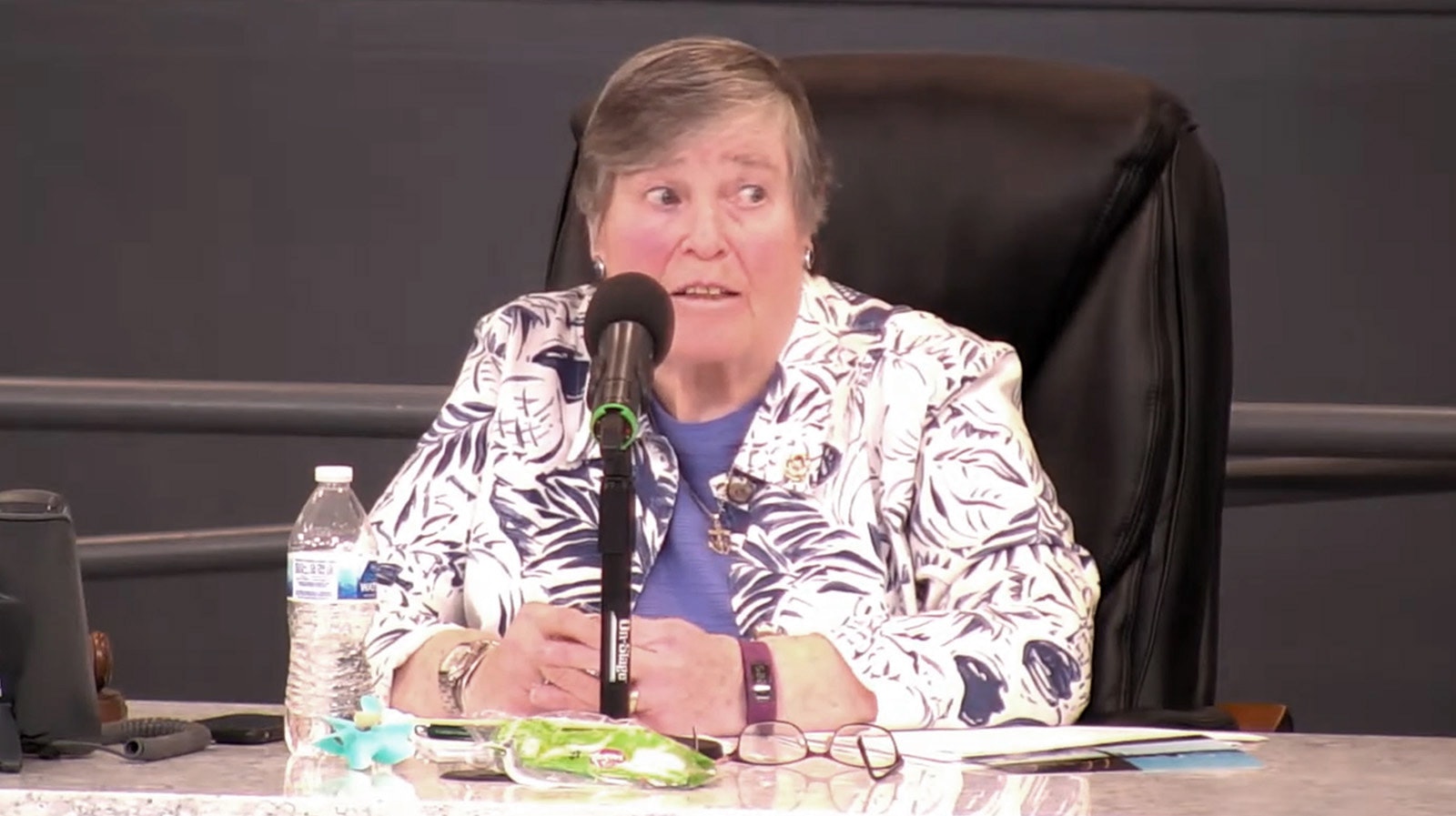
School Board Chairwoman Carol Jelaco defended the school district Monday and said the board is preparing its legal response to the lawsuit.
“I continue to believe in our superintendent and her leadership team here at our district. We stand behind them, and they have our full support and confidence,” said Jelaco, adding that the district has “no intention of attempting to try this suit in the court of public opinion.”
She continued to say that “students are our first priority, and we are determined to create the best possible learning environment while respecting individual and cultural differences. Our track record shows our success at doing just that.”
Jelaco said the district wants to protect the privacy of those involved, especially its students, but also wants “to fight back against personal attacks, rumors or innuendo that can hurt our district or our students.”
Policy Or Procedure?
Parent Glen Reddon grilled the board on whether the district’s decision not to inform some parents of their students’ social gender transitions is a policy or a procedure.
The board generally discusses policies and votes on them in public, whereas procedures may be district behaviors adopted without a public vote.
“Was the decision made that happened with the child — was it policy or procedure that kept the parents out?” asked Reddon.
The district denied the Willeys’ claims in a statement to Cowboy State Daily, calling the lawsuit “false” and “fabricated.”
However, the district in August 2022 dispatched a procedure instructing staffers to respect students’ privacy regarding alternate names and pronouns, along with talking points saying parents don’t have a right to know “how a school or teacher refers to the student informally,” according to documents released last year in a public records request.
“Will the board change it to where these procedures cannot just be handed off, that everything must go through the board, or you don’t want the responsibility?” asked Reddon.
Jelaco asked Superintendent Kelly McGovern if McGovern should answer the question or if someone should take Reddon’s contact information to discuss it with him later.
McGovern urged Jelaco to “be cautious.”
“We have to be careful because of the lawsuit,” Jelaco told Reddon. “So, if you’d give Mrs. (Nicole) Bolton your name, we’d have to check and see if we can respond.”
Reddon pressed on.
“Where’s the accountability gonna lay?” he asked.
“We’ll get back to you on that,” answered Jelaco.
'Do The Right Thing'
State Rep. Clark Stith, R-Rock Springs, told the board he believes in local government control, such as school board control over education issues.
But Stith, who also is an attorney, warned that if the board doesn’t adopt a policy respecting parents’ desire for rights over their children, it could soon face “a very heavy-handed approach from the state Legislature.”
Lawmakers told Cowboy State Daily last week they’re preparing to bring parental rights legislation in 2024 after two such bills failed this year.
Stith told the board members to listen to their lawyer, but to remember that they can adopt a parental-rights policy while the lawsuit is pending without harming their defense, under relevant rules of evidence.
“Make a policy that makes sense,” said Stith. “You can do the right thing. You can make a reasonable policy.”
Stith in the 2023 lawmaking session sponsored a parental rights bill that, if it had passed, would have forbidden schools from infringing on parental rights over the care, custody and control of their children in most circumstances.
‘This Is Not A Witch Hunt’
Some parents raised issues outside of the lawsuit.
“This is not a witch hunt. We are just trying to have adult conversations and get to issues,” said Cherell O’Driscoll, who is a parent and a member of the school accountability board. “It is ungodly the amount of email messages that I get from teachers that do not want to come forward because of retaliation. That is disgusting. They should be able to come forth with their issues.”
O’Driscoll said the district lacks consistency in how it penalizes errant students, and that some students are subjecting their teachers to “appalling” sexual harassment.
She said she teaches six hours a week at Western Wyoming Community College, also in Rock Springs.
“I can definitely tell the caliber of students that come out of Rock Springs and the ones that come out of Green River in my classroom,” she said, adding that Green River students show more respect and work ethic. “It’s completely different.”
Though she did not address the lawsuit specifically, O’Driscoll told the board that transparency toward parents is paramount.
“Let us know. I will come down there and, if I need to, give my kid a spanking in the parking lot,” she said. “I will come do it.”
Many attendees applauded O’Driscoll, Stith, Reddon and others after their brief speeches.
The Long Wait
The board went into executive session for about 90 minutes in the middle of the meeting, before public comment.
Attendees both online and in person railed against the delay. The public comment segment started about four hours after Jelaco called the meeting to order.
Melissa Gold, who called herself “just a mother,” asked board members if they were stalling to drive people away and discourage them from commenting.
“I just feel like you guys were doing it to deter everybody, and make us all go home, so you didn’t have to listen to comments and concerns,” said Gold.
Jelaco said the board was not stalling, but was “discussing some issues that are coming up later in the agenda, that we had to inform board members about so that they could vote appropriately; so they could vote with all the information that they needed.”
The board did not take any votes during the executive session, Jelaco said.
Public agencies under Wyoming law can only convene executive, or private, meeting sessions for a few specific reasons. Most relevant to school boards are discussions of:
· Personnel matters.
· Litigation.
· A real estate purchase when there’s a fear that discussing it publicly will drive up the price.
· Accepting confidential gifts and donations.
· Any information classified as confidential by law.
· Offers concerning wages and terms of employment.
· Suspensions and expulsions.
· Safety and security planning, which would jeopardize people if made public.
‘We Also Follow The Law’
Jelaco told attendees that the U.S. Department of Education interprets the federal Title IX law as barring discrimination based on sexual orientation and gender identity.
“We also follow the law,” said Jelaco.
The federal department’s Title IX interpretation is not grounded in a judicial ruling on Title IX, but in Title VII, which deals with workplace treatment, not school practices. A federal judge has blocked the department from enforcing the new interpretation in 20 states, not including Wyoming.
Wyoming did not join the 2021 lawsuit because it did not have a law at the time contradicting the department’s Title IX interpretation.
On July 1, however, the state will have an active law doing just that, as a ban on males competing in girls’ school sports takes effect that day.
Wyoming Attorney General Bridget Hill, who takes legal actions on Wyoming’s behalf, did not respond by Tuesday morning to a Monday email requesting comment.
Clair McFarland can be reached at: Clair@CowboyStateDaily.com