
Technology can be a boon or a bludgeon for farmers.
Tractors have become so technologically advanced that even the simplest maintenance can be held up by computer codes. And only authorized technicians can reset the codes, Wyoming Farm Bureau spokesman Brett Moline told Cowboy State Daily.
That means expensive service calls and long waits.
“Say you need to change your fuel filter,” he said. “You can change the filter, but you can’t change the computer code. And sometimes your machine can be down for a couple of days so somebody can drive a couple of hours each way just to push the damn button.”
And given Wyoming’s short growing season, such delays can have significant consequences, Moline said.
“You’ve got to get your crop planted and all of the sudden the one tactor you’re depending on is going to be down for a couple of days?” Moline said. “That kind of kisses the duck right on the tailfeathers, but there’s not a damn thing you can do about it, because you’re snookered.”
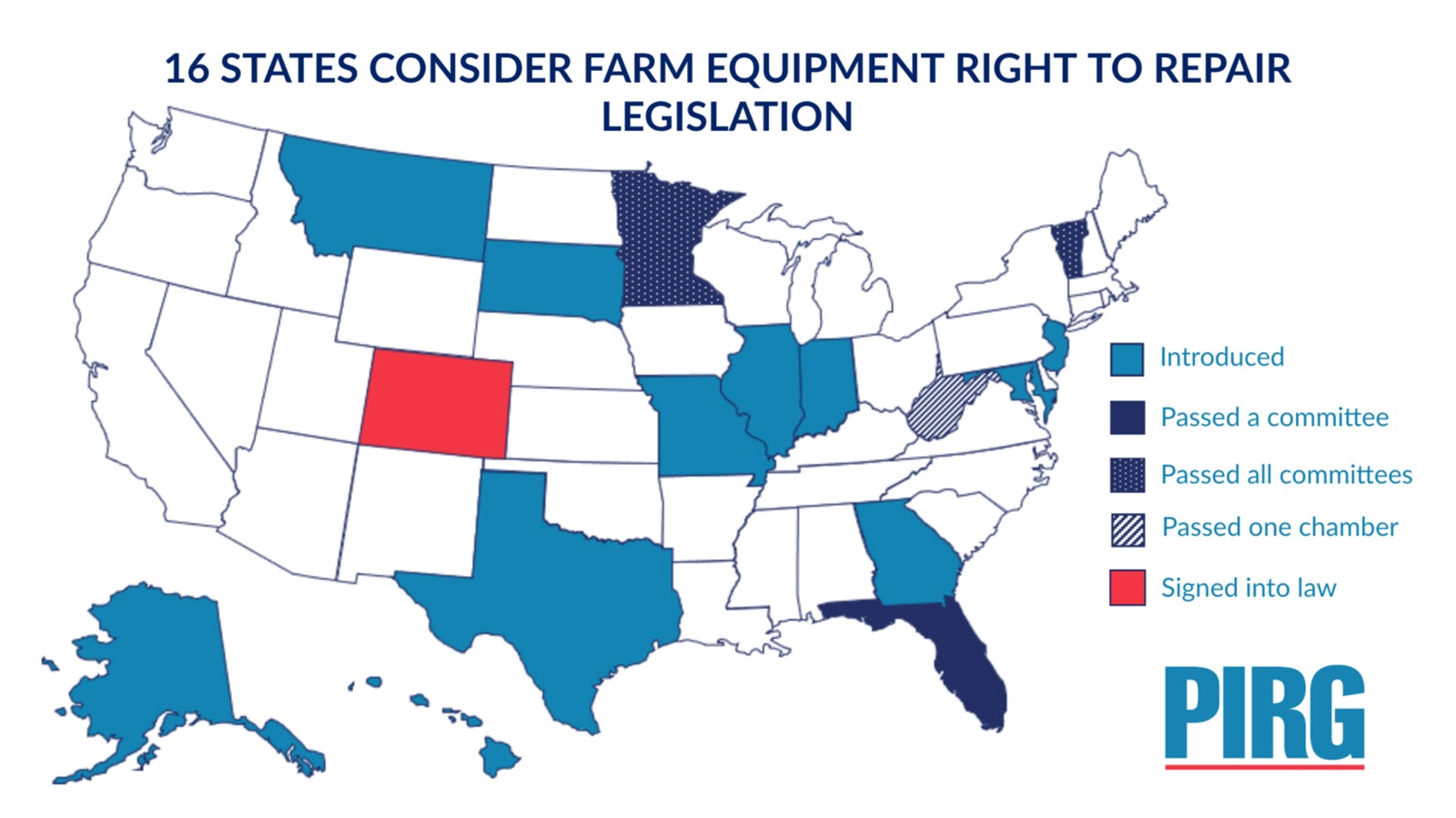
Several states considered “right-to-repair” bills this year, and Colorado recently became the first to pass it, meaning farmers there can repair their own equipment.
Similar bills are being considered in Alaska, Florida, Georgia, Hawaii, Iowa, Illinois, Maryland, Minnesota, Missouri, Montana, New Jersey, South Dakota, Texas, West Virginia and Vermont.
A right-to-repair bill was introduced a few years ago in the Wyoming Legislature, but failed.
The aim of right-to-repair laws is to loosen the monopoly that farm equipment manufacturers have on software and specialized tools, allowing farmers and ranchers more leeway to do their own maintenance and repairs.
“It’s something that I think is dramatically needed nationwide,” Moline said.
Not Great For Dealers Either
As things are now, large manufacturing companies hold excusive rights to specialized software and tools needed to fix technologically advanced equipment. Dealers must pay monthly fees for access to them, Jeff Rose, owner of the Rose Bros Inc. dealership in Lingle, told Cowboy State Daily.
“As a dealer, you really don’t want just anybody and everybody to have access to that (software), because we pay the fees for it and they don’t have to, so it tips the tables,” he said. “I have to pay $500 a month to have access to that link. It’s not the dealers, it’s the companies we represent that force us to do this.”
Even so, Rose said he can see the farmers’ side of things, so he has mixed feelings about right to repair bills.
“It’s hard for me to answer ‘yes’ or ‘no’ on those bills,” he said. “If it could (put) pressure on the companies to lower the price on some of the diagnostic equipment, it could level the playing field and drive down costs for everybody.”
Moline said he’s not certain if or when there will be another attempt at a Wyoming right-to-repair law. It won’t likely be in 2024, because that’s a budget session and bills not directly related to the budget won’t do well.
“We will maybe see how things work out, how Colorado’s right to repair law works out, and then maybe bring something to the 2025 session,” Moline said.
Is The ‘MOU’ Enough?
The American Farm Bureau recently established a memorandum of understanding with some major agricultural equipment manufacturers, Moline said. That has helped loosen some access to vital repair software and tools.
“We’ll see how it works out. It’s a step in the right direction,” he said. “By the time we get done with the harvest this fall, we’ll see if it was enough.”
The North American Equipment Dealers Association (NAEDA) thinks the MOU is enough, spokesman Eric Wareham of Montana told Cowboy State Daily.
It establishes the “fair and equitable pricing of parts” and allows wider access to security locks on the software needed to diagnose and fix problems on modern equipment, he said.
The right to repair measure that Colorado passed was a “watered down” version of the original bill, which NAEDA opposed, he said.
“I testified on the original legislation in Colorado, it went beyond access and availability,” he said. “We opposed that initial legislation because it contained price fixing and unfettered access to intellectual property.”
What Colorado ended up passing was essentially what the MOU already does in Wyoming and many other states, so NAEDA would consider additional right-to-repair bills “redundant,” he said.
Parts Must Remain Available
The section of Colorado’s original bill that included “price fixing” on parts was worrisome, Wareham added. It would have fixed prices at manufacturers net costs, which ultimately would have hurt farmers.
That’s because if local dealers aren’t allowed to mark up prices and make a profit on parts, they’re less likely to stock large inventories, he said. And if a local dealer doesn’t have parts readily available, farmers could face delays during critical planting and harvest times.
Rose said that for decades, his family’s business sold tractors and other large equipment. It has since scaled down to mostly a parts business, so he knows the importance of keeping parts readily available for local farmers.
The remoteness of much of Wyoming’s cropland can make things difficult, Moline said.
“We don’t have the dealer network in Wyoming that we used to,” he said. “The availability of those technicians needs to expand so we can have timely repairs.”
Just Say ‘No’ To Tractor Hacking
Meanwhile, pirated tractor hardware is available through black markets in Eastern Europe, Russia and other countries. That’s prompted an underground network of “tractor hacking” among some U.S. farmers.
Moline and Rose said they’ve heard of tractor hacking, but don’t recommend it.
“I haven’t personally known anybody who has done it,” Moline said. “But anytime you’re getting something off the black market, you have to wonder is it the straight scoop?”
Rose also said he wouldn’t consider the sketchy quality of clandestine software to be worth the risk.
“You could throw a glitch into your software and end up shutting your machine’s entire processor down,” he said.
As another option, some farmers have opted to just keep older equipment that isn’t so computerized — or buy older used tractors.
Moline said he’s seen the demand for older, simpler equipment surge in recent years.
Frustration over how technical newer tractors have become “has really pushed up the price of used equipment,” he said.
Mark Heinz can be reached at mark@cowboystatedaily.com.